Census Shows Immigration Accounted for Two-Thirds of Canada’s Population Growth Since 2011

First reports of Canada’s 2016 census reveal that two-thirds of Canada’s population growth between 2011 and 2016 can be attributed to immigration. Because the Canadian census is conducted every five years, this data provides valuable new insight into statistics that have changed significantly since 2011.
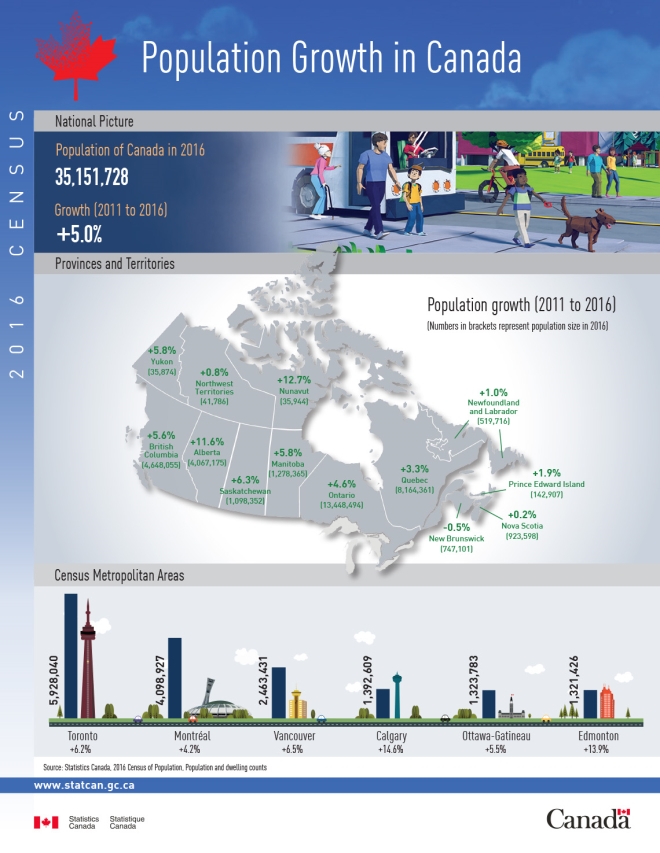
Canada’s population grew by five percent from 2011 to 2016, and the country had a population of 35,151,728 on May 10, 2016 — the day of the census. Canada remains the fastest-growing country in the G7 group of nations, a title it has claimed for the past 15 years.
While full data on immigration statistics is not scheduled to be released until October, this first release of data shows that immigration is a vital factor in Canada’s population growth, and consequently, its economic growth.
The territory of Nunavut saw the greatest percentage of population growth, at 12.7 percent. Alberta follows close behind with a growth of 11.6 percent, and all the western provinces saw growth rates higher than the national average. New Brunswick is the only province that has seen a decline in its population, at a rate of -0.5 percent. Also notable is the 5.8 percent growth rate in Manitoba. This is the first time in 80 years that Manitoba’s population increase was greater than the national average.
Immigration Crucial to Population Growth
The remaining one-third of population growth was due to natural population growth based on the difference between births and deaths. Newcomers to Canada therefore accounted for a greater percentage of population growth than natural increase among the existing Canadian population.
This has been the case in Canada since the late 1990s. In every year since 1999, population growth from immigration has exceeded that from natural increase. Statistics Canada, the country’s national statistical agency that operates the census, predicts that “without a sustained level of immigration, Canada’s population growth could be close to zero within 20 years.”
A report from the Conference Board of Canada, released in October 2016, projected that Canada would need to increase its immigration levels to receive 413,000 newcomers per year by 2030 in order to strengthen the country’s economic growth, and respond to the aging population. The report highlighted the benefits of population growth through economic immigration, as young, skilled workers enter directly into the workforce and begin contributing to Canadian society. Other projections estimate that immigration may account for Canada’s entire population growth by the year 2050.
More recently, in January 2017, a report financed by Immigration, Refugees and Citizenship Canada (IRCC) projected that up to 30 percent of Canada’s population could be immigrants by the year 2036.
“This latest data confirms what previous reports have projected — that immigration is vital to our growth as an economy and as a country,” says Attorney David Cohen.
“We look forward to the release of further valuable data about the characteristics of Canada’s immigration scene. Newcomers to Canada make up an increasingly significant portion of our population, so of course it follows that they make a significant contribution to the Canadian economy and society. With the detailed statistics collected through the census, we hope that policymakers and government officials can continue to operate an active and relevant immigration system.”
To find out if you are eligible to immigrate to Canada permanently, fill out a free online assessment form.
© 2017 CICNews All Rights Reserved

- Do you need Canadian immigration assistance? Contact the Contact Cohen Immigration Law firm by completing our form
- Send us your feedback or your non-legal assistance questions by emailing us at media@canadavisa.com