International migration accounted for 70% of Canadian population growth in last three months of 2017

International migration continued to drive Canadian population growth in the final quarter of 2017, accounting for nearly 70 per cent of the increase seen during that three-month period, new Statistics Canada data reveal.
The federal agency said international migration, which includes immigration, return emigration and net non-permanent residents, “remained the main driver of population growth” between October 1, 2017, and January 1, 2018.
During that period, Canada’s population increased by 78,805 people, or 0.2 per cent. Of that number, nearly 70 per cent (55,048) was attributed to what Statistics Canada calls “international migratory increase.”
The agency described this level of increase as “uncommonly high” for a fourth quarter.
"Such strong growth has rarely been seen during a fourth quarter since the beginning of the period covered by the current demographic accounting system [in place since July 1971]," Statistics Canada said.
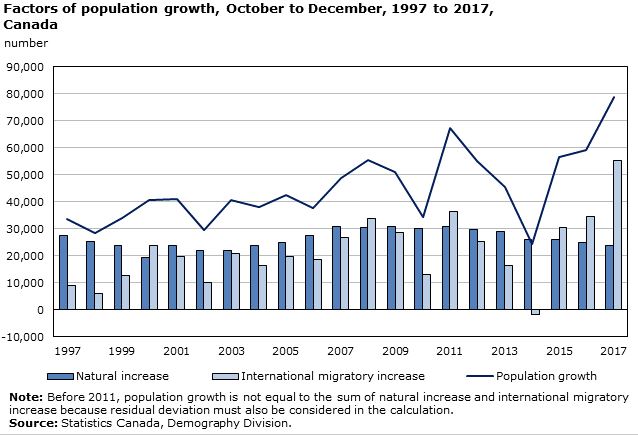
Immigration accounted for a gain of 65,539 people in the last three months of 2017, the second highest level in a fourth quarter since 1991.
Canada also gained 2,087 non-permanent residents in this time period, many of them refugee claimants.
Net emigration accounted for a loss of 12,578 people. This number is subtracted from the combined totals of immigration, return emigration and net non-permanent residents to obtain the international migratory increase.
International migration drives population increases in provinces, Yukon
International migratory increase was also the main driver of population growth in the Yukon Territory and nearly every Canadian province that posted a population increase in the fourth quarter of 2017.
“Quebec, Ontario, Manitoba and Yukon have rarely posted such strong international migration growth in the fourth quarter,” the study notes.
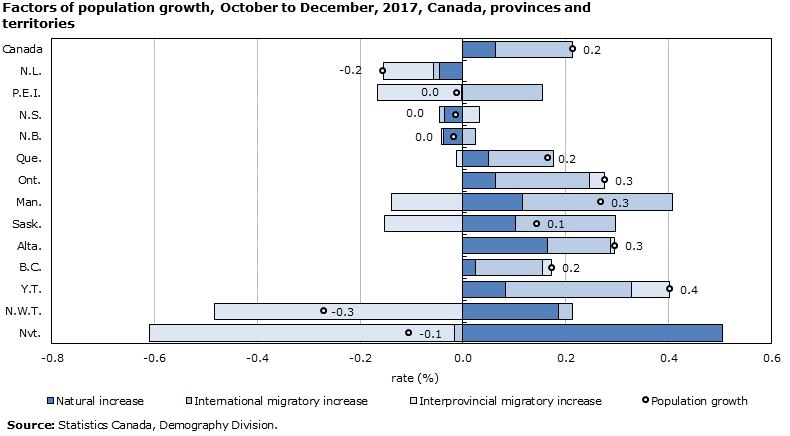
International migration also helped offset some of the interprovincial migration losses in Prince Edward Island and the negative natural increase (more deaths than births) in New Brunswick.
Non-permanent residents also played a role in increases noted in Quebec, Manitoba and British Columbia. Quebec recorded an increase of 3,078 non-permanent residents during a period when it normally sees a decline.
© 2018 CICNews All Rights Reserved
- Do you need Canadian immigration assistance? Contact the Contact Cohen Immigration Law firm by completing our form
- Send us your feedback or your non-legal assistance questions by emailing us at media@canadavisa.com