Canada’s Provincial Nominee Program at 20: Helping more people immigrate and succeed


Since its inception 20 years ago, Canada's Provincial Nominee Program has grown in both size and importance and now stands as the country's second largest program for economic immigration.
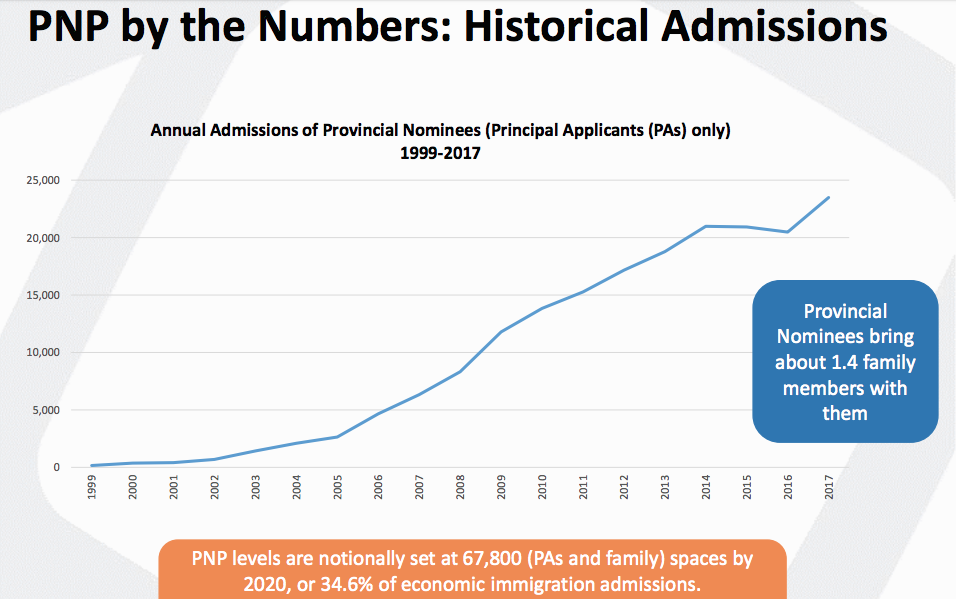
From its humble beginnings in 1998, when around 200 people were admitted to Canada through it, the Provincial Nominee Program, or PNP, will be responsible for more than 30 per cent of planned economic immigration to Canada in 2018.
Source: IRCC
The PNP allows participating Canadian provinces and territories to select an allotted number of economic immigrants each year and nominate them for permanent residence.
There are now more than 60 PNP streams across 11 provinces and territories, with each one specifically designed to target immigrants who match specific labour market and economic needs in those regions.
Most participating provinces and territories now have at least on PNP stream that is aligned with the federal Express Entry system, which is Canada's principal source of economic immigration.
Express Entry-linked PNP streams, also referred to as 'Enhanced' PNPs, allow a province to select Express Entry candidates and invite them to apply for a provincial nomination. Express Entry candidates who are nominated by a province or territory are awarded an additional 600 points toward their Comprehensive Ranking System score.
PNP streams that operate outside of Express Entry, referred to as 'Base' PNPs, can also nominate candidates, who then pursue permanent residence outside of the Express Entry system.
To find out if you are eligible for Canadian Immigration, complete our free online assessment form.
No Canadian experience necessary
One common misconception among immigration candidates is that you need prior Canadian study or work experience to pursue a nomination from a Canadian or province. While this is true for some PNP streams, it is not the case for all PNP streams.
Statistics provided by Immigration, Refugees and Citizenship (IRCC) show that 64.7 per cent of immigrants admitted through Canada's PNP between 2010 and 2015 were previous temporary residents, which means more than a third of provincial nominations went to overseas candidates.
Taken together with the province of Quebec's immigration allotment from the federal government, provincially led immigration accounts for almost 50 per cent of total annual economic immigration to Canada.
In 2017, Canada's admission target for the PNP was 51,000. Under the federal government's 2018-2020 multi-year levels immigration plan, PNPs are slated to grow by 11 per cent annually over the three years, for a total increase of nearly 33 per cent in admissions.
IRCC says no other immigration program will grow as fast as the PNP.
| PNP target admissions | |||||
| Year | Low | High | Target | Target Increase | |
| 2017 | 49,000 | 54,000 | 51,000 | ||
| 2018 | 53,000 | 57,400 | 55,000 | 4,000 (8%) | |
| 2019 | 57,000 | 63,500 | 61,000 | 6,000 (11%) | |
| 2020 | 62,000 | 68,500 | 67,800 | 6,800 (11%) | |
Success by the numbers
Statistics provided by IRCC also show a number of important trends when it comes to immigrants admitted through the PNP:
- 20 per cent of principal applicants had a higher incidence of employment compared to Canadian average 5 years after landing;
- 52.5% have employment earnings at or above the Canadian average 5 years after
- Principal applicants admitted through the PNP had the following occupational distribution:
- Managerial: 13%
- Professional: 21%
- Skilled and Technical: 36%
- Intermediate and Clerical: 15%
- Labourers: 3%
- 54% hold a university degree.
"Canadian provinces need immigrants to grow and the PNP is helping them fill their labour market needs through increases in allocations and innovations designed to attract candidates who will thrive,” said David Cohen, senior partner with the Campbell Cohen Canadian immigration law in Montreal.
"Given there are more than 60 immigration programs, pursuing the right PNP can make the difference and allow a candidate to successfully immigrate and adapt to life in Canada.”
To find out if you are eligible for Canadian immigration, complete our free online assessment form.
© 2018 CICNews All Rights Reserved

- Do you need Canadian immigration assistance? Contact the Contact Cohen Immigration Law firm by completing our form
- Send us your feedback or your non-legal assistance questions by emailing us at media@canadavisa.com