Atlantic Canada’s immigration revolution continues

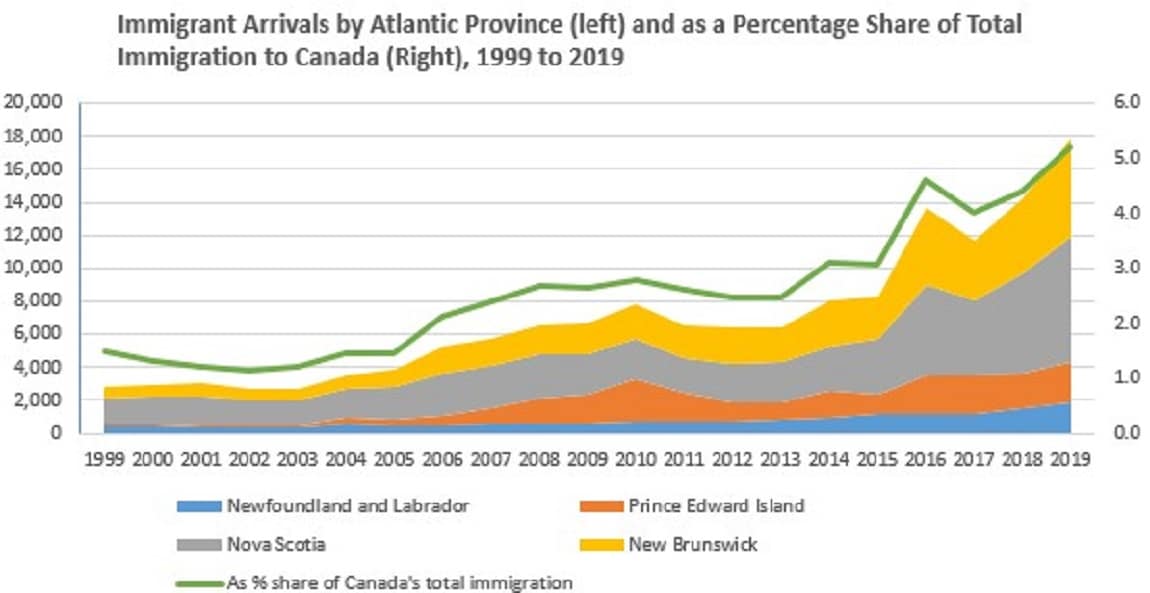
Atlantic Canada’s incredible immigration run continued in 2019 as the region welcomed nearly 18,000 newcomers.
The Atlantic region, which includes Newfoundland and Labrador, Prince Edward Island, Nova Scotia, and New Brunswick, has been making significant efforts in recent years to welcome more immigrants.
Atlantic Canada has a rapidly aging population, low birth rate, higher rates of out-migration, and lower rates of interprovincial migration than other parts of the country. As a result, governments, employers, colleges, and universities, and immigrant-serving organizations within the region have been working to develop strategies to welcome and retain more immigrants, international students, and temporary foreign workers.
In 2010, Atlantic Canada welcomed only 8,000 immigrants. This accounted for about 3 per cent of all newcomers to Canada, even though the region comprises about 6.5 per cent of Canada’s population. In other words, Atlantic Canada’s immigrant intake was disproportionately lower than the newcomer intakes of other provinces.
Sources: Immigration, Refugees and Citizenship Canada, CIC News
Find out if you are eligible for any Canadian immigration programs
Immigration revolution began in 2016
Since 2016, Atlantic Canada’s immigration revolution has been in full force as the region was able to welcome nearly 5 per cent of newcomers to Canada that year. This was largely due to the region welcoming more Syrian refugees as well as more economic class immigrants through the Provincial Nominee Program (PNP).
In 2017, the federal government launched the Atlantic Immigration Pilot (AIP) to complement Express Entry and the PNP as an added tool to promote immigration in the Atlantic region.
The AIP began to pick up steam in 2018. In conjunction with the PNP, the AIP has brought approximately 14,000 immigrants to the Atlantic region. This represented a 22 per cent increase
compared with the nearly 12,000 immigrants welcomed by the region in 2017.
A 26 per cent increase in 2019
In 2019, the number of immigrants in Atlantic Canada increased by another 26 per cent.
All four Atlantic provinces broke their own immigration records.
Newfoundland and Labrador saw a 21 per cent increase in its newcomer population, welcoming nearly 1,900 immigrants, up from 1,500 the previous year.
Prince Edward Island saw a 15 per cent increase as its intake went up to nearly 2,500 compared with 2,100 in 2018.
Nova Scotia experienced a 27 per cent gain to about 7,600 immigrants compared with 6,000 in 2018.
New Brunswick had the largest increase as its intake grew to 6,000 compared with about 4,600 the previous year.
Atlantic Canada could reach an important milestone in 2021
Atlantic Canada is on the right track and is closing in on an important milestone. It needs to welcome about 24,000 newcomers to reach its proportional share of immigrants to Canada. Assuming it continues to increase the number of newcomers by 20 per cent or more per year, as it has recently done, it could reach this milestone as early as 2021.
Increases to the region’s PNP allocations in recent years have been instrumental in the success of immigration to Atlantic Canada, as has the AIP.
The current federal government has stated in the mandate letter from Immigration Minister Marco Mendicino that it will make the AIP a permanent program.
Canada’s 2019-2021 Immigration Levels Plan set a target of doubling the AIP intake from 2,000 in 2019 to 4,000 in 2020. The PNP’s intake target will also rise to 67,800 compared with the 61,000 target in 2019. This means that Atlantic Canada’s PNP allocation will likely increase in 2020.
As such, there is strong reason to believe that Atlantic Canada will welcome 6.5 per cent of Canada’s newcomers within the coming years.
Find out if you are eligible for any Canadian immigration programs
Kareem El-Assal is the Director of Policy & Digital Strategy at CanadaVisa. 
© 2020 CIC News All Rights Reserved

- Do you need Canadian immigration assistance? Contact the Contact Cohen Immigration Law firm by completing our form
- Send us your feedback or your non-legal assistance questions by emailing us at media@canadavisa.com