
Newly released data designates Ottawa as Canada’s most livable city for 2026, providing a high quality of life for residents and visitors alike.
Ranking 28 on a global scale, Ottawa also takes the top spot across all of North America for quality of life, based on factors such as cost of living, safety, and traffic commute time.
In total, 17 Canadian cities were lauded for their quality of life, including Nanaimo and Victoria in British Columbia, and Calgary in Alberta.
Join the Angus Reid Forum and get $5 in points!
This data was published by Numbeo, a crowd-sourced database used for international location comparisons of cost of living, quality of life, and other socio-economic indicators.
Which Canadian cities made it on the list?
In this global quality of life ranking, a total of 17 cities across seven Canadian provinces ranked among the most livable for 2026—with Ontario having the highest number of featured cities.
The table below shows which cities were featured by province, ordered by the number of cities that made an appearance.
| Province | Canadian city |
|---|---|
| Ontario | Ottawa |
| London | |
| Mississauga | |
| Toronto | |
| Brampton | |
| Hamilton | |
| British Columbia | Nanaimo |
| Victoria | |
| Vancouver | |
| Kelowna | |
| Alberta | Calgary |
| Edmonton | |
| Quebec | Quebec City |
| Montreal | |
| Saskatchewan | Regina |
| Manitoba | Winnipeg |
| Nova Scotia | Halifax |
Compared to last year’s rankings, only 14 Canadian cities appeared on the 2025 Quality of Life Index, though the same seven provinces were featured. Brampton, Hamilton, and Nanaimo are new additions this year.
How did the 17 Canadian cities rank nationally?
On a national scale, cities based in Ontario (one), British Columbia (three), and Quebec (one) ranked among the top five cities with the highest quality of life.
View the table below to see the rankings for the 17 cities that made it onto Numbeo’s 2026 Quality of Life Index.
| National rank | Canadian city |
|---|---|
| 1 | Ottawa, Ontario |
| 2 | Nanaimo, British Columbia |
| 3 | Victoria, British Columbia |
| 4 | Vancouver, British Columbia |
| 5 | Quebec City, Quebec |
| 6 | Calgary, Alberta |
| 7 | Halifax, Nova Scotia |
| 8 | Edmonton, Alberta |
| 9 | Kelowna, British Columbia |
| 10 | Montreal, Quebec |
| 11 | London, Ontario |
| 12 | Mississauga, Ontario |
| 13 | Toronto, Ontario |
| 14 | Brampton, Ontario |
| 15 | Regina, Saskatchewan |
| 16 | Winnipeg, Manitoba |
| 17 | Hamilton, Ontario |
Join the Angus Reid Forum and get $5 in points!
To contrast, here’s how the top five cities last year did in 2026 when compared against other Canadian cities in Numbeo’s ranking:
- Calgary dropped five spots this year, having been in first place last year;
- Ottawa took second place last year, but climbed to number one in 2026;
- Vancouver rose to fourth place in 2026, up from fifth place last year;
- Edmonton fell by four ranks in 2026, from fourth place in 2025 to eighth place;
- Mississauga was the fifth most livable city in 2025; now it comes in at 12—the biggest year-over-year drop.
How did the 17 Canadian cities rank globally?
The Numbeo rankings evaluated 304 cities across 95 countries/regions around the world.
Six Canadian cities ranked among the top 100 most livable cities worldwide this year—one less than in 2025.
The table below shows how Canadian cities ranked globally, as well as their overall scores for quality of life:
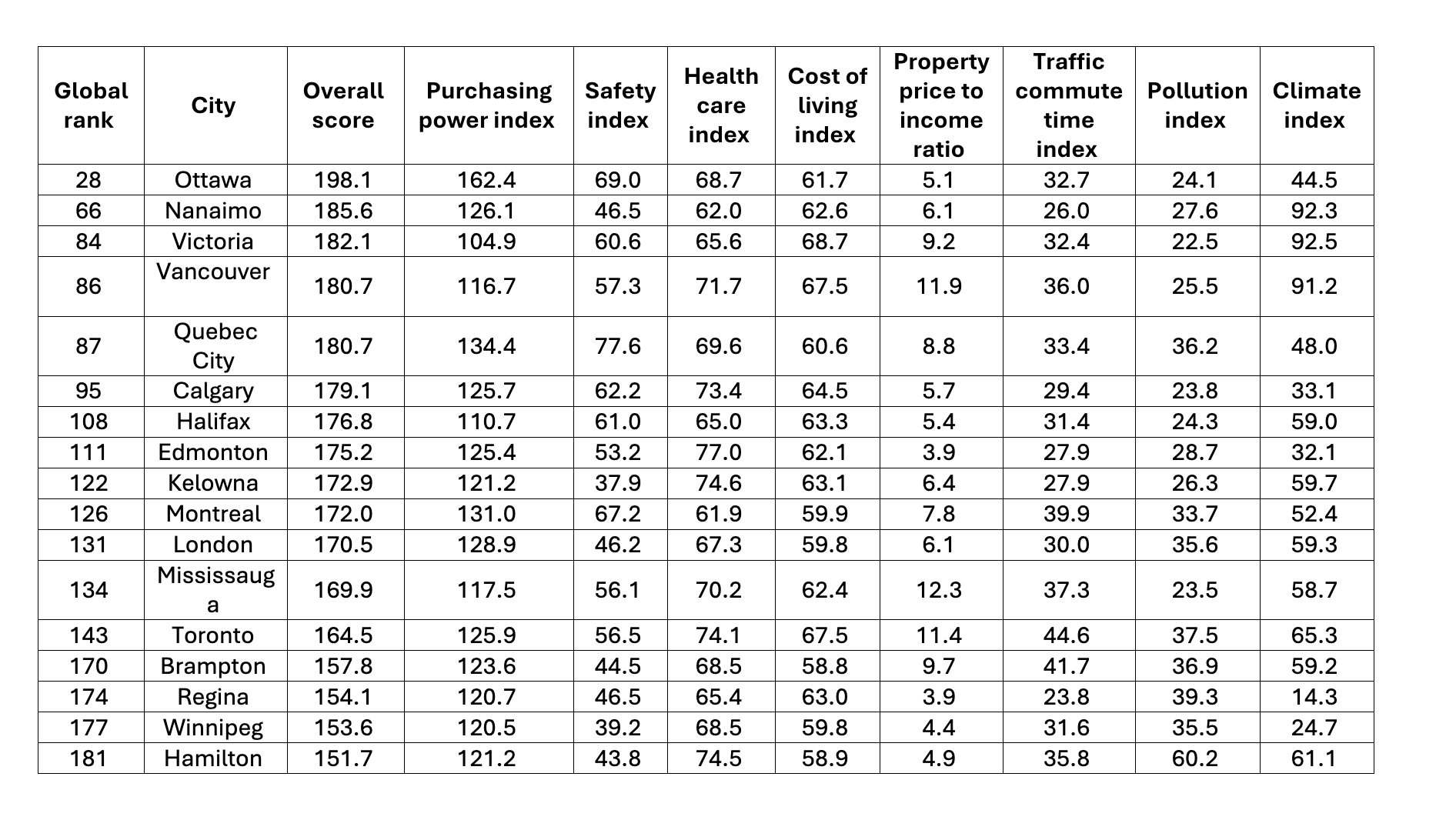
Last year, the US beat out Canada for the top North American city, with Boise, Idaho coming in as the 13th most livable city worldwide—and Canada first appearing on the list at spot 74 with Calgary, Alberta.
A few Canadian cities tied with international cities based on overall quality of life score this year, including:
- Nanaimo (with Colorado Springs, US);
- Vancouver and Quebec City (with Auckland, New Zealand);
- Montreal (with Salt Lake City, US);
- Toronto (with Tel Aviv-Yafo, Israel);
- Brampton (with Windhoek, Namibia); and
- Winnipeg (with Lisbon, Portugal).
While the overall quality of life scores in these cities were the same, the scores each city received in sub-categories such as safety or healthcare index varied.
Methodology
Numbeo’s Quality of Life Index is an estimate of overall quality of life, taking into account the factors listed below, as well as what is considered for each factor.
Numbeo compiles its database using both user-submitted information and data it collects directly from reputable sources, including supermarket and taxi company websites, as well as government institutions.
The manually collected figures are updated twice per year and are weighted three times more heavily than user input to improve reliability.
The quality of life index is derived by applying an empirical formula that prioritizes factors through assigned weights, consolidating the data into a single quantitative score.
Purchasing Power Index (higher score is better): Considers the price of consumer goods and services, the cost of renting an apartment, the cost of groceries, the price of restaurant/bar meals and beverages, etc., using New York City as a baseline.
Cost of Living Index (lower score is better): Same factors as purchasing power index.
Pollution Index (lower score is better): Considers air and water pollution, garbage disposal and cleanliness, noise and light pollution, availability of green spaces, and overall pollution comfort.
House Price to Income Ratio (lower score is better): Price to income ratio, mortgage as percentage of income, loan affordability, price to rent ratio, and gross rental yield.
Safety Index (higher score is better): General perception of crime levels, perceived safety (day and night), specific crime concerns, property crime severity, and violent crime severity.
Health Care Index (higher score is better): Considers overall quality of a healthcare system based on medical professionals, equipment, staff, doctors, and costs (infrastructure, services, resources).
Climate Index (higher score is better): Considers climate desirability—temperature, humidity, extreme weather conditions.
Traffic Commute Time Index (lower score is better): Commute time (one way in minutes), dissatisfaction with time spent in traffic (due to long commute times), CO2 emissions, and overall traffic system inefficiencies.
Join the Angus Reid Forum and get $5 in points!