The five most common mistakes when declaring your job for Canadian immigration, and how to avoid them

Choosing the right National Occupational Classification (NOC) code to categorize your work experience is one of the most important decisions in the creation of your immigration profile and application.
See how competitive your Express Entry profile is
The NOC that you choose to represent your work experience, and for the main occupation in your immigration profile, can:
- Determine your eligibility for Express Entry programs;
- Qualify you for Express Entry category-based selection, which typically have lower invitation requirements; and
- Qualify you for some Express Entry-aligned Provincial Nominee Program (PNP) streams.
Declaring the wrong NOC code, on the other hand, can have dire consequences—including having your application refused, and being found guilty of misrepresentation.
We consulted with several immigration lawyers to identify the five most common mistakes people make when selecting their own NOC—and practical ways to avoid them.
1) Relying on your job title instead of what you actually did
The trap:
Job titles are inconsistent across countries and employers.
Someone called a “Sales Manager” in one company may be doing the day-to-day work of a marketing coordinator, account executive, or business development specialist in another.
This is why choosing the right NOC relies far more on matching job duties, responsibilities, and descriptions, rather than titles.
How to avoid it:
Due to how the NOC website is designed, you will likely still need to start with your title, but it is important to have your duties in mind when making a final deliberation on your NOC code.
Before you start the process, it may be useful to make a list of your 10–15 most common tasks at work (the things you’re paid to do repeatedly as a defining part of your job).
You can then use the NOC website to search for your job title. Once you enter a specific title, you will be directed to the search page, which shows all jobs under the NOC system that can use this title.
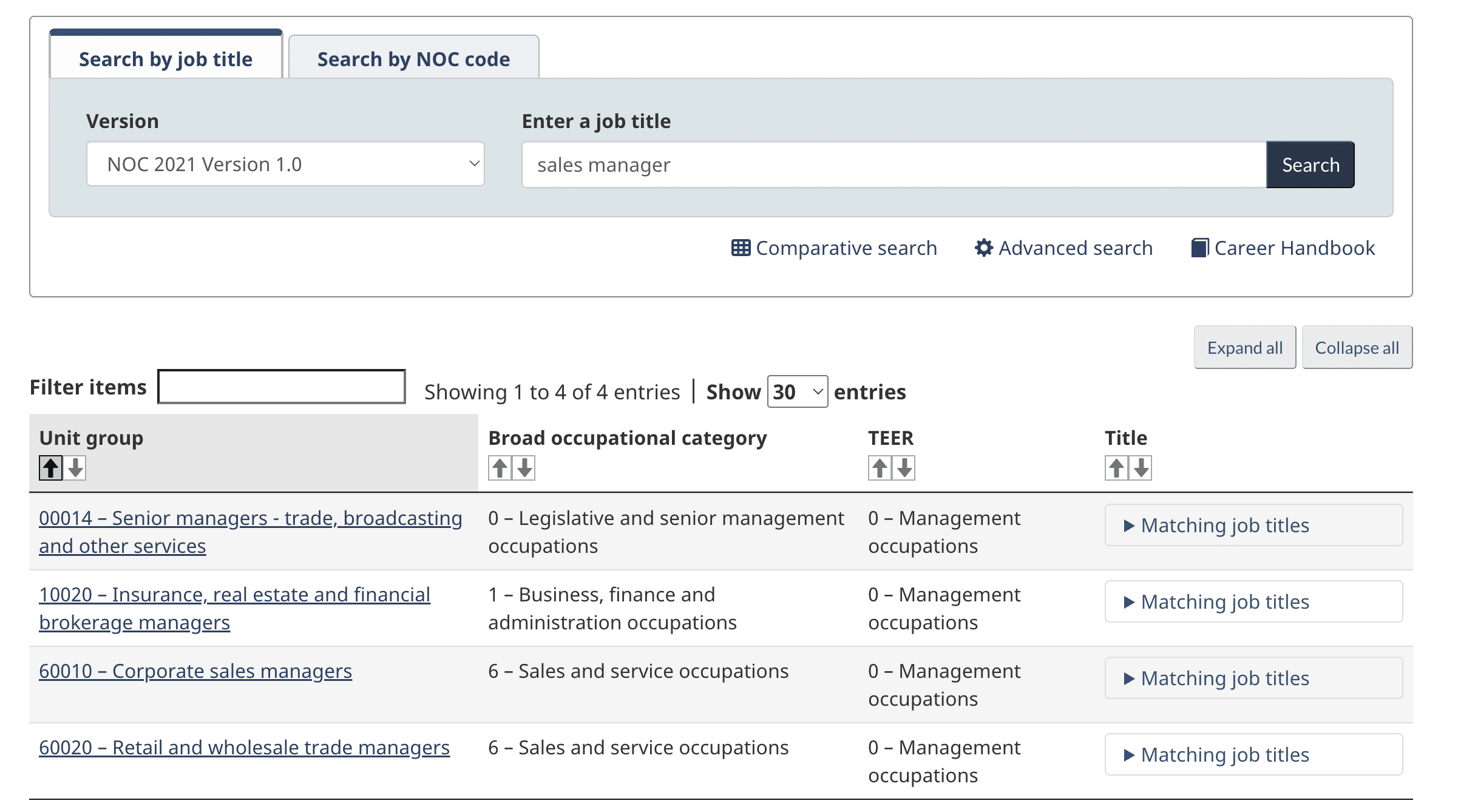
The search results will also show you the “matching job titles,” allowing you to see inclusions that fit in a certain NOC entry.
Once you click through to one of the search results, you will be able to see the lead statement and the main duties performed in each role.
Your goal is to find a NOC where you can truthfully show you performed the actions in the lead statement and most (or a substantial number) of the main duties.
A lot of applicants use a “~70–80% duties match” as a practical benchmark, though this is not a rule imposed by Immigration, Refugees and Citizenship Canada (IRCC)—what matters is whether the evidence you provide shows that your real work aligns with the NOC's description.
2) Picking a NOC in the wrong TEER level
The trap:
Applicants sometimes choose a NOC because it sounds more skilled, or because it matches their education, even if the actual role performed doesn’t align.
But the Training, Education, Experience, and Responsibilities (TEER) level of a NOC can affect whether the experience is considered “skilled” for certain immigration programs.
For example, under Express Entry programs, IRCC generally looks for work experience falling under TEER 0, 1, 2, or 3 for programs like the Federal Skilled Worker Program (FSWP) and Canadian Experience Class (CEC).
Thus, choosing an occupation in the wrong TEER can have huge consequences for your immigration application.
How to avoid it:
The first step is to confirm the occupation’s TEER and whether it’s eligible for your pathway.
Again, in choosing a NOC, you must use the occupation profile itself (lead statement/duties/exclusions) as your anchor.
If you’re torn between two NOCs with different TEERs, choose the one that best matches the actual daily responsibilities, which you can prove on paper.
Note: Declaring work experience in a NOC that you have not worked in constitutes misrepresentation and is a crime under Canadian law. You can only choose a different NOC at an eligible TEER if you have actually worked in that occupation and can prove this fact.
3) Submitting reference letters that don’t support the NOC you chose
The trap:
Even if you choose your NOC correctly, if your proof of employment and supporting documentation don’t show it, this can still pose a problem to your application.
IRCC’s Express Entry guidance explicitly includes proof of work experience as a requirement in a PR application, with a reference/experience letter from an employer being the main component.
A letter that only lists a job title and dates (with vague wording like “handled various tasks”) will not help an immigration officer connect your job to the NOC, and can lead to complications in your application.
How to avoid it:
Your letter should clearly describe your main responsibilities and duties, plus the basics (such as dates, hours, pay, and employer contact info).
IRCC checklists spell out these kinds of details as expected elements in an employer reference letter.
Write duties in plain language that reflect what you actually did—and make sure those duties line up with your chosen NOC’s lead statement and main duties.
IRCC may also accept other supporting documentation that supports your work experience, such as an offer of employment or pay stubs.
See how competitive your Express Entry profile is
4) Skipping the “Exclusions” section (and missing a “not covered” warning)
The trap:
Many individual NOC pages include an "Exclusions" section that details occupations that may be similar or have similar-sounding titles, but are not a part of that specific NOC entry.
The purpose of the exclusion section is to help you avoid accidentally choosing the incorrect occupation under the NOC by pointing you toward similar-but-different occupations.
Choosing the wrong occupation due to a failure to consider the exclusions can result in your application being rejected.
How to avoid it:
Treat looking through the Exclusions as a required step, not optional reading.
Each exclusion is also linked in the section, making it easy for users to navigate to the NOCs that may be more suitable.
If your job is listed as excluded (or “not covered”), follow the breadcrumb trail to the NOC(s) the system suggests instead.
5) Having inconsistencies across documents, forms, and your profile
The trap:
Even when the NOC is right, your application may come off as disjointed if your documents don’t match one another (different titles for the same job, conflicting start dates, different hours per week, or duties that change from one document to another).
While this may seem like a relatively simple mistake, inconsistencies can be easy to produce when entering information into multiple forms, and over an extended period of time.
How to avoid it:
One way to ensure that you use consistent information is to keep a “master” employment record on a spreadsheet or document.
Once you have checked that all the information in your sheet/document is accurate, you can simply copy and paste the information from there into application forms, relevant sheets, or wherever it may be needed.
Your “master” employment record should include
- Exact dates (start/end);
- Official title(s) used by the employer;
- Hours/week and whether paid;
- Supervisor/HR contact details; and
- A stable list of core duties (and which NOC duty each maps to).

- Do you need Canadian immigration assistance? Contact the Contact Cohen Immigration Law firm by completing our form
- Send us your feedback or your non-legal assistance questions by emailing us at media@canadavisa.com