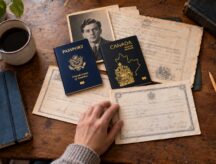
Was your parent born in Canada? If so, you can get a Canadian passport

Regardless of where in the world you were born, if even one of your parents was a Canadian citizen at the time of your birth, you inherited the right to Canadian citizenship.
As a Canadian citizen by descent, you have the same right to citizenship as Canadian citizens born in Canada.
With copies of the official documents showing your parent’s ancestry, you can apply for a proof of Canadian citizenship certificate and obtain a Canadian passport.
Get a Free Consultation on Applying for Proof of Canadian Citizenship
How to get your Canadian passport
Before you can apply for a Canadian passport, you must first apply for a proof of citizenship certificate from Canada's citizenship department, Immigration, Refugees and Citizenship Canada (IRCC).
Once you have the certificate, you can use it to apply for a passport.
The application is straightforward for someone with a Canadian-born parent. You will need to provide your birth certificate showing your parents' names, and proof that your at least one of your parents was a Canadian citizen at the time of your birth.
If your parent was born in Canada, you'll typically use their birth certificate as proof of their Canadian citizenship. If your parent was naturalized rather than having been born in Canada, their citizenship certificate or naturalization record would serve as proof.
After submitting a completed application for your proof of Canadian citizenship certificate, along with the required supporting documents, you can expect to receive your certificate in about 10 months, as of the time of writing.
With your proof of Canadian citizenship certificate in hand, you can apply for a Canadian passport, which currently takes 10 to 20 business days.
A note on dual citizenship
For Americans, there is no downside to applying for proof of Canadian citizenship. Both the United States and Canada fully recognize dual citizenship, so U.S-Canadian dual citizens enjoy the full rights and privileges afforded to citizens of each nation.
Claiming Canadian dual citizenship as an American also confers no additional tax obligations: Canada imposes no worldwide tax on its citizens, unlike the U.S.
Canada fully recognizes the rights of Canadian citizens by descent, including those holding other nationalities.
But your other nation(s) might not.
China, Japan, India, Singapore, and Saudi Arabia generally do not permit dual citizenship for adults. Other countries, like Austria and the Netherlands, allow dual citizenship only in limited circumstances.
Before you apply for a proof of Canadian citizenship certificate, make sure you understand the implications under the laws of any other countries of which you are a national.
Dual citizenship is allowed by the United Kingdom, France, Germany, and Australia, many countries in Europe, the Americas, and Oceania, and do
Which passport should you use when travelling?
If you (for example) hold both a Canadian and a U.S. passport, the general rule is simple: use the passport of the country you are entering. Enter Canada on your Canadian passport. Enter the United States on your U.S. passport.
For travel to any third country, you can use whichever passport offers the better access, whether that is visa-free entry, faster processing, or fewer restrictions.
If you are a dual citizen of Canada and a country other than the United States, the same principle applies. It is generally advisable to enter Canada on your Canadian passport and enter your other country of citizenship on that country's passport.
A note on further eligibility for Canadian citizenship by descent
Even if your parent does not have a Canadian passport, nor legal proof of Canadian citizenship, you may still be eligible for citizenship by descent, provided that you can trace your lineage back to a Canadian ancestor—such as a grandparent or great-grandparent.
If you were born on or before December 15, 2025, when Canada changed its citizenship law, you're not subject to any generational limit for inheriting Canadian citizenship.
Compared to someone whose parent was born in Canada, you will typically require additional documentation for establishing a continuous line of descent from a Canadian ancestor, and may need to request copies of official documents from Canadian provincial archives.
Get a Free Consultation on Applying for Proof of Canadian Citizenship
- Do you need Canadian immigration assistance? Contact the Contact Cohen Immigration Law firm by completing our form
- Send us your feedback or your non-legal assistance questions by emailing us at media@canadavisa.com