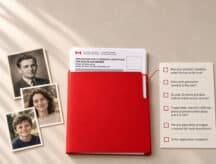
How to confirm with IRCC whether your ancestor was a Canadian citizen before you apply for proof of citizenship

There's a request you can submit to the Canadian government that can benefit your citizenship by descent application in two important ways, and most applicants have never heard of it.
The first: it hands you the exact names, dates, and file numbers to put on your application, so the government's own records check confirms your claim instead of stalling it.
Get a Free Consultation on Applying for Proof of Canadian Citizenship
The second: if an ancestor's original document is lost or was never issued, it gives you the file details you need to prove that gap under Canada's tightened proof rules.
It's called a search of citizenship records. It won't make you a citizen, and it won't prove you are one; however, when utilized correctly, it can be a powerful catalyst for your citizenship claim.
What a search of citizenship records is, and what it can show you
A search of citizenship records is a request to Immigration, Refugees and Citizenship Canada (IRCC), Canada’s citizenship department, asking one question: does the government hold a citizenship record for this specific person?
The search only finds people IRCC actually has a record for: someone who naturalized after arriving in Canada, someone issued a citizenship certificate, or someone registered as a British subject before 1947.
Typically, the search does not capture ancestors born in Canada unless they would have needed to document their citizenship with IRCC for any particular reason. A person born on Canadian soil is Canadian automatically, from birth. They never applied for anything, so IRCC often holds no record for them at all — their proof is a provincial birth certificate.
What a successful letter tells you
If IRCC finds a record, the letter it sends back is specific. It states the exact date the person became a citizen and whether they currently have a citizenship application in progress. It confirms the person's full legal name as it appears in Canada's registries, along with their date and place of birth. It carries a unique file number.
It also has a shelf life. If the person searched is alive, the letter is valid for one year. If the person searched has died, it doesn't expire.
So, this search is usually built for the ancestor who became Canadian, not the one born that way. If your line runs through someone who immigrated and naturalized, this is your tool.
What a search of citizenship records cannot do
The letter you get back is not proof of your citizenship. IRCC is explicit about this. You can't use it to prove you're a citizen, and you can't use it to apply for a Canadian passport.
It's also not one of the documents on IRCC's checklist of supporting information accepted for a citizenship by descent application. When you apply for proof of citizenship, IRCC asks for specific records issued by the original authority — a provincial birth certificate, an actual citizenship or naturalization certificate, a registration of birth abroad. The search letter isn't on that list. It's a research tool, not a document for the file.
What you're really applying for, if you qualify by descent, is a citizenship certificate. Under the law, you don't apply to become Canadian; if you qualify, you already are one. The certificate is the document that proves it. The search letter just helps you get there.
How to use search for citizenship records as part of your citizenship application
Despite its limitations, a search for citizenship records yields two important benefits for citizenship-by-descent applicants, both of which are worth considering.
The first is getting your application to match the record. When you apply for a citizenship certificate through a parent or ancestor, IRCC runs its own internal search of its citizenship records to verify your claim. Your job is to make sure the details on your form line up with what's in that registry. If the name, date, or file number you enter doesn't match, the file can stall while IRCC tries to reconcile the difference.
That's where a search done in advance pays off. It reveals the exact name in the registry, the precise date citizenship was acquired, and the certificate number. You can then mirror those details on your application, so IRCC's check confirms your claim instead of questioning it.
The second is proving a gap. IRCC recently tightened what counts as proof of citizenship by descent and now leans firmly on original-authority documents. If you can't produce one, you have to submit a written explanation, with evidence that you tried to get it. When an ancestor's original certificate is lost and can't be reissued — say the person has died and the estate is closed — the file numbers and dates from a prior search let you write that explanation with precision, pointing IRCC straight to its own internal record.
One money-saving note: If you're already applying for the citizenship certificate, you don't need to file a separate search, and there's no separate search fee. IRCC does that internal check as part of processing your application. The standalone search is for people who want the information before they apply.
Get a Free Consultation on Applying for Proof of Canadian Citizenship
Why timing matters
Proof of citizenship applications are taking around 19 months to process as of the writing of this article. A detail mismatch in an application, discovered late in that window, is expensive — not in money, but in months.
So, if there's any doubt about your ancestor's registry details, the sensible move is to run the search early, before you file. You find out what IRCC has on record, you align your application to it, and you are far more likely to see your application processed without delays.
What a mismatch actually costs
Picture a retired consultant, Johnathan Canon, near Charlotte, North Carolina. He knew his great-grandfather had immigrated from overseas, settled in Saint John, New Brunswick, and become a citizen in the 1890s.
He had the story right and filed his application confidently.
What he didn't have was the details. The name in his family papers was spelled one way, while the name in Canada's registry, anglicized by a clerk generations ago, was spelled another. He didn't have the certificate number at all.
IRCC's internal check couldn't cleanly match his claim to its record. The file was flagged, and a letter came back asking for more documents. Months passed while he reconstructed what a single search could have told him at the start.
Run first, that search would have handed him the registry's exact spelling and the certificate number, ready to copy onto his form. The match would have been clean. That's the tool in one story: it turns a guess into a known fact before the guess can cost you.
How to apply
If you're searching for a parent, a grandparent, an ancestor — you apply on paper, using the form CIT-0058.
For a living person, that person has to consent by signing the form. For someone who has died, IRCC asks for proof of death and proof of your relationship, with the requirements depending on how long ago they passed. One detail for older searches: if your ancestor came to Canada before 1915, IRCC says to fill in the father's information, because records from that era were built around the father.
If the answer is "no record"
A no-record letter can feel like a dead end. It's often the opposite.
IRCC's updated guidance for citizenship by descent applications leans harder on original-authority documents and flags applications that lean on secondary sources.
Under those rules, if you can't produce an original document, you have to show IRCC that you tried. A no-record letter is one way to do exactly that. It's official confirmation, in writing, that the record isn't there to be found.
The same letter serves people going the other direction, too. Some request it specifically to prove to a foreign government that they are not Canadian citizens, so they can keep or obtain another citizenship.
A blank result doesn't mean your ancestor wasn't Canadian, and it doesn't end your claim. For ancestors from before 1947, there was no Canadian citizenship as we know it — people were British subjects, and naturalization wasn't always required. A "no record" simply redirects you: you build the chain with original-authority documents for each generation, and where one is missing, you document the gap and explain it.
You can check your eligibility in a few minutes with CanadaVisa's free citizenship by descent eligibility checker — and if your family's history is tangled enough to need a professional eye, the team at Cohen Immigration Law can help you sort the record from the proof.
Get a Free Consultation on Applying for Proof of Canadian Citizenship

- Do you need Canadian immigration assistance? Contact the Contact Cohen Immigration Law firm by completing our form
- Send us your feedback or your non-legal assistance questions by emailing us at media@canadavisa.com