
Vancouver, British Columbia, has ranked among the top 10 most livable cities in the world, in the 2026 Global Liveability Index released by the Economist Intelligence Unit (EIU).
It is the only North American city to make it onto the EIU’s top 10 list, for the second consecutive year.
Assess Your Eligibility for Canadian Permanent Residence
The 2026 edition of the EIU’s Global Liveability Index was released on July 7 and evaluated 173 cities globally.
EIU’s annual quality-of-life rankings are based on how each city performs across five categories, examining factors such as stability, healthcare, and education.
The top 10 most livable cities
Among the world’s 10 most livable cities, Europe holds the largest share with four, while the rest are distributed across Oceania, Asia, and North America.
The cities that made it onto the top 10 list this year largely mirror those from 2025, though this year we see the inclusion of Tokyo, Japan, and the removal of Auckland, New Zealand.
The table below features the full rankings for the top 10 most livable cities of 2026:
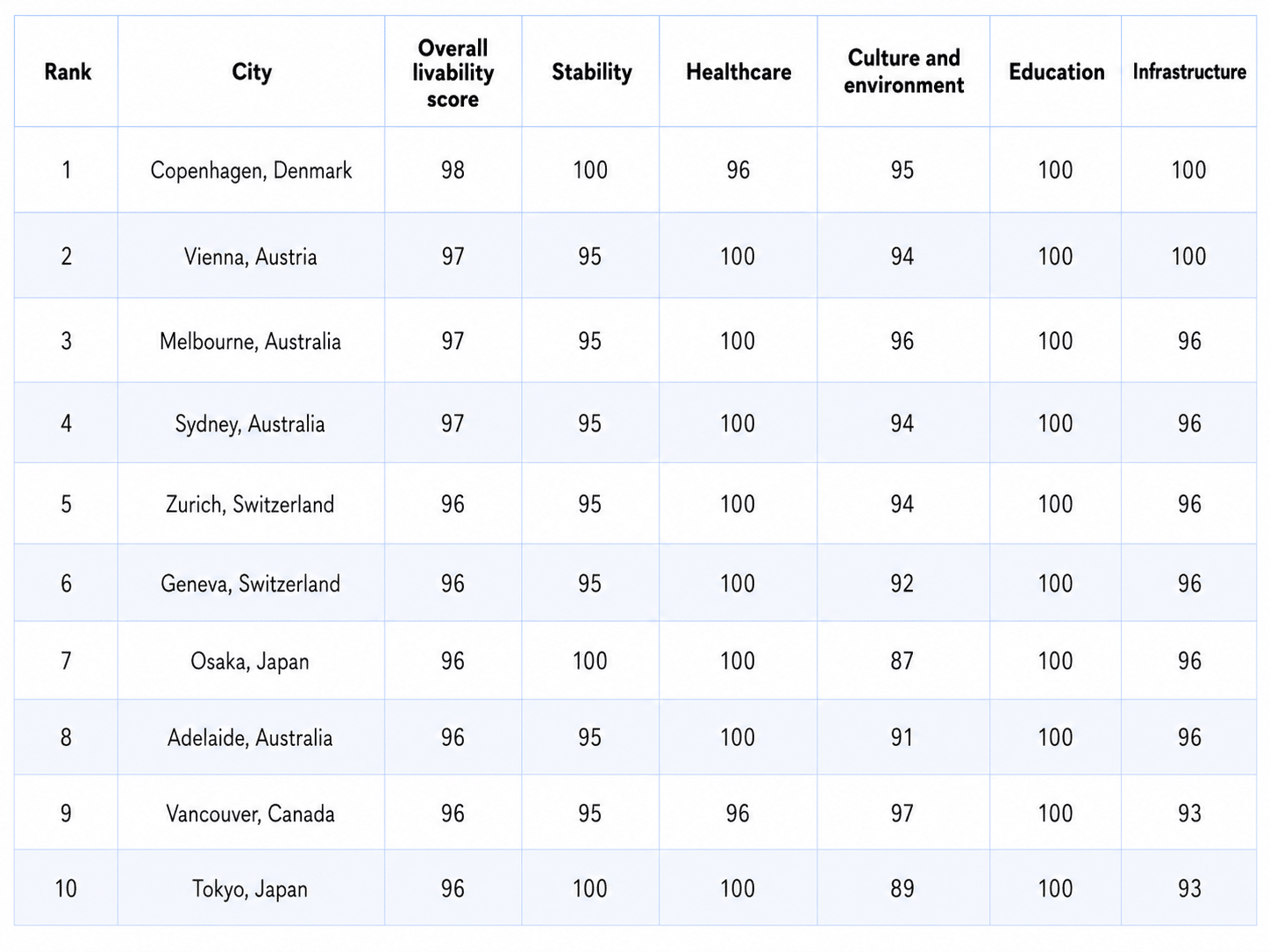
By contrast, countries that scored among the bottom 10 positions have “nearly all been affected by war or poverty,” the EIU rankings report states, including Tehran (Iran), Kyiv (Ukraine), Karachi (Pakistan), and Tripoli (Libya). Damascus (Syria) came in last.
A look at Vancouver’s standing
Compared to 2025, Vancouver—the sole Canadian city to make an appearance—moved up a rank in this year’s index, going from 10th place to ninth place.
Vancouver’s overall livability score increased from 95.8 in 2025 to 96 in 2026, with several of its category-specific scores shifting as well:
- Healthcare: increased from 95.8 to 96.
- Culture and environment: decreased from 97.2 to 97.
- Infrastructure: increased from 92.9 to 93.
It continues to maintain its perfect score (100/100) in education and ranks above Copenhagen in culture and environment (despite a minor score drop in that category).
Although Vancouver moved up in this year’s ranking, it still finished below its seventh-place position in 2024—trailing behind Calgary, Alberta, which placed fifth that year.
Looking even further back, Vancouver held strong at number one for around a decade between 2002 and 2010 before gradually slipping in ranks—though usually still remaining among the top 10.
Ranking methodology
The EIU evaluated 173 cities worldwide using 30 distinct indicators, which were equally grouped into five categories.
Indicators were weighted within each category to produce a category score of one (intolerable) to 100 (ideal). Category scores were then weighted into an overall livability score out of 100, with final scores grouped as acceptable, tolerable, uncomfortable, undesirable, or intolerable.
Below are the five categories and their total weight, as well as the indicators grouped into each category.
- Stability (25%): Presence of petty and violent crime, threat of terror, military conflict, and civil unrest/conflict.
- Healthcare (20%): Availability and quality of private and public healthcare, availability of over-the-counter drugs, and general healthcare indicators adapted from the World Bank.
- Culture and environment (25%): Humidity/temperature rating, discomfort of climate to travellers, level of corruption and censorship, social or religious restrictions, sporting and cultural availability, food and drink, and consumer goods and services.
- Education (10%): Availability and quality of private education, and public education indicators adapted from the World Bank.
- Infrastructure (20%): Quality of road networks, public transportation, international links, energy and water provisions, and telecommunications, and availability of good quality housing.
Assess Your Eligibility for Canadian Permanent Residence