From Canada to California: How tens of thousands of Californians are Canadian citizens by descent today

Be it the gold rush of 1848 or the lure of Hollywood, the most populous state in the U.S. is known for attracting people from around the world.
Migration has always been a key part of California’s growing population. As a matter of fact, native-born Californians didn't outnumber those who migrated from elsewhere until 2010.
Canada has supplied a steady share of those migrants. And that rich history means that today tens of thousands of California residents are eligible for Canadian passports, even if they've never set foot north of the border.
Get a Free Consultation on Applying for Proof of Canadian Citizenship
Why some Californians are now Canadian?
On December 15, 2025, Canada's Bill C-3, An Act to Amend the Citizenship Act, took effect.
The bill removed the first-generation limit on citizenship by descent for those born before that date. That means anyone born before December 15, 2025, who can document an unbroken line of descent from a Canadian ancestor may already be a Canadian citizen. It could be someone with a Canadian grandparent, great-grandparent, or an ancestor further back.
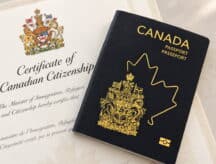
In this scenario, there is no need for a citizenship test or oath. Instead, applicants file for proof of Canadian citizenship, and a successful application results in a Canadian citizenship certificate. Since the passing of this bill, thousands of Americans have been applying for Canadian citizenship certificates every month.
With a sizeable share of Californians holding Canadian ancestry, that could mean they now hold a second citizenship they never expected.
A long history of migration
Canadian migration to California was steady through most of the 19th century.
The 1848 discovery of gold in the Sierra Nevada foothills triggered the California Gold Rush, which changed things. Roughly 300,000 people arrived from across the U.S. and abroad, including some from what is now Canada. Note that Canadian citizenship only began as a legal status on January 1, 1947 ((or April 1, 1949, in the case of Newfoundland), with the passing of Canada’s first citizenship law. Before then, residents were classed as British subjects, making exact numbers hard to pin down.
Decades later, Canadians left a different kind of mark that's still on the map. In the 1880s, a lumber company built a mill town in Humboldt County and needed a name. Most of the workers who'd settled there came from Nova Scotia and New Brunswick, so the town took the name Scotia. It's still called that today.
Between 1900 and 1950, other factors kept drawing Canadians south, from mining jobs to cheap farmland. Research on California immigration, published by the Center for Immigration Studies, found that half the state's immigrants in the 1950s came from Canada or Europe, with most of the rest arriving from Mexico.
French Canadians made up a large stream of that movement. Between 1840 and 1930, close to 900,000 left rural Quebec, most heading to the textile mills of New England. That’s one of the reasons that. If you’re from New England, there’s now a one-in-four chance you’re a Canadian citizen under Canada’s new citizenship law.
Families that put down roots in those mill towns in New England didn’t always stay there though. They kept moving, and California drew its share of them west.
That history adds up to something measurable.
The numbers behind the story
The U.S. Census Bureau's 2024 American Community Survey estimated that roughly 64,000 Californians reported Canadian ancestry, one of the highest absolute numbers in the country. And roughly another 79,000 reported French Canadian ancestry.
These are two census categories, and both qualify for Canadian citizenship by descent under the updated law.
These self-reported estimates likely undercount the real number, since plenty of people with a qualifying ancestor may not know their family history in detail. This is especially true because just one Canadian ancestor could make a whole side of a family tree eligible for Canadian citizenship by descent today.
Think you might be a Canadian citizen by descent?
Not every Californian with a Canadian ancestor is eligible for a Canadian citizenship certificate.
Applicants will need to prove that they have an unbroken line of descent, generation by generation, through documentation from an original source authority.
But if your family story includes a Canadian grandparent or a great-grandparent who immigrated from "up north”, or an ancestor based in Scotia, it might be worth a second look.
A Canadian citizenship certificate comes with tangible benefits: a Canadian passport, which currently outranks the U.S. passport on the Henley Passport Index, and dual citizenship rights that include living, working, and voting in Canada.
If you are unsure, CanadaVisa has a free citizenship by descent eligibility checker that can help you get started in your search.
Get a Free Consultation on Applying for Proof of Canadian Citizenship

- Do you need Canadian immigration assistance? Contact the Contact Cohen Immigration Law firm by completing our form
- Send us your feedback or your non-legal assistance questions by emailing us at media@canadavisa.com