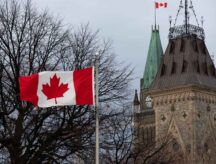
Generations of Minnesotans are now Canadian citizens through their ancestry and don’t know it yet

Ask Americans to name the most Canadian corner of the US, and most will point to parts of New England.
Yet just north of St. Paul, in Ramsey County, Minnesota, sits a city literally called Little Canada.
The city wears its roots openly. Its water tower spells out "Little Canada," and its flag carries a maple leaf.
Get a Free Consultation on Applying for Proof of Canadian Citizenship
Little Canada is one of many reminders of how closely Minnesota is tied to its northern neighbour. Apart from a love for hockey and a propensity for politeness, the state shares a border with Ontario and Manitoba, and French Canadian names are scattered across its map.
Thanks to a Canadian law that took effect in December 2025, those ties mean that tens of thousands of Minnesota residents may now be dual Canadian-American citizens.
A long history of migration
The French Canadian settlement that became Little Canada is closely associated with Benjamin Gervais, a French Canadian voyageur and farmer.
In 1844, Gervais moved north of St. Paul and founded a French-speaking farming community he called Little Canada. He built a grist mill there, and the lake on the city's east side still bears his name. The settlement became a township in 1858, a village in 1953 and a city in 1974. Close to 10,800 people lived there as of the 2020 census.
By 1895, an estimated 70,000 French Canadian immigrants lived in Minnesota and its neighbouring states. The community was large enough to sustain its own French-language press: in August 1896, the newspaper Echo de l'Ouest counted 5,000 subscribers, according to the Minnesota Historical Society.
The French American Heritage Foundation of Minnesota credits these settlers with helping build much of the state, from its farms and towns to its civic institutions.
That legacy appears in Minnesota's official symbols too. The state motto, L'Étoile du Nord, is French for "The Star of the North." It reflects Minnesota's place as the northernmost state in the contiguous US and honours the French Canadian explorers and settlers who arrived before statehood.
What the numbers really say
The U.S. Census Bureau's 2024 American Community Survey five-year estimates show more than 6,000 Minnesotans reporting Canadian ancestry and more than 41,000 reporting French Canadian ancestry.
The Census Bureau counts the two groups separately. Canada's citizenship rules do not: a French Canadian ancestor counts the same as any other Canadian one. Together, the figures add up to roughly 47,000 ancestry responses in Minnesota with a claim to a Canadian citizenship certificate.
The true number of potential claimants is likely higher. Ancestry is self-reported, and many families have lost track of where a great-grandparent was born. A single Canadian-born ancestor can be enough to carry a claim down an entire family line, so people who never listed Canadian ancestry on a census form may still qualify.
What this means for eligible Minnesotans
Bill C-3, which amended Canada's Citizenship Act, came into force on December 15, 2025. It removed the first-generation limit, which had stopped Canadian citizens born abroad from passing citizenship to children who were also born abroad.
As a result, Minnesotans with an unbroken line of descent from even a single Canadian ancestor may already be Canadian citizens, even if no one in the family has lived in Canada for generations.
These Minnesotan-Canadians need only apply to formally claim their citizenship status, through a proof of citizenship application to the Canadian government. Approved applicants receive a Canadian citizenship certificate, which confirms their status and lets them apply for a Canadian passport.
U.S.-Canadian dual citizens can enter, live and work in Canada. Those under 30, or 35 in some cases, can also use Canada's youth mobility arrangements to live and work in more than 35 countries, most of them in Europe.
A citizenship certificate does not, on its own, create Canadian tax obligations. Canadian income tax generally depends on where a person lives and where their income comes from.
In other words, that leaves little downside for Americans looking to claim their Canadian citizenship status.
Checking whether you qualify
A Canadian ancestor on its own does not guarantee a certificate. Each generational link between you and that ancestor has to be backed by supporting documents from an original source authority.
If your family tree includes a relative who came down from Quebec or Manitoba, or one who farmed near Little Canada, it may be worth a closer look.
CanadaVisa's citizenship by descent eligibility checker can help you see where you stand.
*Methodology: Ancestry figures come from table B04006 of the US Census Bureau's 2024 American Community Survey five-year estimates. The Bureau records "Canadian" and "French Canadian" as separate categories. Both fall under Canada's citizenship by descent provisions, so this article combines them. Respondents may report up to two ancestries, so the combined figure counts ancestry responses, not unique residents. Ancestry is self-reported and does not establish citizenship or a documented chain of descent.
Get a Free Consultation on Applying for Proof of Canadian Citizenship

- Do you need Canadian immigration assistance? Contact the Contact Cohen Immigration Law firm by completing our form
- Send us your feedback or your non-legal assistance questions by emailing us at media@canadavisa.com