In Minnesota, French-Canadian descendants are digging through parish records and other documents for a shot at Canadian citizenship

If you call the Little Canada Historical Society (LCHS) in Minnesota these days, you may find yourself amongst other people trying to work out whether a Quebec ancestor makes them Canadian.
Jon Tremblay, the society’s president, had an efficient solution: opening the society’s doors for an informal workshop. That workshop led to the creation of a starter kit, which is available to anyone who joins the society.
How Bill C-3 changed Canada’s citizenship law
The interest follows a fairly recent change in Canadian citizenship law.
Get a Free Consultation on Applying for Proof of Canadian Citizenship
On December 15, 2025, Bill C-3 took effect. It removed the first-generation limit on citizenship by descent in certain circumstances.
Under the old rules, a Canadian citizen born outside Canada generally could not pass citizenship to a child who was also born abroad. That limit no longer applies to people born before December 15, 2025.
That means that Americans born before that date who can trace their lineage to a qualifying Canadian ancestor may already be Canadian citizens, including through a grandparent or great-grandparent born in Canada.
Since Bill C-3 took effect, tens of thousands of Americans have applied for Canadian citizenship certificates every month, based entirely on their ancestry.
Minnesota’s French-Canadian roots
Little Canada, a city just north of St. Paul, was founded by French-Canadian and Métis families.
John Vanek, a public historian and writer from Minnesota, is a descendant of one of those families. He has been documenting his ancestry for a book, The Long Road to Little Canada, which is still in its early stages.
As part of his research, he looked into how people of French-Canadian descent were instrumental in founding St. Paul and its twin city, Minneapolis. Today, descendants of French Canadians in the US may be Canadian citizens and qualify for a Canadian passport.
This includes Tremblay, who spent two months on research, emails and trips to county courthouses before submitting a citizenship by descent package earlier this year.
How many residents share that ancestry is harder to pin down. According to Tremblay, Italians and other groups arrived after the French Canadians, and the Twin Cities have grown considerably over the past fifty years.
“I think it’s safe to say that over half of the population can find a familial connection,” he says.
Many families in the region are learning that they may have a claim to Canadian citizenship for the first time. The surprise is felt most among families who don’t carry a French-Canadian surname. Often, a grandparent married a French-Canadian woman and the connection got “lost,” as Tremblay puts it.
Trace your family lineage with the Family Line Explorer
Support for those submitting proof of citizenship applications is available
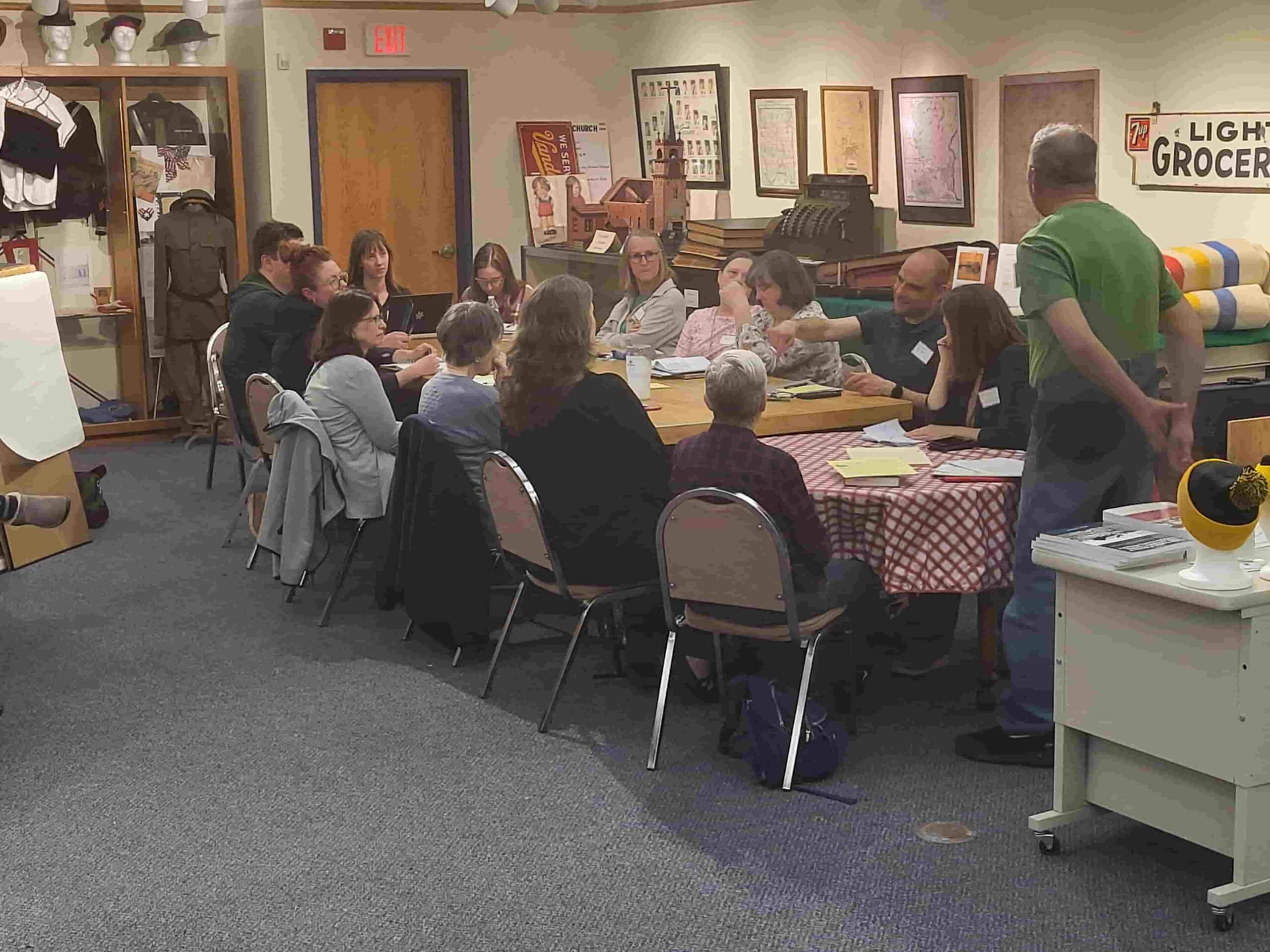
Jon Tremblay, President of the Little Canada Historical Society, speaks to a smaller gathering
The society has hosted four workshops so far, with attendance ranging from 12 to 50 people. Most attendees are tracing a line back to Quebec.
Tremblay says the purpose of the workshops is to point people in the right direction. “The LCHS has a lot of records and many have benefitted from our collection of parish records. The archdiocese here is completely overwhelmed and although we cannot provide a certified copy of something, we can still provide a copy of the real thing,” he says.
For families who suspect French-Canadian roots and don’t know where to start, Vanek offers the following advice:
Start with your immediate family. Begin with parents and grandparents and work backwards from there.
Check what your relatives already have. Once you identify an ancestor born in Canada, look at the records within your own family, such as a certified marriage record or birth certificate. Finding the documents you need within the family is often the cheapest route.
Identify the shortest line back to Canada. The fewer generations you have to prove, the simpler the application, and the fewer chances a reviewer has to find errors.
Weigh that against the best-documented line. Vanek says the shortest line is not always the strongest. For something as important as citizenship, he says, you need clear, unambiguous, unbroken proof of each family and each generation.
Check with local collections
- The LCHS has binders on French-Canadian families and church records from French Catholic parishes. Those interested can also benefit from the earlier-mentioned starter pack for people who are interested in Canadian citizenship but unsure where to begin.
- The Minnesota Genealogical Society (MGS) also has a large collection of Canadian records, including Catholic church records and dozens of linear feet of family histories, says Vanek. “In fact, the largest single collection of books and records at MGS is the Canadian Collection. This includes records not just from Quebec but from all the provinces,” he says. “For some Minnesotans, the shortest line might be Irish or Scottish Canadian.”
Both organizations have volunteers who can help visitors find Minnesota or Canadian records through heritage sites and national, provincial and local archives, so it’s worth asking for help, says Vanek.
The Little Canada Historical Society’s work isn’t limited to local residents, either. It also serves as the French-Canadian Center for the State of Minnesota.
“We have shared information with people from all over the state and even elsewhere in the US. People in Little Canada, Minnesota, are very proud of our connection with ‘Big Canada,’” says Tremblay.
Get a Free Consultation on Applying for Proof of Canadian Citizenship

- Do you need Canadian immigration assistance? Contact the Contact Cohen Immigration Law firm by completing our form
- Send us your feedback or your non-legal assistance questions by emailing us at media@canadavisa.com