International migration to Canada reached record levels in second quarter of 2018

International migration to Canada reached an unprecedented level between April 1 and July 1, 2018, driving an overall population increase that was the second largest recorded for a three-month period since 1971.
Canada's population grew by 168,687 in the second quarter of 2018, of which 82 per cent, or 138,978, was attributed to international migration.
Statistics Canada says this level of international migration was "never before seen for any quarter."
International migratory increase was the "main driver of Canada's population growth" during the second quarter of 2018 both nationally and at the provincial level, Statistics Canada says.
International migratory increase is calculated by adding the number of immigrants, returning emigrants and net non-permanent residents arriving in Canada and then subtracting net temporary emigration and emigrants departing Canada.
At the national level, Canada welcomed 87,661 new immigrants during the quarter, the second most for a three-month period since the study period began in 1971.
The number of non-permanent residents increased by 60,446 during the quarter, which Statistics Canada said was "significantly higher than those observed in recent years." It attributed the increase primarily to a rise in the number of work permit holders, followed by study permit holders and refugee claimants.
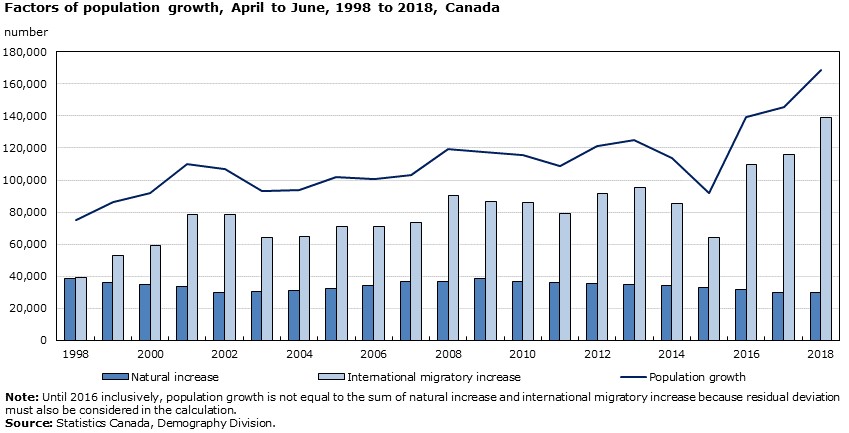
This unprecedented level of international migration for a quarter helped offset what Statistics Canada said was a record number of deaths for a three-month period (67,997). Overall, Canada's estimated natural population increase (births minus deaths) of 29,709 was the third lowest for a second quarter.
Nova Scotia and New Brunswick actually experienced a natural decrease in population (more deaths than births), which was off-set by the number of international migrants who arrived in the provinces.
Statistics Canada said international migratory increase was the main driver of population growth in most Canadian provinces and the Yukon Territory between April 1 and July 1.
Other than Newfoundland and Labrador, Alberta, the Northwest Territories and Nunavut, Statistics Canada said international migratory increase "either peaked or has rarely been this high" in the remaining provinces and the Yukon Territory.
Quebec experienced a gain of 19,506 non-permanent residents, the most ever recorded over a three-month period. Ontario and British Columbia also recorded unprecedented increases in the number of non-permanent residents for a second quarter (28,329 and 8,189).
Under its Multi-Year Levels Immigration Plan, Canada is expecting to welcome nearly one million new immigrants between 2018 and 2020.
Under the plan, 310,000 new permanent residents will settle in Canada in 2018. This target will be increased to 330,000 newcomers in 2019, with a further 340,000 to settle in 2020.
To find out if you are eligible for any Canadian immigration programs, fill out a free assessment.
© 2018 CICNews All Rights Reserved
- Do you need Canadian immigration assistance? Contact the Contact Cohen Immigration Law firm by completing our form
- Send us your feedback or your non-legal assistance questions by emailing us at media@canadavisa.com