Where do most South Asians live in Canada?

Often noted for both its cultural diversity and its ethic of multiculturalism, Canada today represents one of the world’s most diverse populations, with Canadian citizens and permanent residents, hailing from all around the world.
One of the strongest communities in Canada is the South Asian community, which has seen substantial growth in the last 20 years. As of the latest census (2021), there are 2.3 million people in Canada of South Asian heritage. Considering that South Asian countries are huge sources of newcomers every year (projected by Statistics Canada to exceed 5 million people in Canada by 2041), South Asian newcomers may want to know where to find people of similar backgrounds throughout the country.
Discover if You Are Eligible for Canadian Immigration
How does Statistics Canada define South Asian?
According to Statistics Canada, the term “South Asian” can be ascribed to individuals from a variety of national backgrounds, including Indians, Pakistanis, Bangladeshis, Bhutanese people, Nepalis, and Sri Lankans.
Of these groups, Indians were the most populous at 1.3 million people, followed by Pakistanis (303,000 people), Sri Lankans, (132,000), Bangladeshis (75,425), and Nepalis (22,000).
Where do most South Asians live in Canada?
Breaking down the question by province, here are the respective populations of South Asian communities in Canada:
- Alberta: 267,375 people;
- British Columbia: 428,910 people;
- Manitoba: 63,235 people;
- New Brunswick: 8,400;
- Newfoundland and Labrador: 4,600;
- Nova Scotia: 21,345;
- Ontario: 1,484,185;
- Prince Edward Island: 3,485;
- Quebec: 129,000; and
- Saskatchewan: 40,760.
Where do most South Asians live in these provinces?
To break down further where members of the South Asian community reside in Canada, we will consider the Census Metropolitan Areas (CMAs) and Census Agglomerations (CAs) in each province where South Asians are the most prevalent.
A CMA or CA are groupings of municipalities around a population center (or core). For example, the CMA of Toronto (with the city of Toronto as its core) includes a multitude of municipalities (cities) that might themselves be confused for CMAs or CAs—such as Mississauga, Brampton, Markham, Caledon, Oakville, Milton, Vaughan, and other cities in the Greater Toronto Area. The diagram below illustrates this:
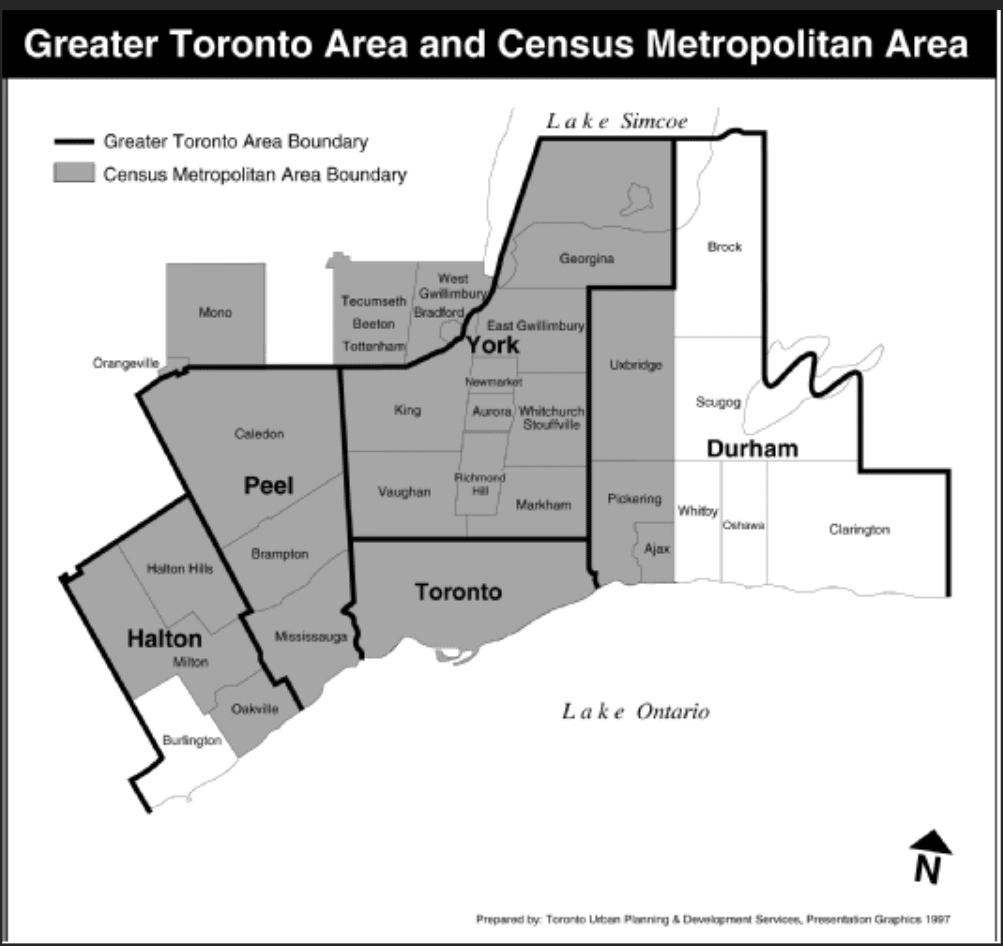
To see which CMA or CA your city fits into, a quick web search with the following phrase: “(city name) + CMA/CA, Canada” will likely yield results.
Note: All data presented is from Canada’s 2021 National Census, conducted by Statistics Canada.
Ontario
Ontario is the most populous province for South Asians in Canada, with more than a million people calling the province home.
The five CMAs or CAs in Ontario with the most South Asians were:
- Toronto—1.1 million people;
- Ottawa—62,095 people;
- Kitchener—52,110 people;
- Hamilton—47,570 people; and
- Oshawa—39,810 people.
British Columbia (B.C.)
B.C. is the second most populous province in Canada for people of South Asian origin. Within the province, the CMAs or CAs with the greatest South Asian populations were:
- Vancouver—333,385 people;
- Abbotsford—43,855 people;
- Victoria—13,405 people;
- Kelowna—6,925 people; and
- Kamloops—3,885 people.
Alberta
Alberta was the third most populous province of South Asians in Canada. Across the province, the CMAs and CAs with the biggest South Asian populations were:
- Calgary—138,280 people;
- Edmonton—109,615 people;
- Wood Buffalo—4,310 people;
- Lethbridge—2,790 people; and
- Red Deer—2,240 people.
In addition to the CMAs and CAs listed above, other CMAs in Canada with the largest South Asian populations include:
- Montréal, Quebec: 128,280 people;
- Winnipeg, Manitoba: 56,180 people;
- Saskatoon, Saskatchewan: 14,560 people;
- Regina, Saskatchewan: 14,285 people; and
- Halifax, Nova Scotia: 12,925 people;
- Do you need Canadian immigration assistance? Contact the Contact Cohen Immigration Law firm by completing our form
- Send us your feedback or your non-legal assistance questions by emailing us at media@canadavisa.com