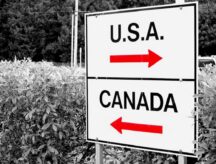
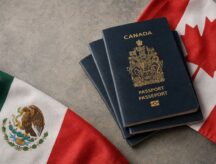
Even as the US-Canada trade war escalates, many Americans are applying for Canadian citizenship

On August 27, US president Donald Trump signed an executive order directing U.S. federal agencies to refer to Lake Ontario as ‘Lake America.’
Within hours, Prime Minister Mark Carney responded, pointing out that the name behind Lake Ontario is more than 400 years old, predating both Canada and the US.
Ontario Premier Doug Ford was a bit more candid: "No one is going to call it Lake America," he said.
Get a Free Consultation on Applying for Proof of Canadian Citizenship
Renaming Lake Ontario is only the latest in a series of events following a breakdown in trade talks between the two countries. On Sunday, August 30, Trump called Canada "one of the Worst Abusers" of the United States on trade in a social media post.
Carney, for his part, has said the United States proposed terms he called "uneconomic" and "unfair," including limits on Canada's ability to sign trade deals with other countries.
A trade war that is escalating
The sequence of events follows months of tensions that began in February 2025, when Trump signed an order imposing tariffs on goods entering the US from Canada.
This has led to consequences such as Canadian provinces restricting the sale of US alcohol. Meanwhile, the agriculture and construction industries on both sides of the border have felt the impact.
Many economists predict the trade war will shave only a modest amount off Canada's overall growth, but will hit specific provinces and industries. Trevor Tombe, economics professor at the University of Calgary, has predicted that the tariffs will be felt most acutely in British Columbia, followed by Ontario and Quebec.
Others are questioning what a prolonged rupture means for two economies that spent decades becoming more entangled with each other.
As economist Peter Schiff put it, as Canadian companies invest more in logistics or infrastructure within other markets, it may become more lucrative to pursue other trade relationships.
In other words, the longer Canadian companies look outside the United States for buyers and suppliers, the more permanent this shift could become.
Meanwhile, more Americans are applying for proof of citizenship
Ironically, even as the divide between the two countries grows, tens of thousands of Americans are applying to become fully recognized Canadian citizens every month
This follows an update to Canada's citizenship law on December 15, 2025 that removed the first-generation limit on citizenship by descent, meaning anyone born before that date who can prove a direct line from a Canadian ancestor is also a Canadian citizen.
That means anyone with a Canadian grandparent, great-grandparent, or an ancestor from an even earlier generation may already be a Canadian citizen — even if they have never set foot in Canada. They are only required to apply to the Canadian federal government with supporting documentation to prove their claim.
In these cases, applicants do not have to swear an oath or take a citizenship test. Instead, they apply directly for proof of Canadian citizenship. If successful, they receive a citizenship certificate, a document that cements their status and gives them access to all the benefits of Canadian citizenship, including a Canadian passport.
Since Bill C-3 passed, demand for Canadian citizenship certificates from Americans has surged. According to a report, the number of applications from US citizens in January 2026 alone outnumbered the combined total from the next nine source countries.
Meanwhile, the queue keeps growing: the number of people awaiting processing for proof of Canadian citizenship rose from 70,400 in May to 121,800 in August 2026 — an increase of 51,400 people in three months. Canadian archives have also reported overwhelming demand for documents that can prove ancestry, with some saying they have seen years’ worth of demand in just a few months.
Get a Free Consultation on Applying for Proof of Canadian Citizenship
The surge in applications from Americans is due in no small part to availability: the long history of cross-border migration from Canada to the US, whether for work or other reasons, has made millions of Americans eligible to claim Canadian citizenship today. Between 1840 and 1930 alone, roughly 900,000 French Canadians migrated from Quebec to New England. Following the passing of Bill C-3, their descendants all qualify for Canadian citizenship — and, by extension, Canadian passports
The second reason is a bit more obscure: demand has risen as many Americans look for a back-up option amid Trump's second term. Investor citizenship applications from Americans through residence and citizenship advisory firm Henley & Partners jumped by more than 75% in 2025, the year Trump started his second term. A spring 2025 Harris poll found that almost half of all Americans — and two-thirds of Gen Z and Millennials — would like dual citizenship. About a quarter of those pointed to the "greater security and stability" dual citizenship offers, alongside healthcare and affordability.
Others are applying for more practical benefits. Canadian citizenship means their children can study in Canada without a study permit. Those under the age of 30 or 35 can qualify for International Experience Canada, which allows them to live and work in more than 35 countries, many of them in Europe. And should they choose to settle in Canada down the road by establishing provincial or territorial residency, they gain access to the country’s public healthcare and social services.
Getting a Canadian citizenship certificate does not affect their American citizenship. Both countries permit dual nationality, so Americans who become dual citizens keep their US passport and its protections in full.
Nor does it trigger new taxes. Canada taxes based on residency rather than citizenship, so an American who obtains dual citizenship but doesn't move to Canada or acquire property or a business there won't owe Canadian income tax. Only Americans who eventually settle in Canada and become Canadian tax residents would need to navigate both systems — and even then, the US-Canada tax treaty provides some relief from double taxation.
For many Americans with Canadian ancestry, the question isn’t why they should apply for a second citizenship they’re entitled to. It’s, “why not?”
Think you have a Canadian ancestor?
Whether it's a great-grandparent who spoke French, family who live close to or regularly travel "up north," or a French Canadian surname, there are a few signs that you might have Canadian ancestry.
If that's the case, start by speaking to your oldest living relatives. This can help you identify your "anchor ancestor" — the person through whom your Canadian citizenship claim runs.
Once you find that connection, it is a matter of collecting the required documentation needed to prove your line of descent, according to IRCC’s criteria, generation by generation, and filling out the required form.
If you're still unsure, CanadaVisa+ has a free citizenship eligibility checker you can try. A licensed immigration lawyer may also be able to offer more personalized guidance.
Get a Free Consultation on Applying for Proof of Canadian Citizenship
- Do you need Canadian immigration assistance? Contact the Contact Cohen Immigration Law firm by completing our form
- Send us your feedback or your non-legal assistance questions by emailing us at media@canadavisa.com