
In 2025, new student arrivals have declined by 70%, and new worker arrivals have declined by 50%, according to new data published by Canada’s immigration department.
In the period between January and June of 2025, Canada welcomed 88,617 fewer international students and 125,903 fewer foreign workers, compared to the same period in 2024.
This cumulatively has yielded a total decrease of 214,520 fewer new student and worker arrivals over this period, demonstrating that measures taken by Immigration, Refugees and Citizenship Canada (IRCC) to curb inflows of temporary residents have had a substantial impact.
Join the Angus Reid Forum and get $5 in points!
Changing proportions of new arrivals
The latest data from the immigration department also indicates that there has been a marked decrease in the proportion of new arrivals that are study permit holders since the start of 2025.
While the degree to which study permit and work permit holders dominate the monthly share of new arrivals to Canada tends to fluctuate, IRCC’s data shows a consistent shift towards most new arrivals being work permit holders (averaging 80% between February and June 2025), with study permit holders seeing a sharp decrease in their share of new arrivals. This is in contrast to the same time last year, when work permit holders averaged 70% of new arrivals.
Though August and December tend to see more international student arrivals in anticipation of the fall and winter intakes, this change in the proportion of new arrivals that are study permit holders is consistent with other trends seen in new arrival data.
Slower rates of intake
Canada’s rate of intake for both study permit holders and work permit holders has also decreased significantly. The following table breaks down the average number of new monthly arrivals among both study permit and work permit holders between January and June of 2024, as compared to the same period in 2025:
| Study permits | Work permits | |
|---|---|---|
| January to June 2024 | 20,839 | 40,865 |
| January to June 2025 | 6,070 | 19,872 |
Current populations
IRCC’s most recent data also shows interesting changes to the population of international students and foreign workers already in Canada.
From January 2024 (the implementation of Canada’s first study permit cap) to June of 2025, the number of foreign nationals in Canada who hold only a study permit has decreased by 133,325.
| Month | January 2024 | June 2025 |
|---|---|---|
| Number of study permit holders | 679,887 | 546,562 |
Over this same time period, the number of foreign nationals who only held a work permit has increased by 262,262 permit holders.
| Month | January 2024 | June 2025 |
|---|---|---|
| Number of work permit holders | 1,242,311 | 1,504,573 |
An increase in work permit holders and decrease in study permit holders is to be expected in the context of policy changes over the last several years: a large share of work permits are Post-Graduation Work Permits (PGWPs).
As international students graduate, many obtain PGWPs and remain in Canada as work permit holders. Since a typical undergraduate program lasts four years, PGWP issuances can lag the issuance of initial study permits by four years or longer, and the federal government only began to scale back study permit issuances beginning in Jan 2024.
Lastly, IRCC notes only a slight decrease of 32,014 dual permit holders among the number of foreign nationals who hold both a work permit and a study permit in Canada, over the same time period.
| Month | January 2024 | June 2025 |
|---|---|---|
| Number of foreign nationals holding both a study and work permit | 344,044 | 312,010 |
Between these three distinct populations, IRCC data actually shows an increase of 137,851 foreign nationals in the overall number of temporary residents in Canada, between January 2024 and June 2025.
| Month | January 2024 | June 2025 |
|---|---|---|
| Total number of temporary residents in Canada holding either a work permit, or a study permit, or both | 2,225,294 | 2,363,145 |
However, this is not the entire story. Canada’s temporary resident population peaked in August of 2024 at 2,446,523 individuals, and has been trending downward since then (with some fluctuation in between).
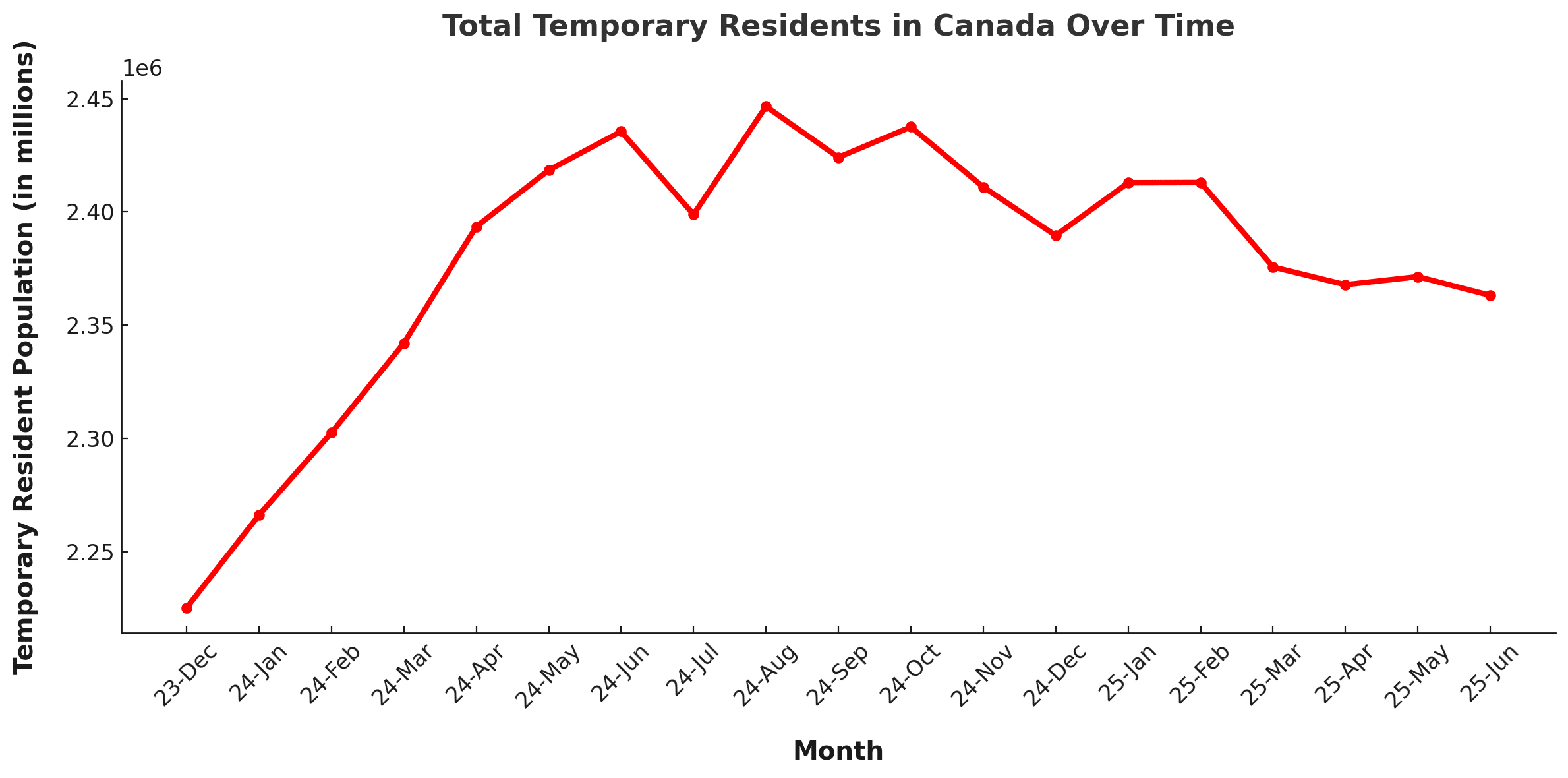
At the same time, the rate of new arrivals between these two periods has seen great shifts, going from a strong positive growth through the first half of 2024, to a continued contraction in the temporary resident population from August of 2024 onwards. This contraction indicates that the rate of new arrivals is outpaced by the rate of departures of temporary residents from Canada, yielding a decline in the overall temporary resident population:
| January to June 2024 | June to December 2024 | January to June 2025 | |
|---|---|---|---|
| Absolute change in temporary resident population over the time period | +169,281 | -45,910 | -49,706 |
| Percentage change in temporary resident population, relative to start of the time period | +7.47% | -1.89% | -2.06% |
These changes have yielded a decline in the proportion of Canada’s population that are temporary residents:
| Month and Year | Temporary residents as proportion of Canada's population |
|---|---|
| June 2024 | 5.93% |
| June 2025 | 5.69% |
Understanding current population numbers
While somewhat unexpected, it is natural to see work permit numbers remain higher and decline more slowly compared to study permit levels. This is because today’s work permit holders include large cohorts of international students who arrived in previous years.
Upon graduation, many international students become eligible for a PGWP—a key pathway that allows former students to gain Canadian work experience. Since the PGWP is a study permit to work permit pathway, with large numbers of students being eligible, it logically holds that Canada would see an increase in work permit holders through this cohort, even independent of the measures the country has taken to curb new arrivals of work permit holders.
Many of these students are still completing their studies or are just now graduating, also contributing to a delay in the decline of active study permit numbers.
Join the Angus Reid Forum and get $5 in points!
Measures IRCC has taken to reduce new study permit and work permit holders in Canada
Since 2024, IRCC has rolled out a series of reforms designed to slow the growth of temporary resident numbers, particularly international students and foreign workers.
On the study permit side, changes have included
- Capping study permit applications across provinces and territories;
- Raising cost-of-living financial requirements for study permit applications; and
- Tightening eligibility for PGWPs,
For work permits, notable reforms included
- A moratorium on the processing of Labour Market Impact Assessments (LMIA) under the low-wage stream of the Temporary Foreign Worker Program (TFWP) in regions with an unemployment rate of 6% or higher;
- An increase of the wage requirements for the high-wage stream of the TFWP;
- The removal of COVID-era policies that allowed visitors to transition more easily to job-offer-supported work permits;
- Updated guidance for Intra-Company Transferees (ICTs), limiting eligibility to employees of multinational corporations with specialized knowledge;
- A ban on flagpoling, preventing same-day processing of applications at ports of entry;
- Establishing multi-year targets for net new work permits under the IMP and TFWP beginning in 2025; and
- Restricting eligibility of Spousal Open Work Permits (SOWP)s for spouses of international students; and
- Restricting SOWP eligibility for spouses of temporary foreign workers.
Inclusion of temporary resident levels in the Immigration Levels Plan
The above measures flow from macro-level changes in the landscape of Canadian immigration, as communicated in the annual Immigration Levels Plan.
For the first time in Canadian history, IRCC’s Immigration Levels Plan introduced targets for temporary residents in addition to permanent residents.
Announced on October 24, 2024, the plan aims to reduce the share of temporary residents from 7% to 5% of Canada’s population by the end of 2026.
How IRCC counts arrivals
IRCC counts new arrivals based on the number of people issued a study permit or work permit in a given month. If a person is issued both in the same month, they are counted only under the study permit group.
Some groups are not included in the arrival data:
- Asylum claimants – claims are not part of planned immigration levels;
- Permit extensions – these individuals are already in Canada, so they are not new arrivals;
- Seasonal agricultural workers – short-term workers tied to rural labour shortages, usually housed by employers; and
- Short-term Temporary Foreign Worker Program (TFWP) workers (≤270 days) – contracts that begin and end within the same calendar year, often in industries like tourism or construction.
Join the Angus Reid Forum and get $5 in points!