Change in citizenship law opens route to Canadian passports for 300,000 Connecticut residents

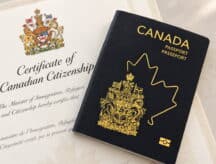
Close to 300,000 Connecticut residents became U.S.-Canadian dual citizens overnight when Canada updated its citizenship by descent law.
The changes to Canada's Citizenship Act, which came into force on December 15, 2025, abolished the generational limit to inheriting Canadian citizenship for anyone born before that date.
Get a Free Consultation on Applying for Proof of Canadian Citizenship
Today, any Connecticuter old enough to read this, as of the time of writing, can apply for proof of Canadian citizenship, and obtain a Canadian passport, provided they can trace a continuous line of descent from a Canadian ancestor.
Around *9% of present-day residents of Connecticut are estimated to have Canadian ancestry, based on research by Patrick White and data provided by the U.S. Census Bureau.
The high levels of Canadian ancestry in Connecticut can be traced back to “La Grande Saignée” (The Great Hemorrhage), the migration of nearly 900,000 French-Canadians that from Quebec to New England between 1840 and 1930 in search of employment.
By the end of that period, Connecticut was home to over 67,000 French Canadians, who yielded exponentially larger numbers of descendants with at least one Canadian ancestor with each successive generation.
This spring, Connecticut residents join Americans across the country in gathering documents and submitting proof of citizenship applications, not because they’re planning to move to Canada anytime soon, but because they’d like to have a Canadian passport in their back pocket, just in case.
Getting a Canadian passport as a resident of Connecticut
Americans born in the United States who have at least one Canadian ancestor—no matter how many generations removed— already qualify as U.S.-Canadian dual citizens.
Before they can get Canadian passports, however, they must first obtain official confirmation of their dual citizenship status by Canada’s citizenship department, in the form of a proof of Canadian citizenship certificate.
Most Americans will need to apply for a citizenship certificate on paper, and their applications will need to include copies of official documentation to prove their Canadian ancestry, such as birth certificates, marriage licenses, and/or baptismal records.
Those who successfully secure the required documentation can submit their application to Immigration, Refugees and Citizenship Canada and join the 56,000+ people currently awaiting processing.
As of the time of this writing, the current processing time for a Canadian citizenship certificate is 10 months, which means that an eligible American who applies today can expect to have their dual U.S.-Canadian citizenship officially recognized by March of 2027, provided their application is successful and encounters no kinks that slow down processing.
Eligible Americans can either handle the application process themselves, or hire a representative legally authorized by the Canadian government, such as an immigration lawyer, to do so on their behalf. Professional representatives can help reduce the risk of refusal by assisting in the submission of a complete, error-free application.
For many Americans, document acquisition may prove to be the most time-consuming and onerous task, particularly for those whose Canadian ancestor is many generations removed.
Many Americans may require vital records from over 100 years ago from the Canadian province of Quebec, especially if they are claiming Canadian citizenship through a great-grandparent or more distant French-Canadian ancestor.
In such cases, they will need to seek historical records from Quebec’s national archives, the Bibliothèque et Archives nationales du Québec (BAnQ), which has reported a 3,000% increase in requests, the majority from Americans, following the passage of Canada’s new citizenship law.
Because the BAnQ prioritizes requests from Quebec-based residents, eligible Americans might consider hiring Quebec-based licensed representatives to assist with obtaining the necessary copies of official documents.
Many Americans won’t be able to proceed with their proof of citizenship applications without first obtaining documents from the BAnQ.
Others may find their least-distant Canadian ancestor originated from a different Canadian province, in which case they can proceed on the basis of official documents from one or more other regional archives.
Why pursue official recognition of Canadian citizenship?
After obtaining proof of Canadian citizenship, a U.S-Canadian dual citizen can apply for a Canadian passport, which currently ranks above the U.S. passport on the Henley Passport Index.
The Canadian passport also provides access to youth mobility programs, allowing individuals to live and work in 36 countries, such as Italy, Japan, or Switzerland, for up to two years.
Currently, the processing time for a Canadian passport is 10–20 days, with the Canadian government offering a full, automatic refund for applications not processed within 30 days.
U.S.-Canadian dual citizens are afforded the full rights and privileges of both countries; they can enter, live, and work unrestricted in both nations, and can access Canadian healthcare and government social services if they establish residency in Canada.
Obtaining proof of Canadian citizenship or a Canadian passport as an American does not result in any additional tax obligations. Unlike the U.S., Canada does not apply a worldwide tax on its citizens.
Americans who qualify as U.S.-Canadian dual citizens will only become subject to Canadian income tax if they establish residency in Canada or develop financial ties to Canada, such as owning real estate, businesses, or other assets in Canada.
*In a 2020 presentation to the Rhode Island Historical Society, Patrick White estimated that approximately 20% of New England has French-Canadian ancestry. In Vermont, genealogist Ed McGuide places that figure closer to 30%. We’ve arrived at a 8–9% estimate for Connecticut through adjusting these two figures downward relative to the proportion of self-reported Canadian ancestry among residents of each state according to the U.S. Census Bureau 2025 5-year estimates, which provide the figure of 2.5% for Connecticut, versus 6.91% for Maine, 7.59% for Vermont, 8.06% for New Hampshire, 4.05% for Rhode Island, and 3.04% for Massachusetts.
Get a Free Consultation on Applying for Proof of Canadian Citizenship

- Do you need Canadian immigration assistance? Contact the Contact Cohen Immigration Law firm by completing our form
- Send us your feedback or your non-legal assistance questions by emailing us at media@canadavisa.com