
Those applying for Canadian citizenship by descent will now have a 15-month wait time for their proof of Canadian citizenship certificates as of June 2026.
There are now roughly 82,000 applications in the queue, according to Immigration, Refugees and Citizenship Canada (IRCC).
As recently as May 12, that figure stood at 70,400. In under a month, 11,600 more people joined the line.
Get a Free Consultation on Applying for Proof of Canadian Citizenship
Because IRCC bases the processing time estimates for citizenship certificates on the number of applications already in the queue, the wait may continue to grow as more people apply.
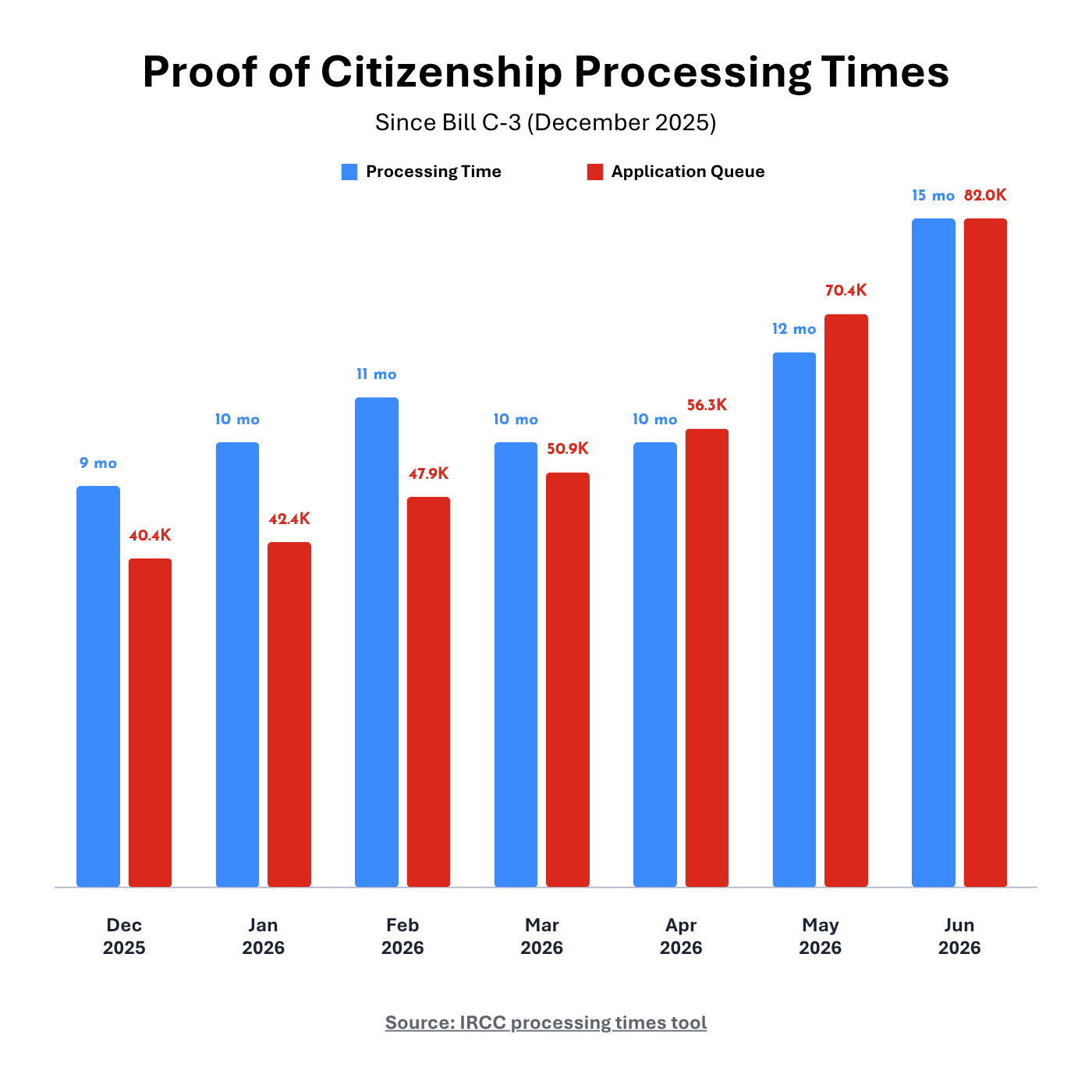
Since Canada’s citizenship laws expanded eligibility in December 2025, processing times have jumped from 9 to 15 months, and application queues have more than doubled in size.
Is it worth waiting to apply?
IRCC says an application received in June will take about 15 months to process. By our calculation, that points to a decision around September 2027.
The figure matters because wait times have only increased month over month since the passage of Bill C-3.
In practical terms, waiting to apply may likely mean a longer wait, not a shorter one. Someone who files today enters the queue behind 82,000 other applicants, with the queue only likely to further increase based on current trends.
Get a Free Consultation on Applying for Proof of Canadian Citizenship
Why are so many people applying?
On December 15, 2025, Canada changed its Citizenship Act, removing the first-generation limit to citizenship by descent for those born before that date.
If you qualify under the new law, you are already a Canadian citizen. You are not applying to become one; you are applying for the document that proves it, so you can get a passport and exercise your rights.
Anyone born before then who can trace a continuous line of descent from a Canadian ancestor can now apply for proof of Canadian citizenship. That holds even for U.S. citizens whose families have lived entirely in the U.S. for four or more generations.
Many Americans have taken notice. Often, it’s not about a plan to move north, but about a second passport kept in their back pocket during uncertain times.
The appeal is easy to understand. Once they receive their certificate, a U.S.-Canadian dual citizen can apply for a Canadian passport, which now ranks seventh in the world and offers visa-free or visa-on-arrival access to 183 countries.
Canadian citizens can also live and work anywhere in Canada, buy residential real estate, and access publicly funded healthcare if they take up residence. And because Canada does not tax its citizens on worldwide income the way the U.S. does, proof of citizenship creates no new income tax obligations.
How IRCC calculates the wait
IRCC uses a forward-looking method to estimate processing times. The figure reflects how many applications are already in the queue, how many staff are available to process them, and how many new applications the department expects to receive.
Your processing time starts the day IRCC receives your complete application and ends when it makes a decision. If you apply online, the clock starts when you submit. If you apply by mail, it starts when your application reaches the mailroom.
The department refreshes the estimate each month. It can move in either direction as the queue and staffing change, though the projections do not account for sharp spikes in new applications.
Factors that can make your application take longer
The 15-month estimate applies to routine applications. IRCC may take longer if it considers your case complex or non-routine. That can happen when:
- The department needs extra documents from you, such as residence documents
- You missed a test, interview, or hearing
- There is a criminal, security, or other admissibility issue
A complete, well-prepared application is the best way to avoid delays of this kind.
Am I a Canadian citizen?
Following Bill C-3, anyone born before December 15, 2025, who can trace a continuous line of descent from a Canadian ancestor qualifies as a Canadian citizen, no matter how many generations have passed. It doesn’t matter where the person was born, or whether their parents or grandparents ever lived in Canada or held Canadian passports.
Those unsure whether they qualify can start by examining their family tree, speaking to relatives, and gathering family records. To apply, you’ll need documentation establishing your descent, such as birth certificates, baptismal records, marriage records, or death certificates.
Get a Free Consultation on Applying for Proof of Canadian Citizenship