Canada updates citizenship by descent forms, shares new information on physical presence requirement


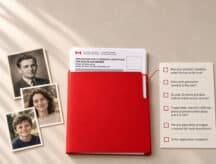
Immigration, Refugees and Citizenship Canada (IRCC) updated its proof of citizenship application package on August 25.
Four documents changed: the application form (CIT 0001), the document checklist (CIT 0014), the physical presence form (CIT 0555), and the instruction guide.
Get a Free Consultation on Applying for Proof of Canadian Citizenship
Most of the update covers how you prove a Canadian parent spent 1,095 days in Canada before their child was born.
Some of the changes give applicants details they didn't have before. IRCC now lists six categories of acceptable evidence where it used to list six vaguer ones. Other changes ask for more than the old forms did. For example, a letter from a church that once counted as proof now has to be a sworn affidavit, with the signer's home address and phone number attached.
Who this affects
The physical presence requirement applies to children born outside Canada on or after December 15, 2025, to a Canadian parent who was also born outside Canada. In those cases, the parent has to show they were physically present in Canada for 1,095 cumulative days before the child's birth, for citizenship to be passed down to the child.
If you were born before December 15, 2025, none of this applies to you. Bill C-3 removed the first-generation limit for everyone in that group, and no physical presence test attaches to their claim.
The affected group is small today. The oldest child covered by the rule is eight months old. But it grows with every month.
Already applied and worried you're missing something? IRCC returns incomplete applications rather than refusing them, and processing officers can ask for more documents at any point. There's a full section on what to do at the end of this article.
What changed on the forms
CIT 0001 now names the form you need. At the physical presence question in Section 13, the application tells you that a "yes" answer means submitting the How to calculate physical presence in Canada for a Canadian parent form (CIT 0555). The old version pointed you at "the instruction guide" without naming anything.
CIT 0555 warns you twice that IRCC will check. Two new lines appear on the form. The first sits on page one: "All information provided in this form is subject to verification by IRCC." The second sits under the box where you total your parent's days, and goes further. It asks you to supply contact details for the people and organizations who can confirm what you've declared. IRCC is asking for references, on the form, before anyone reviews your file.
The document standard is now written down. Anything you send to prove those 1,095 days has to be a clear, easy-to-read colour copy of an authentic document or record.
The evidence list got more specific in both directions. IRCC replaced its old categories with these:
- Employment and educational records, such as T-4 slips or school transcripts
- Travel records, such as passports or entry and exit records
- Residential records, such as rental, mortgage or insurance records
- Canadian government records and documents, federal, provincial, territorial or municipal
- Affidavits by religious institutions, unions, volunteer programs or other organizations with knowledge of the parent's time in Canada
- Affidavits of third parties with knowledge of the parent's time in Canada
The fourth bullet point is worth taking note of. The old list said "other government records." The new one specifies Canadian government records.
The same tightening runs through the affidavit bullets, and it's the sharpest change in the package. The old checklist accepted "attestations by churches, unions or other organizations."
What an affidavit now requires. The person swearing it, called the affiant, declares that what they've written is true. They do that in front of a commissioner authorized to administer oaths where they live. In Canada, that's a notary public, a commissioner of oaths, or a commissioner for taking affidavits. Outside Canada, a notary public or the local equivalent.
Every affidavit has to carry the affiant's name, mailing address, and email or phone number.
There is one restriction. You can't swear your own affidavit, and neither can your family. That rules out parents, guardians, siblings, spouses, common-law and conjugal partners, grandparents, children, aunts, uncles, nieces, nephews and first cousins. A relative who happens to be a lawyer or notary is still a relative.
The general provision stays. A last bullet allows "other proof that demonstrates the applicant's Canadian parent's physical presence in Canada." It carries the same condition as the rest: name, mailing address, and email or phone number for whoever can verify it.
Get a Free Consultation on Applying for Proof of Canadian Citizenship
How IRCC counts a day, and where that answer went
Until this month, the instruction guide specified two things. A day of physical presence was any calendar day spent in Canada. Partial days counted as full days. And cumulative meant the days didn't have to run consecutively.
IRCC deleted both sentences. Neither one moved to CIT 0555 or CIT 0014. The word "cumulative" still appears in three places, including the heading of CIT 0555. Nothing defines it.
That said, the method hasn't changed. The worked example on page one of CIT 0555 remains untouched:
Entered June 21, 1985. Left June 28, 1985. Niagara Falls. Family visit and vacation. 8 days.
June 21 to June 28 is seven nights. IRCC counts eight days. The only arithmetic that produces eight counts both the arrival day and the departure day in full.
The instruction above that table points the same way. It tells you to list the day your parent entered Canada and the day they left, then calculate the total. Box C then asks you to add every trip together, which is what cumulative means.
In other words, the old rule still seems to hold, irrespective of the sentences that have been deleted from the instruction guide.
If you've already applied
If your file is still in processing, you can send the missing documents yourself.
Send the missing documents through IRCC's web form. You'll need your Unique Client Identifier (UCI) and your application number, both of which appear on the acknowledgment of receipt IRCC sent when your application arrived. Do this before an officer reaches the file rather than after.
Note that updating your file is an obligation, not a courtesy. The declaration you sign in Section 16 of CIT 0001 reads: "I agree to advise IRCC if any information on this form changes before the processing of my application is complete."
Everything below applies whether or not you update the file yourself.
Incomplete applications come back to you. IRCC returns them rather than refusing them. If yours comes back, you need to fix the gap and resend. The clock restarts, which is the real cost.
Officers can ask for more at any point. Under the Citizenship Act and the Citizenship Regulations, No. 2, IRCC can request additional information or evidence while your application is in process. The guide says some applications need more time, and that IRCC will contact you for documents in those cases.
Keep your contact details current. If IRCC's request can't reach you, you lose the chance to answer it. Use the Change your address tool for any change to your address, email or phone number while your file is open. Check your file with the application status tool.
If a record doesn't exist, say so in writing. IRCC accepts a written explanation when you can't get a document from the original authority, but you have to show you tried. Emails or letters from the registry work, as does written confirmation that the records aren't available. Send a letter of explanation for anything missing or unclear.
Line up your affidavits now. If you're relying on a church, union or third party, confirm they'll share a mailing address and a phone number, and that they'll swear the statement in front of a commissioner. Family members can't do this for you.
Expect the possibility of a review. IRCC runs a quality assurance program that picks applications at random. If yours is selected, you'll be told in writing and asked to attend an interview. Officers verify your original documents, confirm what you wrote on the form, and can request more evidence. That includes DNA testing to confirm parentage.
Get a Free Consultation on Applying for Proof of Canadian Citizenship
Ways around the physical presence requirement
Canadian parents who can't meet the 1,095 days aren't out of options, and some of them are worth planning around before a child is born.
A child born in Canada is a Canadian citizen at birth, due to Canada’s birthright citizenship laws. The physical presence test doesn't reach them.
The requirement also doesn't apply if the Canadian parent was a Crown servant when their child was born or when an adoption was finalized. That covers employment outside Canada with the Canadian Armed Forces, the federal public administration, or the public service of a province or territory, in anything other than a locally engaged role.
A parent can also meet the test the direct way, by spending 1,095 days in Canada before the child arrives. The days don't have to run together.
If none of that works, the child isn't shut out completely. IRCC's guidance points to permanent residence followed by a citizenship grant under section 5.
Where a child would otherwise be stateless, there's a grant route under subsection 5(5), and applications under subsections 5(1) and 5(2) can be submitted with a request for discretionary consideration on that basis.
We've covered these routes in more detail in our earlier article on what the new rules mean for the children of citizens by descent.
Not sure where you stand?
If you were born before December 15, 2025, and you can trace an unbroken line to a Canadian ancestor, none of the physical presence rules touch your claim. You're already a citizen. What you need is the certificate that proves it.
CanadaVisa's free citizenship by descent eligibility checker will tell you which generation your claim runs through and whether the physical presence test applies. The proof of citizenship page walks through the rest of the application.
Get a Free Consultation on Applying for Proof of Canadian Citizenship

- Do you need Canadian immigration assistance? Contact the Contact Cohen Immigration Law firm by completing our form
- Send us your feedback or your non-legal assistance questions by emailing us at media@canadavisa.com