Canada quietly drops requirement for grandparents’ marriage details from the proof of citizenship application form


Immigration, Refugees and Citizenship Canada (IRCC) has removed requirements to disclose the marriage details of an applicant’s grandparents from CIT-0001, the application form for proof of Canadian citizenship.
Get a Free Consultation on Applying for Proof of Canadian Citizenship
IRCC added a dedicated field for these marriage details on August 25, in the same update that expanded what counts as evidence of a Canadian parent's physical presence in Canada.
IRCC had asked for the marriage details of an applicant's grandparents since January, but only added a dedicated box in Section 9 of the form on the 25th. Within 48 hours of this update, IRCC removed both the request for details and the form field to enter them.
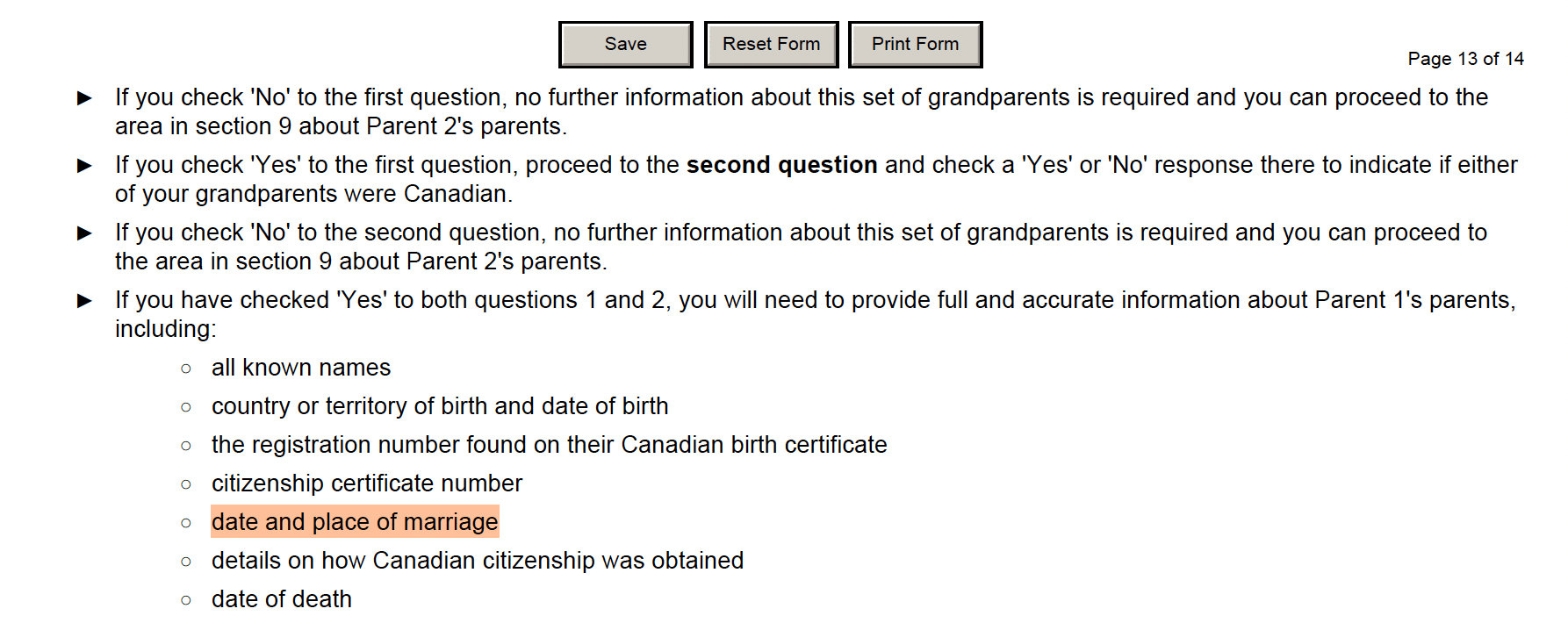
In the most recent update as of the time of publishing, IRCC has also cut the matching line from the instructions on page 13 of the form, where the department had asked for the same detail since January.
Following this change, you won't find grandparents' marriage details requested anywhere else in the package either. IRCC leaves them out of the form, the instructions, the document checklist, and the instruction guide.
At the time of writing, the department made no announcement or comment on the change.
Note that an officer can still ask about a grandparent's marriage while processing your application, and for some claims, the answer and supporting evidence decide whether citizenship is passed down.
For example, in cases where an applicant’s Canadian ancestry runs through a female ancestor (like a grandmother), a marriage certificate can be a crucial supporting document to explain name changes from a maiden name to a marital surname. This is covered in greater detail below.
Check which version you're holding
Two versions of the CIT-0001 form carry the same footer: CIT 0001 (08-2026) E. IRCC swapped the contents but left the revision code unchanged.
If you downloaded CIT-0001 on August 25 or 26, you have the earlier version that still includes the marriage fields.
How to check
Turn to Section 9 on page 5. Under Parent A and Parent B of Parent 1, look for a field marked date and place of marriage. If those sections appear as shown in the images below, you're on the earlier version.
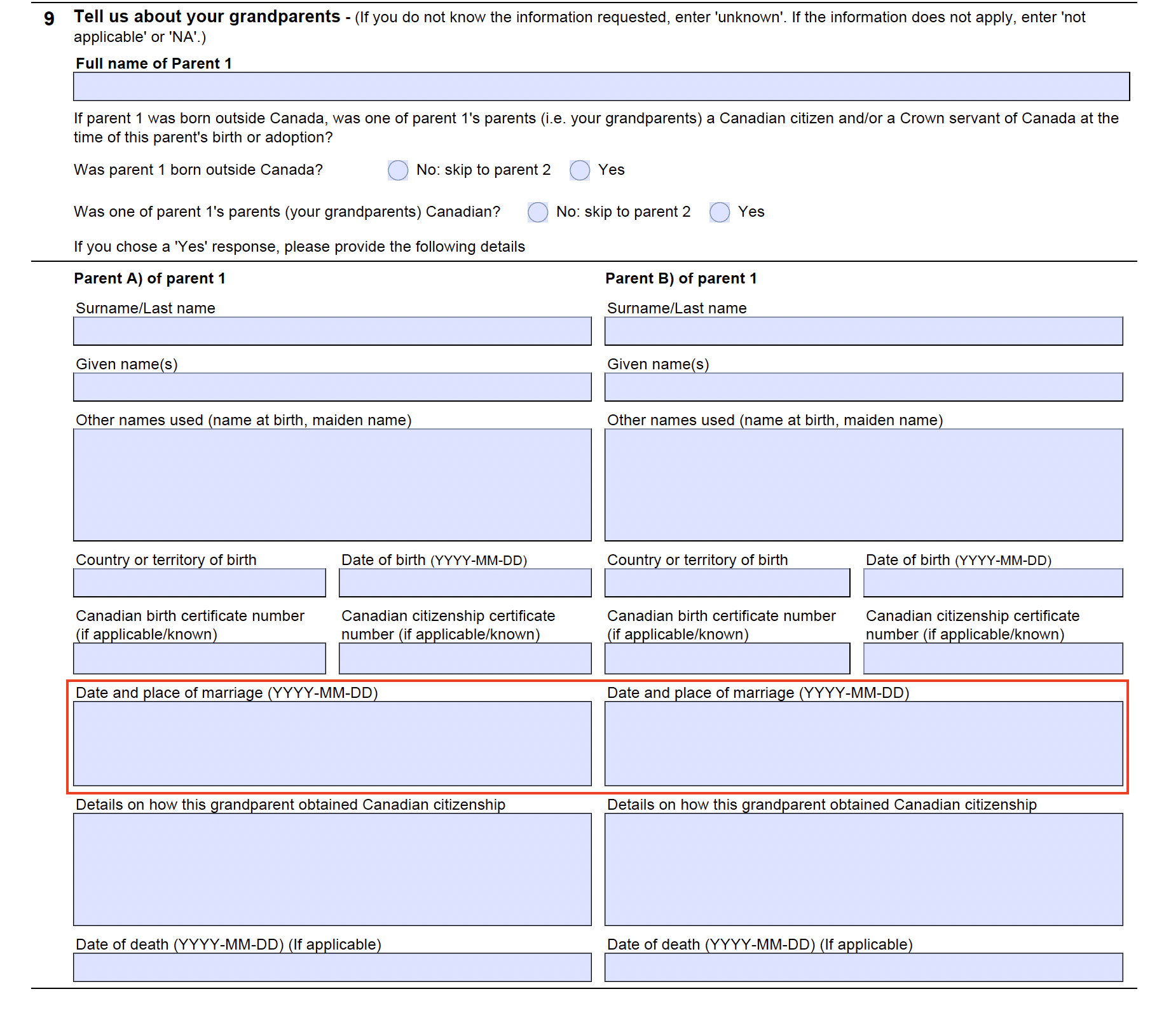
Page 13 carries a similar tell in the instruction list.
Submitting the earlier form won't get your application returned. It asks for one extra detail, and answering it does no harm. That said, it’s best to work from the current form for accuracy, and download a fresh copy before you file.
Get a Free Consultation on Applying for Proof of Canadian Citizenship
IRCC retains the ability to request these documents
The document checklist (CIT-0014) says IRCC "may ask you for further information or documents when processing your application," under the Citizenship Act and the Citizenship Regulations. This line remains unchanged and is still in force.
IRCC also instructs its officers to verify the "possibility of loss of Canadian citizenship or British subject status" before they approve any proof of citizenship application. Marriage is one route to that loss (covered in further detail below).
If you are applying soon, it is worth noting that the form asks you for "the fullest and most accurate information about your parents and grandparents," and warns that without enough information about your parents or grandparents, it may delay your application or find itself unable to assess your claim.
IRCC has taken the question off the form but left the ability for inquiry with the officer. You may hear about it months into processing rather than while you work through Section 9.
Marriage comes up elsewhere on the form. Section 8 asks for both parents' date and place of marriage. Section 12 asks applicants born before 1950 about their own marriage before 1947.
Why a grandmother's marriage still matters: the name link
For most applicants, the reason to keep a grandmother's marriage record has nothing to do with the removed field.
It is about her name. A woman often appears under her maiden name on her own birth or baptismal record and under her married name on her child's. To an officer, those can read as two different people, and a break in the chain of names stalls an otherwise solid claim.
The marriage record is what proves the two names belong to one woman.
This holds whether or not the form asks for it. If your line runs through a grandmother, include her marriage record and let it carry the name from one generation to the next. It is often the single document that keeps the chain intact.
If your claim runs through a grandmother who married before 1947
Before January 1, 1947, a woman could gain British subject status through her husband, and she could lose it the same way. Subsection 11(2) of the Citizenship Act gives women in that position a route back.
If your claim to citizenship by descent traces through a grandmother who married before that date, her marriage may decide whether status passed to your parent. IRCC no longer asks about it on the form, and an officer will look for it anyway.
In these cases as well, a marriage certificate can also be a crucial supporting document to detail a name change and explain a discrepancy in names between documents.
In such cases, these details may be a crucial part of the application. The form tells you to use an extra sheet of paper for anything that doesn't fit, and to note which question you're answering.
A request for more information adds months to a file that already carries a processing time of 25 months at the time of writing.
If you've already applied
Based on the current application form, previous applicants may not be penalized if they left the marriage details of their grandparents undisclosed within CIT-0001—though, as noted, IRCC can always ask for more details on a case-by-case basis.
Applicants who included this information are unlikely to see any pushback from the department. Extra information doesn't make an application incomplete, and IRCC won't return your file over it.
The department will contact you if it needs more information. The declaration in Section 16 commits you to tell IRCC if any information on the form changes before processing ends, so keep your address, email, and phone number current.
Do you have a Canadian ancestor?
If a parent, grandparent or earlier ancestor was born or naturalized in Canada, you may hold Canadian citizenship already. The certificate confirms that status.
CanadaVisa's citizenship by descent eligibility checker can show you which generation your claim runs through.
Get a Free Consultation on Applying for Proof of Canadian Citizenship
- Do you need Canadian immigration assistance? Contact the Contact Cohen Immigration Law firm by completing our form
- Send us your feedback or your non-legal assistance questions by emailing us at media@canadavisa.com