You don’t need French to read the Quebec baptism record behind your citizenship claim

At first glance, a Quebec parish baptism record—one of the most important documents (where needed) for a citizenship by descent claim—looks like an impenetrable wall of 19th-century French cursive.
However, underneath the handwriting sits a form with a determined structure. Priests across Quebec wrote these entries to a fixed template.
The Church set the rules, and so did civil authorities, first the French Crown and later the province. The same facts sit in the same order, act after act, parish after parish.
Learning which slot holds which fact can enable you to read most Catholic parish acts without knowing French.
This article covers all the essential information that citizenship by descent applicants will need to identify and read their ancestor’s baptismal record.
Get a Free Consultation on Applying for Canadian Citizenship by Descent
Start with the margin
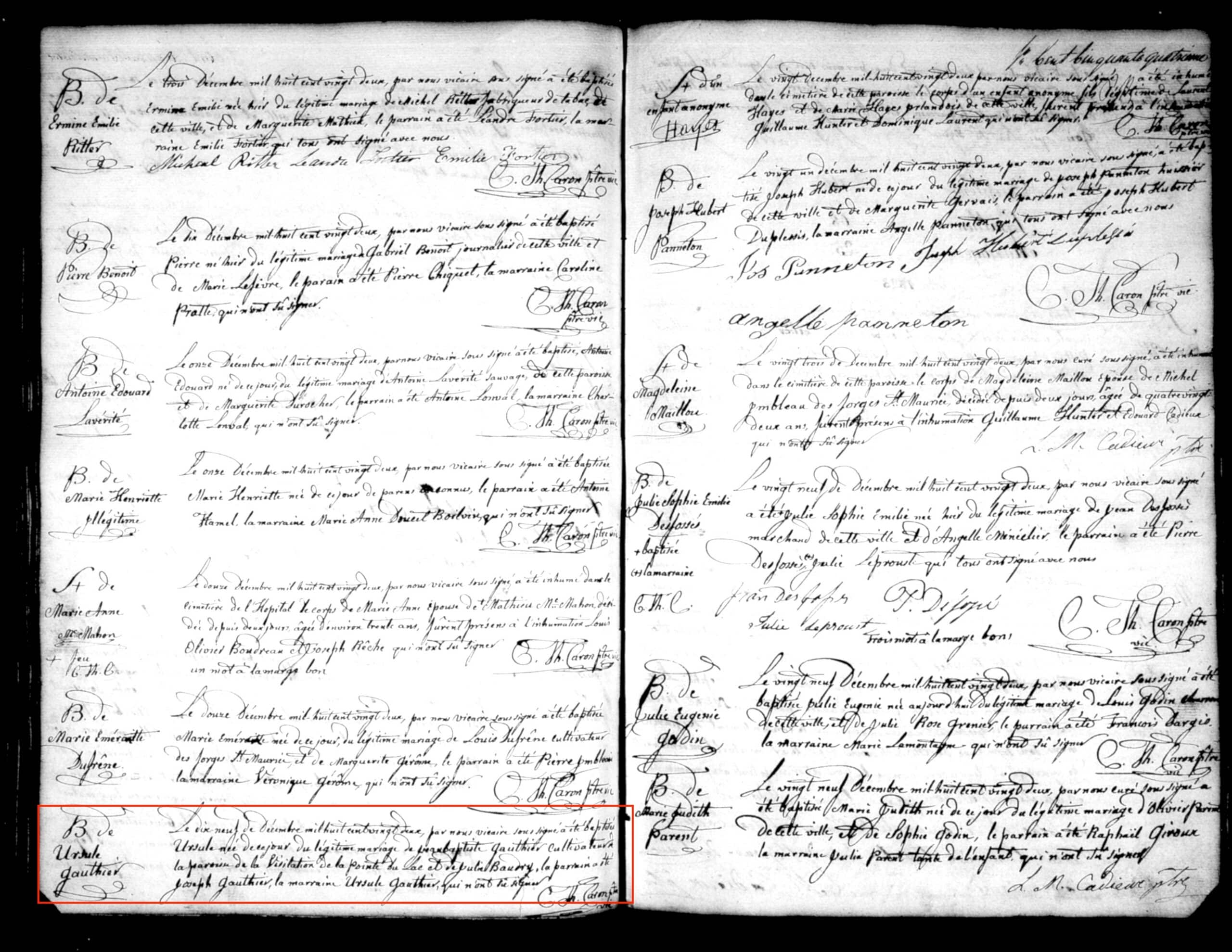
Canada, Québec, registres paroissiaux catholiques, 1621-1979", FamilySearch (https://www.familysearch.org/ark:/61903/1:1:JDR2-QL5 : Thu Oct 23 15:58:14 UTC 2025), Entry for Ursule Gauthier and Jean Baptiste Gauthier, 19 Dec 1822.
The page above holds a month of entries from one Quebec parish. Your search will turn up a page like this one rather than a tidy certificate.
Look at the left margin of each entry. There's a letter:
- B stands for baptême, a baptism.
- S stands for sépulture, a burial.
Priests mixed the two in the same book. On this page, a baptism sits above a burial in the same hand. Read the letter before you read anything else, because it tells you whether you're holding a birth record at all.
The name beside the letter is the person the entry concerns. Use it as your index.
The six factors, in the order you'll read them
Take the last entry in the left column (highlighted in red), for Ursule Gauthier. The other acts on the page follow the same shape.
- The date. Le dix-neuf de décembre mil huit cent vingt-deux. Priests wrote dates in words, never numerals. That one reads 19 December 1822.
- The verb and the name. Look for baptisé or baptisée, then the name. Here, baptisée Ursule. The final "e" tells you the priest baptized a girl.
- The birth reference. Née de ce jour means born this day. Elsewhere on the page you'll find née hier and née aujourd'hui. All three put the birth within a day or two of the baptism.
- The parents. Du légitime mariage de means of the lawful marriage of. Then the father, his trade, his parish, and the mother. Here: Jean-Baptiste Gauthier, cultivateur, of the parish of la Visitation de la Pointe du Lac, and Julie Baudry.
- The godparents. Parrain is godfather, marraine is godmother. Joseph Gauthier and Ursule Gauthier (who the child is presumably named after in this example) stood for this child.
- The signatures. Qui n'ont su signer means who did not know how to sign. The priest then signs alone.
The parents' line deconstructed
Quebec priests recorded the mother under her maiden name rather than her married name. That hands you her family line without a marriage record to bridge the gap.
The father's trade follows his name. This page alone gives you cultivateur (farmer), journalier (day labourer), huissier (bailiff), and marchand (merchant). One father appears as a tobacco maker. These additional names can also derive from other factors, and are often referred to as dit names.
His parish comes next. De cette paroisse means this parish, the register's own. Jeanbaptiste Gauthier's act names a different parish, which tells you his family came from elsewhere.
Also of note, one act on this page has no parents at all. The margin reads illégitime, and the entry says de parens inconnus, of unknown parents.
Am I looking at the right person?
Reading the words and identifying the family are two different jobs, and the latter can be especially difficult.
Quebec parishes were small, and families were large. Cousins shared a surname, a given name, and a church. As we can see in the above example as well, it was not uncommon for children to be named after their parents, godparents, or other relatives, further complicating matters.
A simple solution for this is not relying solely on the child's name. Match both parents, then use the father's trade and parish as tiebreakers. If those line up and the date fits your family's timeline, you likely have the right act.
Watch for one factor: The parish often doesn't appear in the entry at all. The act says de cette paroisse and assumes you know which one. You'll find the parish named at the front of the register, and in the indexed record if a database led you there.
The name on the record probably isn't the name they used
Until the late 1960s, Quebec priests baptized Catholic children with two or three given names in a set order.
The first was Marie for a girl or Joseph for a boy (this can be seen in other examples on the same document). It marked the child's sex, and the family called the child something else.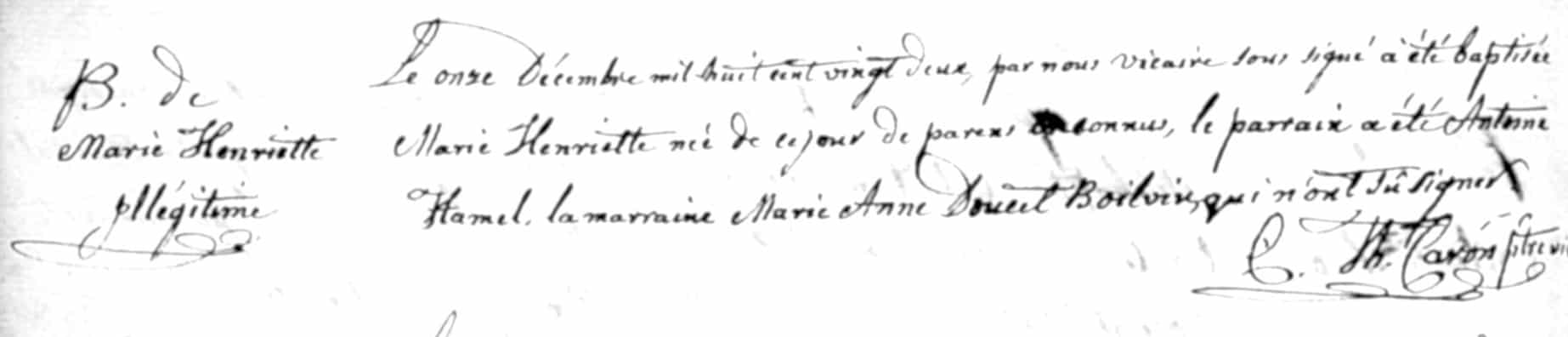
The second name often came from the godparent. The third was the everyday name.
The second entry in the right column shows how this worked. The priest baptized the child Joseph Hubert. The godfather signed as Joseph Hubert Duplessis.
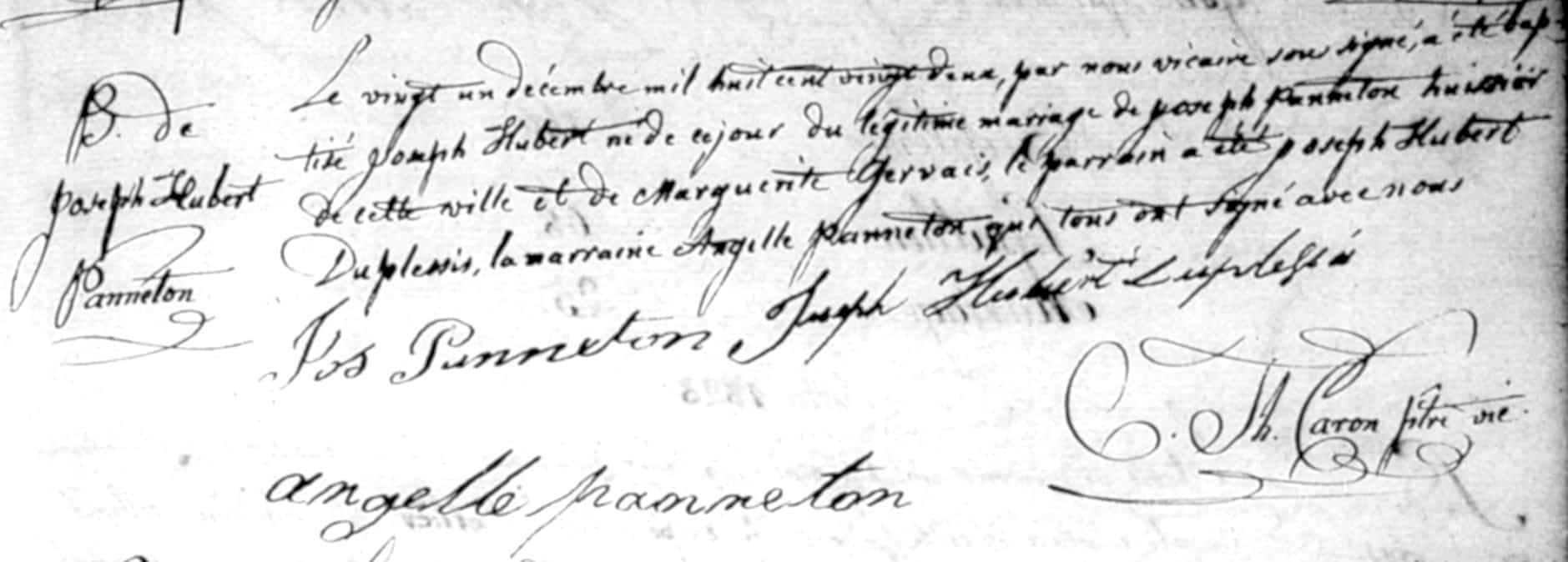
A girl recorded as Marie Henriette may have gone by Judith her whole life. Sometimes a priest wrote down one or two of the names. Sometimes an entirely different name shows up in later records.
That gap between the register and the rest of a person's paper trail can produce mismatches across generations, and Immigration, Refugees and Citizenship Canada (IRCC) flags them. Name discrepancies rank among the most common problems in citizenship by descent applications.
Common discrepancies and differences
Despite the standardized format that these records keep, there are some common differences and discrepancies that citizenship by descent applicants should be aware of.
- Corrections. A priest who fixed a word noted it at the end. Trois mots à la marge bons means the three words added in the margin are valid.
- Unnamed children. A child who died before baptism appears as enfant anonyme.
- Different hands. Each act names its author near the start: par nous vicaire or par nous curé. A curé runs the parish, and a vicaire assists him. Both wrote acts on this page. The handwriting changes, and the template holds.
- Non-French families. Irish, German, and Scottish names run through Quebec registers, all recorded in French.
- Latin and other faiths. Priests kept some early registers in Latin. Protestant denominations and Jewish congregations kept their own civil registers under different conventions.
Important considerations when using a baptism record in support of a citizenship by descent application
IRCC won't accept Quebec birth or marriage certificates issued before January 1, 1994. The issue date decides this, not the date of the event.
If someone printed your Quebec document before 1994, you order a new one. Quebec decides which office produces it based on the age of the event. BAnQ, the Bibliothèque et Archives nationales du Québec, holds records more than a century old. The Directeur de l'état civil holds the recent ones.
Our guide to Quebec documents covers both routes, and the 1994 rule has its own explainer.
IRCC also asks that your documents come from the authority that created or keeps the record, and that the issuer appears on the document. If you can't produce a record, IRCC asks for a written explanation and proof of what you tried.
BAnQ doesn't issue a modern birth certificate for the pre-1994 period. It issues a certified copy of the baptismal act from the parish register.
You can view Quebec parish records through FamilySearch, GenealogyQuebec, the Drouin Collection, and BAnQ's own digital collections. If you haven't found your ancestor's act yet, start there.
Think you have a claim? It takes 30 seconds to check. Visit CanadaVisa's citizenship by descent calculator.
Get a Free Consultation on Applying for Canadian Citizenship by Descent

- Do you need Canadian immigration assistance? Contact the Contact Cohen Immigration Law firm by completing our form
- Send us your feedback or your non-legal assistance questions by emailing us at media@canadavisa.com