Eight clues in your family history that could mean you’re a Canadian citizen by descent

Since Bill C-3 took effect on December 15, 2025, tens of thousands of Americans have been discovering that they are Canadian citizens every month.
This includes some who previously had no idea their family line ran through Canada.
There are very few factors that guarantee Canadian citizenship. But some situations carry stronger odds than others.
Check Your Eligibility for Canadian Citizenship
Here are eight clues that your shot at a second citizenship – and, by default, a Canadian passport – is stronger than you realize.
1. One of your ancestors was born in Canada
You have four grandparents and eight great-grandparents. If a single one of them was born on Canadian soil, you have the strongest clue on this list. Go back further and the odds keep improving, since the number doubles each generation, to 64 by your great-great-great-great-grandparents, and only one of them needs to be Canadian.
In most cases, being born in Canada grants Canadian citizenship automatically. It makes no difference if someone left at the age of two and never went back, or was only born there because their mother happened to be in Montreal that month.
Until December 15, 2025, in cases where two generations are born abroad, that citizenship could only be passed down one generation. Bill C-3 removed the limit. Citizenship still passes only from parent to child, so you need a direct line, with every person between you and that ancestor being the child of the one before, but there is no longer a cap on how many generations that line can run. If you were born outside Canada before that date, you may already be a citizen through an unbroken line of parents running back to that ancestor.
2. Your family has roots near the US-Canada border
The US-Canada border was far more porous than most people assume. Families crossed it for various reasons, including for work.
In some cases, women also crossed it to access better maternity units in hospitals, which led to the phenomenon known as border babies. In the 1940s, roughly a third of babies born at Chipman Memorial Hospital in St. Stephen, New Brunswick reportedly had American mothers.
Obviously, being from a town that’s on the border, on its own, does not automatically make you a Canadian citizen. It may, however, increase the odds that someone in your ancestry previously lived or was born in Canada.
3. You have a French surname
Gagnon, Tremblay, Bouchard, Ouellet, Lévesque. These are the obvious ones.
Then there are names worth closer attention to because they got translated out. For example, Leblanc became White and Boisvert became Greenwood.
CIC News has published a list of old French-Canadian surnames that could mean someone is a secret Canadian. Some families also dropped half of a two-part “dit” name, so a Roy dit Desjardins ancestor could leave descendants named only Roy or only Desjardins.
It is worth pointing out that a French surname could also point to French ancestry, which is not the same thing as Canadian ancestry. Some of these families reached the United States from France, without ever passing through Quebec. The surname tells you where to dig, but it is not conclusive proof of finding Canadian ancestors.
4. You live in a New England state
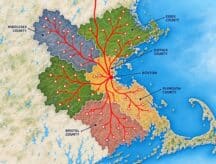
The northeast holds the densest concentration of Canadian ancestry in the US, and it is no accident. Close to a million French Canadians left Quebec for the mills of New England between 1840 and 1930, in a migration now known as the Great Hemorrhage. Their descendants stayed.
New Hampshire, Vermont and Maine lead every in self-reported Canadian ancestry, and in parts of New England the share of residents with a plausible claim may run as high as one in four.
Keep in mind that while having roots in New England may improve your chances of having a French-Canadian ancestor, it is in no way a guarantee.
Trace your family lineage with the Family Line Explorer
5. You have a grandparent (or older relative) who is fluent in French
French-Canadian families who moved south usually kept the language going for generations.
If the oldest people in your family still speak it, or went by Mémère and Pépère rather than grandma and grandpa, that may be an indicator.
Speaking French is not the same as having Canadian ancestry. The line may run back to other countries such as France or Belgium. What the language gives you is a reason to go looking for an ancestor, and their country of origin.
6. Your family lived in Canada, or still talks about their time “up north”
Being born in Canada is not the only way an ancestor could have become Canadian. An immigrant who settled in Canada and naturalized there holds the same value to your claim as someone born in Montreal, provided the naturalization took effect before the next child in your line was born.
That opens the door to families who passed through Canada rather than started there. For example, a great-grandfather who arrived from Poland or Ukraine, spent twenty years in Winnipeg, then moved south.
Living in Canada is not the same as holding status there. Plenty of families worked a few seasons across the border and never naturalized. What you need is the date their citizenship status took effect, and whether it came before the next birth.
7. A close relative recently found out they were Canadian
If someone in your family has been recognized as a Canadian citizen through an ancestor you also descend from, they have done most of the hard work for you. They identified the ancestor, tracked down the records, and got IRCC to accept them.
Their certificate means the government has already accepted that this ancestor was Canadian. What you need to do now is show is your own line back to the same person, and much of the paperwork will be the same as theirs. CanadaVisa has an online tool you can use, in case you find yourself in a similar scenario.
This does heavily depend on who the relative is. For example, a sibling shares your parents, so their result is a strong signal.
A first cousin may descend from a different grandparent, in which case their claim runs along a branch of the family that is not yours. CIC News has looked at which relatives can support a claim and which cannot.
8. A relative applied before December 2025 and was told no
Some families knew about the Canadian ancestor all along. They applied, and they were refused, often because of the first-generation limit that capped citizenship by descent at one generation born abroad. A letter arrived, the file went in a drawer, and the matter was treated as closed.
Bill C-3 removed that limit on December 15, 2025. An application that failed due to the first-generation limit may be approved today.
Where this leaves you
None of these clues makes you a Canadian citizen on its own.
Several things have to line up: whether your ancestor held Canadian status, whether they held it on the day the next child in the line was born, whether anything broke the chain in between, and how the law applied at each generation.
If something on this list sounds familiar, CanadaVisa’s citizenship by descent calculator can point you in the right direction.
If you already know the ancestor and the dates and want someone to read the line properly, you can speak to an immigration lawyer.

- Do you need Canadian immigration assistance? Contact the Contact Cohen Immigration Law firm by completing our form
- Send us your feedback or your non-legal assistance questions by emailing us at media@canadavisa.com