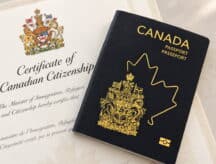
You have 64 great-great-great-great-grandparents. If even one was Canadian, you might be too

If you're an American hoping to get a Canadian passport now that Canada has removed the generational limit for inheriting Canadian citizenship, mapping your genealogy back additional generatons can increase your odds exponentially.
Go back four generations and you have 16 ancestors to check. Go back five and you have 32. Go back six and you have 64. The further back you go, the higher the odds that at least one of them crossed a border, changed a name, or left a province that is now part of Canada.
Since Bill C-3 took effect in December 2025, thousands of Americans have been doing exactly this kind of search.
You need only find one record, one ancestor, to open a path to Canadian citizenship for your entire family.
Already found a Canadian ancestor? Check your eligibility in 30 seconds
Search the free databases (a few hours)
Once you have a plan, the records are often free:
Library and Archives Canada has searchable census records from 1825 to 1931. Search by name, province, or district. The census records show country of birth, parents' birthplaces, religion, and year of immigration. A single entry can reveal a Canadian-born ancestor in an otherwise American family.
FamilySearch holds billions of indexed records across both countries, including Quebec parish records and New Brunswick vital records. Free with registration.
The US National Archives holds federal census records from 1790 to 1950. The years 1880 to 1940 are most useful — they record country of birth and parents' birthplaces. A French-Canadian who crossed into New England in the 1890s would show "Canada" as birthplace.
For Quebec ancestry specifically — the most common Canadian connection for Americans — GenealogyQuebec.com is a specialized paid database with parish records going back centuries. The Drouin Collection, available free through Ancestry's library edition at many public libraries, holds nearly 60 million Canadian records including Quebec church records.
Already found a Canadian ancestor? Check your eligibility in 30 seconds
Where to focus first
Not all branches of your tree are equally likely to hit Canada. Prioritize any branch with French-sounding surnames (Tremblay, Gagnon, Bouchard — or their anglicized versions: White for Leblanc, King for Roy, Carpenter for Charpentier). Family roots in New England, upstate New York, Michigan, Wisconsin, or Louisiana are strong signals. So are older relatives who spoke French, attended a Catholic parish, or mentioned family "from up north."
If you have none of those clues, trace all branches. The math works in your favor the further back you go.
Already found a lead? It takes 30 seconds to check your eligibility. Visit CanadaVisa's citizenship by descent calculator.
Talk to your family (one Sunday afternoon)
Before you go deep into archives, pick up the phone. Grandparents, parents, aunts, and uncles hold information that never made it into any database — the province a great-grandparent came from, a religious affiliation that points to a specific Quebec parish, a maiden name that changed when the family crossed the border.
Ask open-ended questions: Where did the family come from before they lived here? Were there relatives who stayed behind in Canada? Does anyone remember a different version of the family name? Then check the unofficial family archives — attics, filing cabinets, family Bibles, old photo albums. An ancestor described as "formerly of Saint John" in a 100-year-old obituary can point your entire search in the right direction.
Know the pitfalls before you apply
Finding your ancestor is step one. Proving the chain to the Canadian citizenship department, Immigration, Refugees and Citizenship Canada (IRCC), is step two — and it's where most people get tripped up.
Short-form birth certificates aren't enough on their own. IRCC requires a long-form birth certificate for every person in your generational chain — you, your parent, your grandparent, all the way back. Short-form wallet cards typically don't list parents' names, so IRCC can't establish the parent-child link. If you only have a short-form, don't panic — but you'll need to order the long-form version from the relevant vital statistics office before applying. In some cases where a long-form isn't available, additional supporting documentation may be accepted.
Name changes break the chain. Over three or four generations, surnames get anglicized, women change names through marriage or divorce, and clerical errors alter spellings. If the surname on a Vermont birth certificate from 1980 doesn't match the surname on a Quebec birth certificate from 1920, IRCC will flag it. You need "connective tissue" that explains each discrepancy — marriage certificates, divorce decrees, legal name change orders, court orders, or adoption records. Gather these for every generation where a name doesn't match.
Pre-1994 Quebec certificates aren't accepted. Before 1994, Quebec vital records were maintained by the Catholic Church, not the government. IRCC does not accept birth or marriage certificates issued by Quebec before January 1, 1994. You need a re-issued certificate from the Directeur de l'état civil du Québec, or for older parish records, a certified reproduction from Quebec's national archives, the Bibliothèque et Archives nationales du Québec (BAnQ). This is one of the most common bottlenecks in Quebec-lineage applications, and an area where working with experienced legal counsel can save significant time and frustration.
Records are provincial, not national. There is no national vital statistics office in Canada. You request from the specific province where the birth was registered: Service New Brunswick for New Brunswick, ServiceOntario for Ontario, the Nova Scotia Vital Statistics office for Nova Scotia. Each has its own fees and processing times.
Archives are overwhelmed. Quebec's BAnQ went from 32 requests for certified copies in January 2025 to over 1,000 in January 2026 — most from Americans. CNN reported 1,500 in February alone. Archives in New Brunswick, Ontario, and British Columbia are reporting similar surges. Start now — the line is getting longer.
The payoff
The search itself can take as little as 30 minutes or as long as several weeks, depending on how well-documented your family's history is. But the reward scales across your entire family. If you qualify, your siblings almost certainly do too — and so do your cousins, their children, and anyone else who descends from the same ancestor. One discovery can unlock Canadian citizenship for dozens of family members.
Already found a Canadian ancestor? Check your eligibility in 30 seconds

- Do you need Canadian immigration assistance? Contact the Contact Cohen Immigration Law firm by completing our form
- Send us your feedback or your non-legal assistance questions by emailing us at media@canadavisa.com