
BREAKING: Proof of Canadian citizenship wait reaches 34 months in October, as queue shrinks for the first time


A new application for proof of Canadian citizenship now takes 34 months to process.
Immigration, Refugees and Citizenship Canada (IRCC) updated its processing times tool on October 9, adding one month to September’s figure of 33 months.
Get a Free Consultation on Applying for Proof of Canadian Citizenship
That single month is the smallest increase since the wait began climbing in May of 2026.
IRCC also reported fewer people in line month-to-month, for the first time since Canada expanded its Citizenship Act in December 2025. The department now counts 130,700 applicants awaiting a decision, down 5,300 from September’s 136,000.
Both readings break the pattern of the past five months.
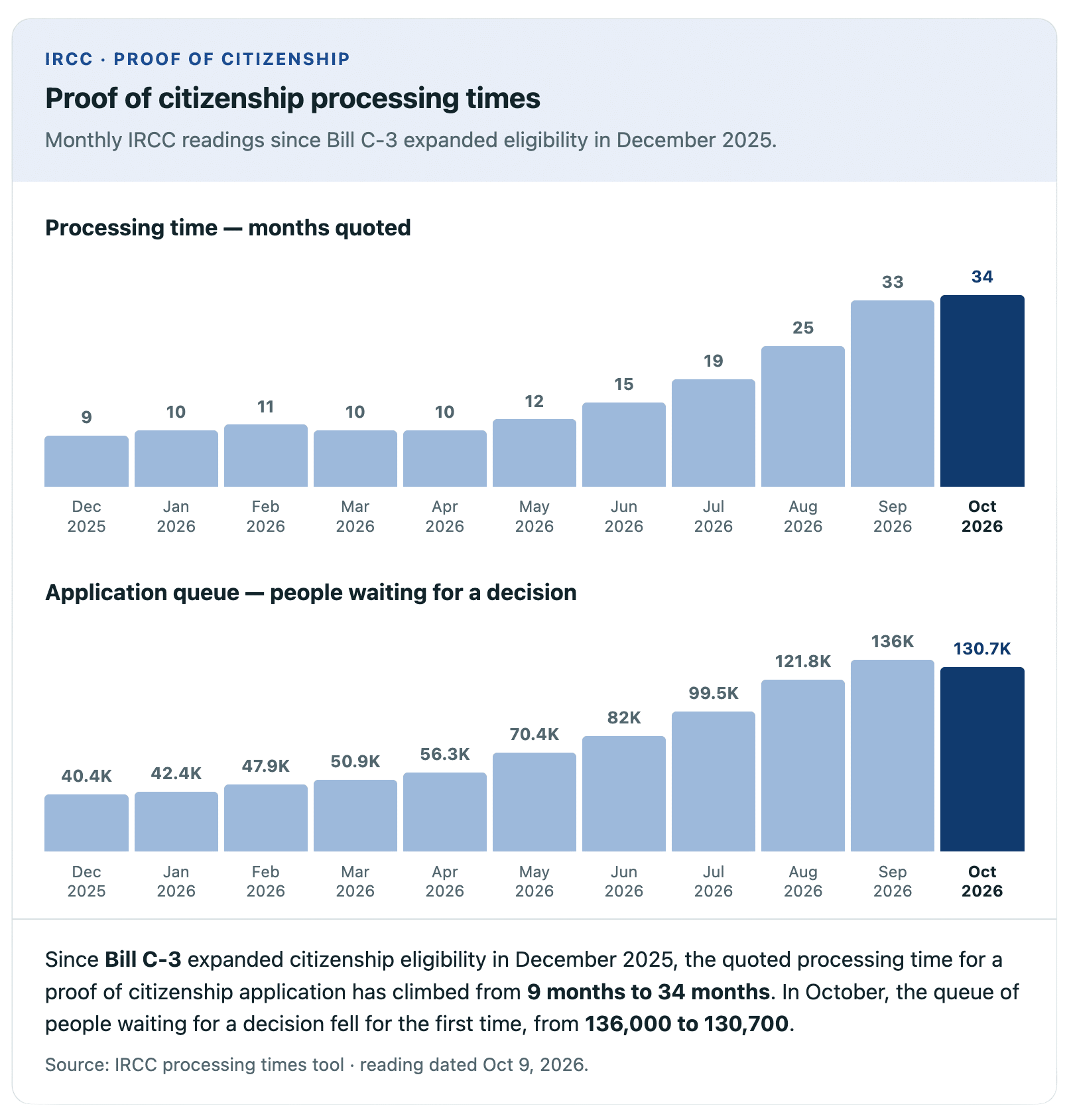
How does this increase in wait times compare to previous months?
Every increase from May through September landed larger than the one before it. September added eight months on top of August’s 25. October added one.
| Reading | Quoted wait | Increase | Month-over-month increase |
|---|---|---|---|
| May 2026 | 12 months | +2 months | 20.0% |
| June 2026 | 15 months | +3 months | 25.0% |
| July 2026 | 19 months | +4 months | 26.7% |
| August 2026 | 25 months | +6 months | 31.6% |
| September 2026 | 33 months | +8 months | 32.0% |
| October 2026 | 34 months | +1 month | 3.0% |
In percentage terms, October’s rise comes to 3.0%, against 32.0% a month earlier.
The quoted wait has fallen once before. IRCC trimmed it from 11 months to 10 in March 2026, before the summer climb began, with wait times tripling since then.
More applications cleared than new applicants added, for the first time since the law changed
IRCC counted 130,700 people waiting for a decision in October, down from 136,000 in September.
Every earlier reading of the citizenship department’s application queue (since the introduction of Bill C-3 into formal Canadian law) saw the line of applicants continue to grow at a rapid clip. August brought the largest single jump at 22,300 files. September added 14,200.
A smaller queue means IRCC finalized more applications over the period than it received. The department hasn’t said what drove the change.
Importantly, one reading does not establish a trend. The queue would need to fall again in November to show the application queue truly changing course.
Can I get my application processed faster?
IRCC can process some certificate applications ahead of the queue. The department calls this urgent processing, and it reviews each request on its own facts.
IRCC lists eight circumstances where it may expedite an application for proof of citizenship. You can use our free tool below to check whether you may fit into any of the approved situations.
A request for urgent processing needs a letter explaining why you need the certificate sooner, along with documents supporting that explanation. IRCC names a plane ticket or itinerary with proof of payment, a letter from an employer, a letter from a school, a doctor’s note, and a death certificate among the documents it accepts.
IRCC states that meeting the criteria carries no guarantee. The department won’t process an incomplete application, and a request falling outside the criteria leaves your file at the normal pace.
A clean, complete, well-documented application that documents attempts made to find any missing documents, and explains any gaps in a descent line (if applicable) is typically still processed faster than one that does not. Missing records and name mismatches across generations send applications back for more documentation, and each round trip adds to the wait.
American historical records and documents can carry some of that evidentiary weight when Canadian ones are hard to find.
Why did the queue grow this large?
On December 15, 2025, Canada removed the first-generation limit on citizenship by descent for anyone born before that date.
The rule change means a person with an unbroken line to a Canadian ancestor is a Canadian citizen today. They can apply for proof of that citizenship no matter how many generations sit between them and the ancestor.
That opened a door for millions of Americans with Canadian ancestry, and applications have arrived in growing numbers every month since.
What determines the processing time?
IRCC builds its estimate from the number of files sitting ahead of a new application, along with staffing and the volume it expects to receive.
A review of already-issued certificates cost the department part of its output earlier this year. IRCC paused finalizing citizenship by descent applications for about a month while it checked the documentation behind certificates it had already approved. The department closed that review on June 30 and resumed processing.
Should I wait to apply?
Waiting rarely helps anyone who qualifies for citizenship by descent.
IRCC counts the files ahead of an application on the day it arrives. Someone who applies in January steps in behind everyone who applied through the autumn, and the queue has grown by roughly 90,000 people since the law changed.
Am I a Canadian citizen?
Anyone born before December 15, 2025 who can trace an unbroken line to a Canadian grandparent, great-grandparent, or a more distant ancestor may hold Canadian citizenship now.
Birthplace outside Canada doesn’t matter. Neither does whether that ancestor held a Canadian passport, lived in Canada as an adult, or kept lasting ties to the country.
The Canadian citizenship certificate confirms the status they already hold and unlocks the benefits that come with it, including a Canadian passport.
If you aren’t sure whether you qualify, you can check your eligibility with CanadaVisa’s citizenship by descent eligibility checker.
Get a Free Consultation on Applying for Proof of Canadian Citizenship

- Do you need Canadian immigration assistance? Contact the Contact Cohen Immigration Law firm by completing our form
- Send us your feedback or your non-legal assistance questions by emailing us at media@canadavisa.com