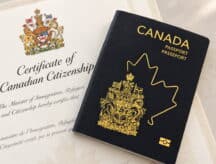
Canada asks new citizens to hand back their citizenship certificates

Recent applicants under Canada’s expanded citizenship laws are facing renewed scrutiny from the government, after their citizenship application has been approved.
The most recent amendment to the country’s Citizenship Act enabled a wave of applications for citizenship by descent, some of which are now facing pushback from the federal government.
On the afternoon of June 13, Canada’s citizenship department sent emails to recent recipients of a Canadian citizenship certificate across the United States.
Get a Free Consultation on Applying for Proof of Canadian Citizenship
These were people who already held a Canadian citizenship certificate. Some even had a passport and a Social Insurance Number, in anticipation of an imminent move to Canada.
The letter told them their citizenship claim, once approved, was now "under review."
This article will cover the best practices that applicants can use to remedy the situation should they have already received a refusal letter, and how to avoid these pitfalls in their citizenship application altogether.
What the letter says
The letters cite subsection 26(1) of the Citizenship Regulations. This is the rule that lets the Registrar of Canadian Citizenship ask a person to surrender a citizenship certificate (one of the few documents that enables a new Canadian citizen to obtain a passport) when there is reason to believe they may not be entitled to it.
This process is not a revocation of citizenship (though it can lead to one), but it is a review. The letter asks for the paper certificate back while their application file is re-examined, in practice suspending the document even though the applicant is still considered a Canadian citizen.
It also says that the recipient of the letter can respond with more documentary evidence in support of their application.
If entitlement is confirmed, the certificate will come back.
The forced surrender of a Canadian's citizenship certificate may be unconstitutional, according to some experts.
Why did these files get flagged?
The letters from Immigration, Refugees and Citizenship Canada (IRCC) give two reasons why these applications were flagged for review.
First, the documents submitted did not come from the source authority: the civil registry, the vital statistics office, provincial archive, or another official body that creates and holds the record needed to support a citizenship application.
Looking for a guide on how to obtain the needed descent documents from the province of Quebec? Visit our dedicated webpage to get all the details.
Second, when an applicant could not get a source document, they did not include a written explanation and proof that they had tried to obtain said documents.
Read against what citizenship by descent applicants describe as submitted, the cause for concern on the part of the citizenship department is generally that applicants do not adequately prove an unbroken lineage (through the appropriate documentation) from a Canadian citizen to themselves.
In other words, these surrender letters have been served to applicants who are Canadian but haven't proven it the way the government needs.
Common trends among those who were flagged
Based on information they have submitted to citizenship forums, the people who received these surrender request letters tend to fall into a few groups.
Some used printouts from Ancestry or FamilySearch as their main proof for an ancestor. Some had certified records but from an archive rather than a vital statistics office, and now wonder whether an archive counts.
Some had a real gap; no birth record exists for an ancestor born in the 1850s, but they never formally documented the gap to IRCC in their application.
What can I do if I have already received a letter?
Individuals who have received a surrender letter are usually told explicitly what factors have raised an immigration officer’s suspicions, and they can still submit further documentary evidence in support of their application.
In the referenced round of issued letters, the two reasons cited (1. submitting “documents not from an original source authority”; and 2. missing explanations for unavailable records) point straight at the fix.
Utilizing the best practices covered in the previous section and carefully documenting any gaps in the supporting documentation proving your line of descent will already put your application on a significantly stronger footing.
If your citizenship certificate was printed, the letter asks you to return it during the review. If you received an electronic copy, there may be nothing to send back. The letter does not give a timeline for processing, which is generally slow (on the order of multiple months), so keep copies of everything you submit.
This is also the point where many people seek professional help.
An immigration lawyer who works under the Bill C-3 framework and knows what IRCC accepts as source documentation can help assemble a file that holds up the first time or build a response to a surrender letter that addresses the exact gap.
Citizenship by descent is, in the end, a matter of proof. The people receiving these letters are not being told they are not Canadian. They are being told to prove it more rigorously than they did. That is a problem you can solve with the right documents.
How to avoid these pitfalls in your citizenship by descent application
Get documents directly from the source
A "source authority" is the office that originally created and keeps the record; a state or provincial vital statistics office, a civil registry, or, in older Canadian cases, a recognized provincial archive.
A scan of the same record from a subscription genealogy site is not the same thing, even when the image is identical. The genealogy site is a finding aid. The registry is the authority.
For each person in your line of descent, a good rule of thumb is at least one authoritative record that proves the link to the next generation. A birth certificate is the strongest single document in this regard. Where a surname changes, a marriage certificate carries the chain across the gap.
Missing even one document (a marriage certificate that explains a name change, for example) can stall or sink an application.
Get your records certified
A certified copy is one that the issuing authority stamps or seals as a true copy of what it holds. Canada has no single national vital records office, so most applicants order these from regional offices that vary by province and state.
It is slower than downloading a scan, but it can also be the difference between a record that speaks for itself and one that invites a question.
For our 10 lawyer-recommended tips on applying for citizenship by descent, read our dedicated article on the topic.
What can I do if the records I need do not seem to exist?
This is a common problem that many applicants face, and official government documentation and instructions are built to facilitate alternatives to this situation.
IRCC's own instruction guide tells applicants to include a letter of explanation for any missing or unclear documents. So the gap itself is not automatically a problem; a lack of an accompanying explanation is.
That proof of effort has a specific form. When a vital records office searches and finds nothing, it can issue a "letter of no record" — a formal statement that the record does not exist in its files.
IRCC runs a parallel process for its own records, issuing what it calls a "no record letter." This document confirms that the official authority is unable to find the needed document in question. Pairing a no-record letter with alternative evidence and a short-written explanation can help document gaps in your application in ways that are much more likely to satisfy an immigration and citizenship officer.
Get a Free Consultation on Applying for Proof of Canadian Citizenship

- Do you need Canadian immigration assistance? Contact the Contact Cohen Immigration Law firm by completing our form
- Send us your feedback or your non-legal assistance questions by emailing us at media@canadavisa.com