My ancestor moved to Canada from another country. Am I a Canadian citizen by descent?

You have always heard that part of the family came to the US from “up north.”
So, you start digging.
There is a Canadian link, but it is not the one you expected. Your ancestor arrived in Canada from another country – say Scotland or Ireland – lived there for decades, and then moved south to start a new life in America.
Get a Free Consultation on Applying for Proof of Canadian Citizenship
Every generation since has been born in America. You have never lived in or even visited Canada. Can you still be a Canadian citizen by descent?
In many cases, the answer is yes.
Having an ancestor who is born in Canada is a more secure route into a citizenship by descent claim but it is not the only one. An ancestor who immigrated there can also anchor a family's claim.
There are some important caveats though. That ancestor had to become Canadian at some point before they moved away. And it had to happen before the next person in the family line was born.
Every Canadian citizenship by descent claim runs back to one person, often referred to as an anchor ancestor, or generation zero. This is the ancestor whose Canadian status everyone after them inherits. It may be a grandparent, a great-grandparent, sometimes someone further back.
And, since Canada passed Bill C-3: An Act to amend the Citizenship Act last year, people born outside Canada before December 15, 2025 can claim citizenship through a Canadian ancestor no matter how many generations back that person is.
Your ancestor moved to Canada before 1947
Before January 1, 1947, people in Canada were generally held the status of British subjects, according to the Canadian government.
For example, an ancestor who arrived in 1912 and went through naturalization in 1920 did not become a “Canadian citizen.” They became a British subject instead.
However, if your ancestor moved to ‘Canada’ and naturalized as a British subject before 1947, they are seen as Canadian citizens.
In this case, the ancestor may be a Canadian citizen even if they left Canada before 1947, as long as it could be proved that they naturalized in Canada. That said, in such cases, proving the naturalization may be harder.
This also holds if your ancestor was a British subject with Canadian domicile on January 1, 1947. Domicile is a legal status rather than an address. It generally meant five years of residence as a landed immigrant.
As an example, for some American families, the shortest line back runs through Irish or Scottish ancestors who landed in Canada first and moved south afterwards.
Check Your Eligibility for Canadian Citizenship
Your ancestor moved after 1947
For an ancestor who immigrated after 1947, the route is a bit more straight-forward.
If they naturalized or were granted Canadian citizenship after, chances are they held a valid certificate that says so.
In these cases, apart from the document, you also need to check when the next generation was born.
For example, if your grandfather was naturalized in 1974, and his daughter was born in 1980, citizenship did pass down to her. However, if the same man had a daughter born in 1972, Canadian citizenship did not pass down to her, as he was not a Canadian citizen when she was born.
Newfoundland and Labrador runs on a different calendar. The province joined Canada on March 31, 1949, so lines traced through there are measured against 1949 rather than 1947.
It's worth noting that none of these routes guarantees that citizenship travelled all the way down to you.
Several things can interrupt a chain including renunciation, or losing British subject status.
Citizenship by descent records you can submit for an anchor ancestor not born in Canada
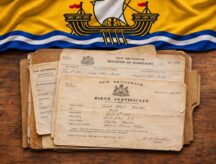
IRCC asks for two things for every link in the chain: proof of the relationship, and proof of that person's Canadian status.
That applies to your Canadian parent, grandparent, and any ancestor further back whose status your claim rests on.
Each document has to come from the authority that created or keeps the record.
In cases where an ancestor is not born in Canada, one or more of the following may be provided:
- a Canadian citizenship or naturalization certificate
- a Certificate of Retention of Canadian Citizenship
- a British naturalization certificate issued in Canada, or in Newfoundland and Labrador
- proof of British subject status before January 1, 1947, or before April 1, 1949 for Newfoundland and Labrador
- proof of landed immigrant status in Canada before those same dates
Where a provincial or territorial birth certificate does not exist, census records or a ship's manifest may be accepted. In this case, you need to also submit proof of your attempt to get a birth certificate, and a letter explaining why it could not be obtained.
Unsure whether you qualify?
If you are still unsure whether your anchor ancestor qualifies as Canadian, it’s best to start mapping down their journey, complete with dates of their milestones.
Look for documents that prove their time and status in Canada (such as those listed above).
Next, check whether their status arrived before or after the birth of the next generation in your family tree.
Who came to Canada, in what year, and is there any sign they took on Canadian status before the next child was born, are the most important questions to ask.
If you are unsure whether to start, CanadaVisa has a free eligibility checker that can give you a clearer read. Or you can speak to a licensed immigration lawyer for personalized guidance.
Get a Free Consultation on Applying for Proof of Canadian Citizenship

- Do you need Canadian immigration assistance? Contact the Contact Cohen Immigration Law firm by completing our form
- Send us your feedback or your non-legal assistance questions by emailing us at media@canadavisa.com