One ancestor, 37 new Canadians: How American families pass down Canadian citizenship by descent

Denise Mahoney brought a pecan pie and a laptop to Thanksgiving dinner in Dracut, Massachusetts. It was the day she found out her family may be Canadian.
The laptop was her daughter's idea. A week earlier, she'd sent Denise an article about Canada's new citizenship law. She suggested doing a little research with the extended family as a fun way to pass the time.
As it turned out, Denise's great-grandfather, Hormidas Charpentier, was born in Quebec. By her count, he may have passed Canadian citizenship down to 37 living relatives.
Get a Free Consultation on Applying for Proof of Canadian Citizenship
Editor's note: Denise Mahoney and her family are a fictional composite, based on real experiences of clients. Names and identifying details have been changed.
Canada changed its citizenship law on December 15, 2025. If you were born before that date, one Canadian ancestor may be enough, however far back they lived. So, if Denise's line to Hormidas holds, the retired labor-and-delivery nurse is already Canadian. She doesn't have to move or take a test. She applies for proof of citizenship, then a Canadian passport. As a dual citizen, she keeps her U.S. citizenship.
Each of Denise's 37 relatives also has a direct line to Hormidas, so they may already be Canadian too. Three people at the table weren't on her list.
CanadaVisa's free eligibility checker can show you in a few minutes whether your family line may qualify.
It started with a name
Denise began with her father. He's 88, the oldest person at the Thanksgiving table. She asked him the first of five questions worth putting to your oldest relative. Where did the family live, as far back as anyone remembers?
Lowell, he said, and before that, "somewhere up in Canada." His grandfather was Hormidas Charpentier. Hormidas's son Wilfrid changed the family name to Carpenter.
That's a common clue. French-Canadian families who moved south often translated their names. Leblanc became White, and Roy became King. Our list of 42 surnames shows more. Many families also used a second surname called a "dit name," which can hide an ancestor in old records.
Denise typed Charpentier into CanadaVisa's free Canadian Ancestry Explorer. It checks whether a surname has documented Canadian roots and links to sources like Quebec parish records. A surname clue plus an ancestor in New England between 1840 and 1930 makes a stronger lead. Hormidas had both.
"Canada French"
Next, Denise searched the free 1930 census on FamilySearch. She found Hormidas in Lowell, age 49. The birthplace column read "Canada French."
Then she tried Library and Archives Canada's free census search. Hormidas turned up as a boy in the 1891 Canadian census, in a farm parish east of Montreal.
A census page is a clue. Immigration, Refugees and Citizenship Canada (IRCC) treats census pages as secondary evidence. They can support a claim, but they can't replace a birth certificate. IRCC wants each record from the office that created or keeps it.
The shoebox
The last of the five questions is the one Denise almost skipped: who has the family's papers?
Her father pointed at his cousin Jeannine. She had cleared out the family house in 1987. One quick phone call confirmed it: Jeannine still had the box.
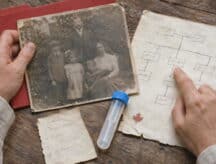
Inside were Hormidas's U.S. naturalization papers from 1914. They named his birthplace in Quebec. An obituary named his home parish. Our guide to what's in the family box explains what papers like these can prove.
CanadaVisa's free Family Papers Checklist lists 26 kinds of papers to look for. U.S. Citizenship and Immigration Services (USCIS) also holds copies of naturalization files from 1906 to 1956.
With a parish name, Denise had a solid lead. She found Hormidas's baptism in the Quebec parish registers on FamilySearch, which are free to browse. You don't need French to read these documents.
The tree of eligibility
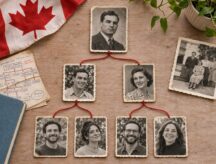
Denise turned over a notepad and drew the family tree, mapping out the line of descent. Every person on it had to pass one test: an unbroken line. That means a parent-to-child link by birth at every generation between that person and Hormidas.
Her father filled in the branches she'd missed, including the Bergerons and Ouellettes descended from Hormidas's two daughters. Women's surnames often drop out of family memory after a wedding. Six grandchildren, 17 great-grandchildren, 12 of their children, and two toddlers brought her count to 37.
Then came the harder part: explaining who wasn't on the list.
A direct line runs straight down the tree, parent to child. It runs from Hormidas to his son Wilfrid, from Wilfrid to Denise's father, and from her father to her. It never runs sideways. An aunt, an uncle, or a cousin can lead you to an ancestor, but they can't pass citizenship to you.
That's also why one family can share the work. Denise's brother sits on the same line, so he shares her whole chain except his own birth certificate. Her first cousins share it down to Wilfrid. Her second cousins share only Hormidas. Each one proves their own branch below the point where it splits. Our guide explains what a cousin's discovery means for you.
A direct line is also a line by birth, and it comes with a date. Marrying into the family doesn't put you on it, and neither does a step-parent. Everyone on Denise's list was born before December 15, 2025.
Three people at the table didn't make the list:
- Paul, a cousin on her mother's side.
- A cousin's stepdaughter.
- A grand-nephew born in April 2026. He's on the line, but he was born after the law changed. A parent born abroad needs 1,095 days in Canada before the birth. His father has never lived there.
What comes next
Denise's next steps are ones you can take too. She ran her line through CanadaVisa's free Family Line Explorer and shared its records checklist with her cousins. They can start with the option "A relative was recognised as Canadian."
Her checklist begins with Hormidas's Quebec birth record. IRCC won't accept Quebec certificates issued before 1994, and our Quebec documents guide explains where to order a new one. Wilfrid's birth record sits at the Massachusetts Archives, and the daughters' branches will need extra marriage records. If a record goes missing, our roundup of five free research tools can help.
Because Hormidas became an American before 1947, his line may take more work. So Denise booked a free consultation with a professional. A lawyer can map your chain and catch gaps before IRCC does. That way, one missing record doesn't send every family file back. As of November 17, 2026, IRCC estimated 35 months to process proof of citizenship.
Get a Free Consultation on Applying for Proof of Canadian Citizenship

- Do you need Canadian immigration assistance? Contact the Contact Cohen Immigration Law firm by completing our form
- Send us your feedback or your non-legal assistance questions by emailing us at media@canadavisa.com