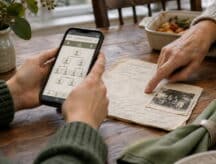
What’s in the box? This Thanksgiving, your family papers could help prove you’re Canadian by descent

Your family may keep a box somewhere: recipe cards, a baptism certificate, a funeral card from a Quebec parish. The papers inside could lead to a Canadian passport for you, and maybe for your children.
That passport comes with a second citizenship you hold alongside your American one. It also gives you the right to live and work in Canada. You can claim it from home, with no move, language test, or residency period. One Canadian ancestor in your direct line may be enough.
If you were born before December 15, 2025, you may already be Canadian through that ancestor. You apply for proof of citizenship, a certificate confirming that status, and then for the passport.
Download the Free Family Papers Checklist
You prove it with the right documents, and the box is a good place to start. A few papers in it can carry real weight in your claim.
Others may be clues, and the best ones tell you which record to order and from which office. Our free “What’s in the box?” checklist lists 26 kinds of family papers and the records each can lead to.
What’s in the box?
Each paper below can help establish one or more facts in a proof of citizenship application. Select a label to see what Immigration, Refugees and Citizenship Canada (IRCC) looks for. The labels match the free checklist, so you can move between the two.
A paper in the box is rarely the one you send. IRCC wants documents issued by the original authority that created or keeps the record, like a vital statistics office. What you find at home tells you what to order. The weight label describes a record from the original authority, so a family copy may not count the same way.
Papers that can help show a Canadian connection
Canadian naturalization certificate
What it can help show: A Canadian connection
Weight: Primary
It turns up in families whose ancestor came to Canada from abroad, like Lebanon or Ireland, before moving to the U.S. It can be one of the strongest papers in the box. IRCC accepts Canadian naturalization certificates for an ancestor, and British ones issued in Canada or Newfoundland and Labrador. Naturalizations before 1947 can raise legal questions, so those families may want a lawyer’s review.
Canadian birth certificate
What it can help show: A Canadian connection. Also: Links between generations
Weight: Primary
It can be one of the strongest documents you’ll find. Canada generally treats anyone born on its soil as a citizen. The exceptions are few, like children of foreign diplomats. Before January 1, 1947, people born in Canada were British subjects. Later law changes extended citizenship to most of them, but those older births may need a closer look.
IRCC looks for the long-form birth certificate that names the parents. Quebec has a catch: IRCC doesn’t accept birth or marriage certificates issued in Quebec before January 1, 1994. IRCC goes by the date the copy was issued, even for a birth in 1920. An older family copy tells you what to reorder, and CanadaVisa’s Quebec documents guide explains where.
Canadian military discharge papers
What it can help show: A Canadian connection
Weight: Secondary
Library and Archives Canada (LAC) finished digitizing more than 600,000 First World War service files in 2018. Each file can hold the record of service, the discharge certificate, and the medal card. The discharge paper at home gives you the name and unit to find the full file. Military service alone doesn’t establish citizenship, but the file can support a claim alongside your other records.
Found one of these? The Family Line Explorer can help you map the documents each generation needs.
Papers that can help link generations
Baptism certificate
What it can help show: Links between generations. Also: A Canadian connection
Weight: Secondary
If your ancestors were baptized, this can be one of the most useful papers after a birth certificate. Before provinces kept civil birth registers, churches recorded most births as baptisms. Ontario began civil registration in 1869, and New Brunswick didn’t require it until 1887.
Quebec relied on parish registers as its civil register until 1994. A baptism record often stood in for a birth record there. It names the child, the parents, and the parish. A family copy issued in Quebec before 1994 may not be accepted, as IRCC rejects pre-1994 Quebec birth certificates. Still, that copy tells you which parish and date to request. IRCC also lists baptism records as an alternative when a birth record is missing. The baptism has to have happened soon after the birth. Franco-American families from the mill towns and Maine’s St. John Valley often kept these.
U.S. long-form birth certificates
What it can help show: Links between generations
Weight: Primary
The American-born generations in your line count too. IRCC accepts a birth certificate from another country if it shows the parent-child link. That means the long form naming both parents. If your grandparents were born in New England, their records may sit at town hall.
A paper that can help connect names
Marriage certificate
What it can help show: Names and family details
Weight: Secondary
A marriage certificate links a woman’s birth name to her married name. IRCC’s document checklist also lists it as proof of a legal name change. That matters if your family’s name was anglicized or carried a “dit name,” an alternate surname common in French Canada. The Quebec 1994 rule applies here too.
Papers with clues worth following
U.S. naturalization papers
What it can help show: Clues worth following
Weight: Clue
If a Canadian-born ancestor became American, the family may have kept the certificate. For naturalizations after 1906, the court file behind it usually lists a birthplace, even when the certificate doesn’t. The certificate’s number, court, and date let you request that file. The U.S. Citizenship and Immigration Services (USCIS) Genealogy Program holds duplicates from September 27, 1906, to March 31, 1956.
The date your ancestor became American may affect your claim. Read how it can matter.
Obituaries and memorial cards
What it can help show: Clues worth following
Weight: Clue
Obituaries and Catholic funeral memorial cards can name parents, a maiden name, or a parish. In Maine’s St. John Valley, families received cards printed in Maine, New Hampshire, or Quebec. They carry little weight on their own, but a parish name tells you where to look next.
Smaller clues
What it can help show: Clues worth following
Weight: Clue
Each of these can lead you to a record:
- the family Bible, where relatives wrote in births and marriages
- a first communion certificate, which names the parish likely to hold the baptism record
- an old passport, which IRCC treats as secondary evidence
- a border-crossing card (U.S. card manifests for the port of Detroit run from 1906 to 1954)
- papers from a Franco-American society like L’Union Saint-Jean-Baptiste d’Amérique
- an LDS Book of Remembrance or a family genealogy website, for the sources they cite
- letters with Canadian postmarks, and recipe cards signed with a maiden name
The checklist also covers papers this article doesn’t, like death certificates, gravestone photos, homestead papers, and old landing papers.
What your papers can help establish
Primary and secondary documents
IRCC has told archivists it sorts documents into two tiers by evidentiary weight. Applicants “must provide” one or more primary documents for each ancestor, and IRCC “may consider” secondary ones. Source is a separate test. A baptism record issued by a Quebec diocese is secondary, and it comes from the original authority. A screenshot of it from a genealogy site is a third-party record. An officer weighs everything on a balance of probabilities: is the claim more likely true than not? See both tiers in full.
A Canadian connection
The ancestor your claim relies on has to have been Canadian, usually through birth in Canada or naturalization. A provincial birth certificate or a naturalization certificate does this best. Other records, like military files, can add support.
Links between generations
Each generation needs a record naming the parents. Long-form birth certificates do this on both sides of the border. Where a birth record is missing, IRCC accepts other records from the original authority, including baptism records.
Names and family details
Names change through marriage, anglicization and spelling. Your records need to show that the woman on one record is the same person on the next. A marriage certificate or a legal change-of-name document makes that link.
Clues worth following
“Clue” is our label for papers that carry little weight on their own. They give you a name, date, parish or certificate number. You use that detail to order the record from the authority that holds it.
When the paper isn’t there
A missing paper doesn’t end the search. IRCC’s application page covers ancestors with no birth certificate or birth record. It lists other documents that can show parentage and Canadian citizenship. The original authority has to have issued them. They can include:
- a hospital record of the birth
- a record from a physician or midwife who witnessed the birth
- a baptismal certificate or record, if the baptism took place within a reasonable time after the birth
- census records
- a boat manifest
If none of these records can be found, IRCC asks applicants to explain why in writing. It also asks for proof of the attempt, like letters to archives. Read what to do if a birth certificate doesn’t exist.
Starting with no papers at all? The checklist’s “No papers yet?” page sets out where to begin, from a single name and place.
This weekend
A few steps can make the search easier. Photographing both sides of each paper keeps a record while the originals stay safe at home. That fits IRCC’s process too, since it asks for colour copies of most documents and doesn’t return originals. Noting names as they’re spelled, with parishes, counties and dates, helps when you order records later.
The checklist gives you a place to keep those notes. You can fill it in on screen or print it for a relative’s house. Each paper gets a status and a note of whose it is, and nothing you enter is sent anywhere.
Once you know what’s in the box, find out if your family line may qualify. Lines through a pre-1947 naturalization, or an ancestor who became American, can get complex. A lawyer can review yours.

- Do you need Canadian immigration assistance? Contact the Contact Cohen Immigration Law firm by completing our form
- Send us your feedback or your non-legal assistance questions by emailing us at media@canadavisa.com