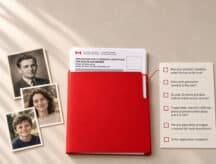
Proof of Canadian citizenship: what to do if your ancestor’s birth certificate does not exist

Finding and gathering the relevant documentation proving your Canadian ancestry is often the hardest part of applying for proof of Canadian citizenship.
That difficulty is compounded for applicants tracing descent from an ancestor born in the 1800s or early 1900s. In many cases, records have been lost to fire, flood, or gaps in early record-keeping.
In some provinces, civil birth registration was also late, interrupted, or incomplete. For example, PEI had no civil registry before 1906, and Nova Scotia did not record births from 1877 to October 1908.
Get a Free Consultation on Applying for Proof of Canadian Citizenship
While a birth certificate is the strongest form of proof, IRCC accepts other kinds of documents when one is not available.
Canada's citizenship department, Immigration, Refugees and Citizenship Canada (IRCC), recently updated its documentation standard for citizenship by descent applications. That makes it more important to understand what to do when a document simply can't be found.
This article will explain what to do when the documentation you need is not available.
What documentation IRCC requires to prove your lineage
An application must show an unbroken chain of documents connecting the applicant to their Canadian ancestor, and to every generation in between.
IRCC requires these documents to come from the original issuing authority — in Canada these are provincial vital statistics offices, civil registries, or archives.
IRCC accepts one or more of the following:
- a provincial or territorial birth certificate;
- a Canadian citizenship or naturalization certificate;
- a foreign birth certificate showing the parent-child relationship;
- a Certificate of Registration of Birth Abroad or Certificate of Retention of Canadian Citizenship
- a British naturalization certificate issued in Canada or Newfoundland and Labrador; or
- proof of British subject status or landed immigrant status in Canada before January 1, 1947 (or April 1, 1949, for Newfoundland and Labrador).
Accepted alternatives when a birth certificate is missing
If a birth certificate can't be obtained, which happens in many cases, IRCC says it accepts other documents to show parentage and Canadian citizenship, provided they come from the original authority.
These can include:
- a hospital record of birth;
- a record from a physician or midwife who witnessed the birth;
- a baptismal certificate or record;
- census records; or
- a boat manifest (an official document recording a passenger who arrived in Canada on board a vessel).
Get a Free Consultation on Applying for Proof of Canadian Citizenship
Baptismal records as an alternative
For ancestors born before civil birth registration was standard; a baptismal certificate or record is an important substitute. IRCC accepts these provided the baptism took place within a reasonable time after birth, and the record comes from the original issuing authority, such as the church or archive holding it.
This alternative comes up often for Quebec-born ancestors, where parish baptismal records predate civil registration by generations. In Quebec, applicants can request an ancestor's parish and baptismal record from the Bibliothèque et Archives nationales du Québec (BAnQ). Original, handwritten French-language parish records are accepted without translation, since French is one of Canada's official languages.
Older parish records can be difficult to read due to handwriting and document condition, so applicants may want to pair a baptismal record with additional government-issued documents confirming the ancestor's Canadian birthplace, such as a death certificate or a descendant's birth certificate.
What if I am unable to source documentation?
Contacting the relevant provincial or territorial offices in Canada is an essential first step, even if they're ultimately unable to produce the record. That's because IRCC requires applicants to explain, in writing, why a document can't be obtained, and to show proof that they tried to get it.
This can include correspondence with the issuing authority, a letter confirming that the record doesn't exist (called a no-record letter), or even an archive’s published policy confirming birth certificates were not issued during a specific time period.
You can reach out to authorities in the province where your Canadian ancestor was born; each maintains its own vital statistics office and archive system.
To find more information on collecting documents from Nova Scotia, Quebec and Ontario, visit CanadaVisa’s dedicated webpages.
Supplementary records can help fill gaps
When a direct birth or baptismal record can't be located, some applicants have supplemented their file with records connected to siblings or descendants of the ancestor in question. Examples include:
- a delayed birth certificate filed by a next-of-kin decades later, naming the ancestor and their birthplace; or
- a marriage certificate belonging to one of the ancestor's children, which may list the parents' names and birthplace.
It's important to note that supplementary evidence, such as a next-of-kin record mentioned above, can support a case, but it does not replace the primary chain of documents.
In these cases, the key is pairing multiple government-issued records – such as death certificates, marriage certificates and the like – together alongside an explanation and proof of your attempts to obtain official birth records.
IRCC will assess all documents and information submitted and may request additional evidence before making a decision.
For more complex cases
More complex cases — including renunciations, Indigenous ancestry, adoptions, or British subjects with naturalizations — can raise additional considerations. Applicants seeking case-specific guidance can reach out to an authorized immigration representative.
Get a Free Consultation on Applying for Proof of Canadian Citizenship

- Do you need Canadian immigration assistance? Contact the Contact Cohen Immigration Law firm by completing our form
- Send us your feedback or your non-legal assistance questions by emailing us at media@canadavisa.com