What do you need to be eligible for the PGP 2020?

Individuals who wish to submit an online application form to the Parent and Grandparent Program (PGP) should first make sure they meet all the eligibility requirements of the program.
Sponsorship applications will be accepted by Immigration, Refugees and Citizenship Canada (IRCC) between October 13 and November 3 and are subject to income, age and status requirements.
Individuals who wish to bring their parents or grandparents to Canada under the sought-after PGP need to be Canadian citizens, permanent residents or status First Nations.
In addition to this requirement, PGP sponsorship applicants must be 18 years of age or older and have the means to support the family member they are sponsoring.
Sponsors must also prove that they have sufficient income to support all family members for whom they will be financially responsible, including themselves, once they become sponsors. All applicants are therefore encouraged to check how much money they will need to support the number of people for whom they will be financially responsible before submitting an application to the PGP.
Are you eligible for PGP 2020? Complete CanadaVisa's free eligibility tool!
Key eligibility factor for the PGP
The Minimum Necessary Income (MNI) is a key eligibility factor for the PGP. This proof of necessary income is only to be provided after interest in sponsorship has been expressed via the online form. However, applicants who are selected and invited to apply and who do not meet the minimum necessary income requirement will see their application refused.
Sponsors residing outside of the Canadian province of Quebec who are invited to apply and their co-signers (if applicable) will have to provide Notices of Assessment from the Canada Revenue Agency (CRA) for each of the three taxation years immediately preceding the date of their application.
IRCC has noted that because it will likely receive applications in January and February 2021, sponsors will need to meet income requirements for the 2020, 2019, and 2018 tax years. IRCC says that sponsors can submit their 2020 Notice of Assessment after they have submitted their sponsorship application.
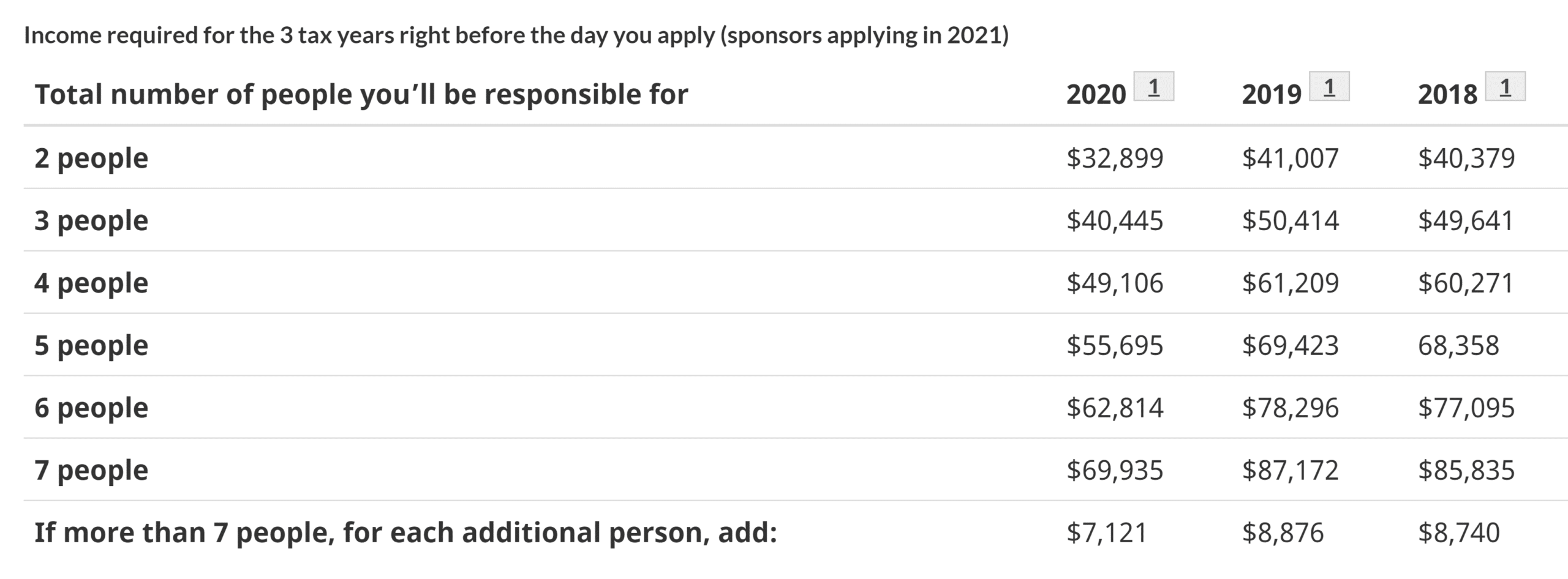
Interested sponsors will need to determine the size of their family in order to confirm that they meet the minimum necessary income requirements, which includes all persons for whom they will be financially responsible once they become sponsors, including :
- the interested sponsor;
- their spouse or common-law partner;
- their dependent children;
- their spouse’s or partner’s dependent children;
- any other person the interested sponsor may have sponsored in the past, for whom they’re still financially responsible;
- the parents and grandparents they want to sponsor and their dependents (spouse or partner and dependent children);
- any dependent children who won’t come to Canada with their parents or grandparents;
- their parent or grandparent’s spouse or partner, even if they won’t come to Canada;
- their parent or grandparents’ separated spouse.
Sponsors who live in Quebec
Rather than the three-year income requirement set for the rest of Canada, Quebec requires that potential sponsors and their co-signer (if applicable) demonstrate that they have had sufficient financial resources available to them in the last 12 months to support their family unit.
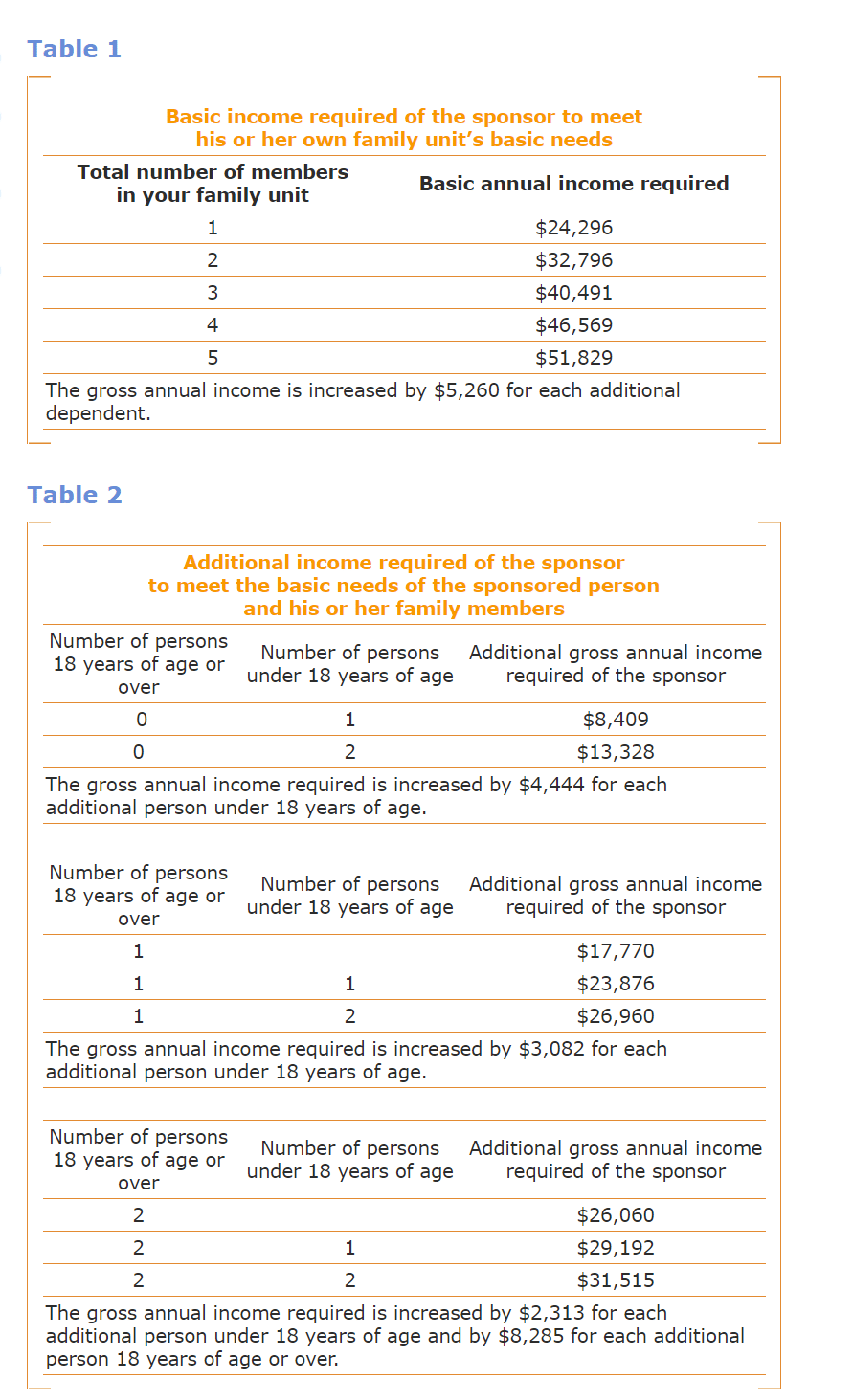
Individuals who wish to sponsor a parent or grandparent and who live in Quebec have their income assessed by Quebec's Immigration Ministry, based on the province's income requirements.
Both IRCC and the Government of Quebec require a signed undertaking from interested sponsors. This undertaking sets out how long the sponsor will be financially responsible for the family members they are sponsoring from the time they become permanent residents of Canada.
The length of the undertaking for parents and grandparents is 20 years for residents of all Canadian provinces except Quebec. For residents of Quebec, the duration of that commitment is 10 years.
Are you eligible for PGP 2020? Complete our free eligibility tool!
© 2020 CIC News All Rights Reserved
- Do you need Canadian immigration assistance? Contact the Contact Cohen Immigration Law firm by completing our form
- Send us your feedback or your non-legal assistance questions by emailing us at media@canadavisa.com