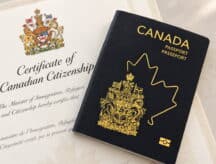
Your proof of Canadian citizenship wait time just got a lot longer. Is there anything you can do about it?

Marie started gathering documents for her citizenship by descent application back in January 2026. Her great-grandmother was born in Trois-Rivières, Quebec, and left for Massachusetts in 1922. At the time, the Canadian government's processing tool showed a 10-month wait.
Marie finally submitted her application last week. She checked the same tool out of habit. It now shows 25 months.
She's not imagining things. The wait for a Canadian citizenship certificate, the document that proves citizenship by descent (CBD), has grown far past what most applicants expected when they started collecting the necessary documentation.
Note: Marie is a composite example based on common applicant scenarios and does not represent a real individual.
Get a Free Consultation on Applying for Proof of Canadian Citizenship
Where things stand right now
As of August 10, Immigration Refugees and Citizenship Canada’s (IRCC's) processing time for a proof of citizenship application sits at 25 months. More than 121,000 people are in the queue according to the department’s processing time tool, a jump of roughly 22,300 applications in the last month alone.
That number only covers the wait after submission. Applicants need to track down birth, marriage, and death records across generations, often from provincial archives that are themselves backed up. They need photos that meet specific requirements, a completed form, and a paid fee before anything gets reviewed.
Once submitted, the processing time IRCC quotes begins. However, this is subject to change every month, and it has only moved in one direction recently.
It is worth noting though that IRCC’s processing time tool provides an estimate, not a guarantee. A more complex file, one with a gap in the document chain, a name that changed somewhere along the way, or records that need to come from multiple provinces or countries, can take much longer than the posted estimate to work through.
Why the wait keeps growing
If you started your research months ago, the number you're seeing now probably doesn't match what you remember. In January, the estimate was ten months. Now it's 25.
Two things are driving that climb.
The first is volume of new applications. Bill C-3 took effect on December 15, 2025, removing the first-generation limit on citizenship by descent for those born before that date. Anyone who can trace an unbroken line to a Canadian ancestor now qualifies, no matter how many generations separate them. Tens of thousands of Americans have applied since.
The second is a review process. In June, IRCC flagged around 100 already-issued certificates over documentation concerns and paused finalizing new applications temporarily while it checked the rest. The review wrapped up by June 30, and processing has since resumed. But it landed on top of an already-growing caseload, and that overlap likely pushed wait times higher still.
More people are discovering they qualify every week. Until that pace slows, the estimate may keep climbing.
What you can actually do
Apply now if you're ready. If your documents are in order and your case is straightforward, waiting doesn't buy you anything. Every month you sit on a complete file can add months to your overall wait time.
Look into whether you can apply without a necessary record. If you have reached out to a provincial archive or vital statistics office and are waiting to receive a record, you may consider applying before receiving the document.
This only works if you have all your other documentation and form in order, and you have secondary documentation that fills in the gap that the primary documentation is supposed to cover.
In this scenario, you also have to show a letter of explanation and proof that you've formally requested the missing document from the correct archive or vital statistics office. Finally, you have to add the original document as soon as it arrives from the original source authority.
Keep in mind that this method does carry risks, as applications that are processed and lack the necessary documentation may be flagged as incomplete and returned, costing you more time in the process. You can find more details on this here.
Apply for expedited processing. IRCC will fast-track a file for a set of specific reasons. These include a job offer or school placement on the line, a family death or serious illness that requires urgent travel, statelessness, bringing a Canadian minor child to the country, or hardship linked to who you are. Qualifying for urgent processing basically requests IRCC to move your file faster.
Talk to a lawyer. An immigration lawyer can help track down hard-to-find documents, flag gaps before IRCC does, and tell you whether your case might qualify for expedited processing.
If you have submitted an application and your file seems stalled, you can request your GCMS notes. If you want a clearer picture of where your file actually stands, you can request your own GCMS notes, the case officer's internal notes and current file status through the Canadian government's ATIP portal.
You'll have to ask a representative who is a Canadian citizen or permanent resident to make this request for you, and give them written consent to do so. The request falls under the Privacy Act, since you're asking for your own personal information, and you'll need your UCI and application number on hand.
If you're stuck with no movement at all: Those facing an unreasonable delay can ask the Canadian Federal Court for a writ of mandamus, an order directing IRCC to decide on a file. Keep in mind that this order asks the government to move ahead with the file, not necessarily to approve it.
In such cases, the courts weigh factors like how long the delay has run, whether the applicant has done everything required of them, and whether the delay falls significantly outside IRCC's own posted processing time.
This may apply for some applicants who have received updates telling them their files have been referred to the Program Support Unit (PSU), and seem to be stalled indefinitely.
Because processing times have been increasing, an application that is within that time frame may be harder to argue as unreasonably delayed, even if the wait feels long. However, while processing times are an important consideration in this situation, an application does not have to exceed the posted processing time before mandamus can be considered. Cases are assessed individually.
Pondering over your next steps? A licensed immigration lawyer may be able to give personalized advice.
This article is for general information purposes only and does not constitute legal advice. Immigration rules and processing times can change. For advice on your specific situation, consult a licensed immigration professional.
Get a Free Consultation on Applying for Proof of Canadian Citizenship

- Do you need Canadian immigration assistance? Contact the Contact Cohen Immigration Law firm by completing our form
- Send us your feedback or your non-legal assistance questions by emailing us at media@canadavisa.com