One section of Canadian law decides whether you can claim citizenship by descent, and this is how to read it

Every Canadian citizenship by descent claim comes down to the same test, applied over and over.
Citizenship by descent is the rule that lets Canadian citizenship pass from parent to child when the child is born outside Canada. To claim it, you trace an unbroken line from yourself back to a Canadian ancestor. Every person in that line has to fit one specific paragraph of section 3 of the Citizenship Act, or be covered by a provision that covers ancestors who died too early.
Four facts pick the paragraph
For any one person in your line, four questions decide which paragraph covers them.
- Where were they born?
- When were they born?
- Did one of their parents hold Canadian status when they were born? Before 1947, that means British subject status. For your anchor ancestor, the answer is nobody, which is how you know you have found them.
- Were they alive when the paragraph that covers them came into force? If not, their child’s claim may need a death bridge (explained below).
The first three you can usually answer from a birth certificate. The fourth is the one almost nobody asks, and it matters because several of these paragraphs are recent. Paragraph 3(1)(k) arrived in 2015. If your ancestor died in 1971, they never lived under it.
When the answer to that fourth question is no, a separate set of provisions steps in. People working on these claims call them death bridges, and each one attaches to a particular law. Every bridge is written around a person’s parent, so they work one generation down and one link at a time.
Note: Section 3 lists eighteen categories of Canadian citizens, and a descent claim only ever touches nine: paragraphs (a), (b), (d), (e), (g), (k), (m), (o) and (q).
The trap that catches applicants early
Open the Act, and the first paragraph you find is 3(1)(a): a person is a citizen if they were born in Canada after February 14, 1977.
That looks like the answer. It is the one line in section 3 that says what everyone expects the law to say, and it sits at the top.
So, you check your grandmother against it. Born in Hamilton in 1932. She fails the date, and the paragraph offers nothing else. The obvious conclusion is that she was never a citizen, and your claim ends with her.
However, she was a citizen. Paragraph 3(1)(a) was written in 1977 and only covers people born after it. Everyone born in Canada before that date sits under paragraph 3(1)(d), which says only that they were already a citizen immediately before February 15, 1977, and leaves the reason to a statute repealed the same year.
So, the safer way for many applicants to read the Citizenship Act is not simply from the top down. Rather, it may be more useful to find your ancestor’s era first and read the paragraphs for it while treating a paragraph that does not fit as the wrong paragraph rather than a failed claim.
Section 3 is a list of routes, not a list of tests to pass.
Check your eligibility for citizenship by descent with CanadaVisa's free citizenship by descent calculator
The paragraphs, by era
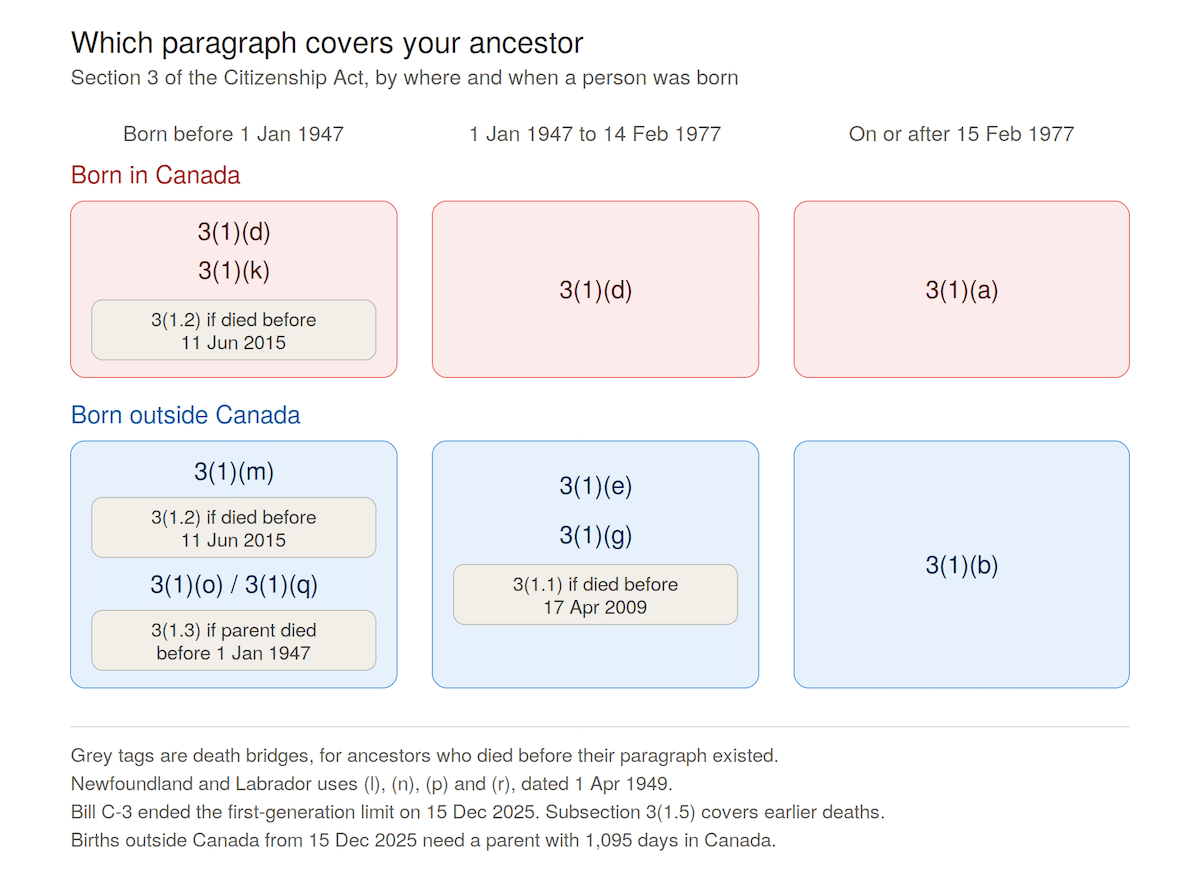
The following section delves deeper into each relevant section of Canada's Citizenship Act. You can check the image below for a quick reference of which paragraph may apply to you:
Your ancestor was in Canada before January 1, 1947
Canadian citizenship did not exist as a legal status until that date. Before it, people born in Canada were British subjects.
Paragraph 3(1)(k) says a person is a Canadian citizen if, before January 1, 1947, they were born or naturalized in Canada, then lost their British subject status, and so did not become a citizen when Canadian citizenship began.
Two complications sit inside it:
- The clause only came into effect on June 11, 2015, so an ancestor who died before that date never lived under it; and
- It does not apply to anyone who made a declaration of alienage, renounced their status, or had it revoked.
So, if your ancestor was born in Canada before 1947 and later took another country’s citizenship, most often American in the 1920s or 1930s, this clause covers them today. Canada did not treat them as citizens while they were alive. The 2015 amendment made them one retroactive to January 1, 1947, and that date is what the generation below them relies on.
Paragraph 3(1)(m) says a person is a Canadian citizen if, on January 1, 1947, they were a British subject born and naturalized outside Canada, were ordinarily resident in Canada, and did not become a citizen that day. This is the residual clause, written for the people the 1946 Act left out.
Most British subjects in Canada did become citizens that day, and the Act reached them in three ways:
- It covered anyone naturalized in Canada who had not since become an alien.
- It covered British subjects who held Canadian domicile, which took five years of residence after lawful landing.
- It covered a woman lawfully admitted for permanent residence who, before 1947, married a man who would have qualified had the Act been in force at the date of the marriage.
A 1953 amendment reached back and added British subjects with twenty years of domicile in Canada immediately before 1947, provided they were not under a deportation order on that date.
If your ancestor immigrated from Britain or another Commonwealth country and was in Canada on January 1, 1947, the question is whether they held Canadian domicile. If they did, they became a citizen outright, and you will find their status referenced in your next ancestor’s clause rather than in one of their own. If they did not, paragraph (m) is theirs. Paragraph (m) turns on ordinary residence while the 1947 test turned on domicile, and that gap is the reason the clause exists.
Paragraphs (l) and (n) do the same work for Newfoundland and Labrador, which joined Canada on April 1, 1949. Every date shifts for those families.
Both clauses arrived on June 11, 2015. Where your ancestor died before then, subsection 3(1.2) lets the generation below them qualify anyway.
Your ancestor was born outside Canada before 1947
Paragraph 3(1)(q) says a person is a Canadian citizen if they were born outside Canada before January 1, 1947, to a parent who became a citizen on that day, and did not become one themselves.
This is the clause for the child who was already abroad when citizenship arrived. Your ancestor stayed in Canada, had children in Maine or Michigan, and those children were foreign-born when the 1946 Act took effect. The parent became a citizen in 1947. The child did not, until 2015.
Paragraph 3(1)(o) says a person is a Canadian citizen if they were born outside Canada before January 1, 1947, to a parent who is a citizen under (k) or (m). The same exclusions apply here as to (k): a declaration of alienage, a renunciation, or a revocation takes the person out of it.
For your family, the difference between (o) and (q) comes down to what happened to the parent. If the parent became a citizen in 1947, you are in (q). If the parent was one of the people the 2015 amendment reached back for, you are in (o). Where an ancestor appears to fit both a parent clause and a child clause, subsection 3(6.3) settles it in favour of (o) or (q).
Paragraphs (p) and (r) are the Newfoundland versions.
These clauses carry most Franco-American and Maritime claims. Where the parent died before January 1, 1947, subsection 3(1.3) runs a counterfactual instead, asking whether that parent would have qualified had the 1946 Act existed at the time of their death.
Watch for one thing here: Before 1947, a woman who married a foreign national could lose British subject status, which is why some grandmothers were excluded and why paragraph (o) now matters so much.
Your ancestor was already a citizen before February 15, 1977
Paragraph 3(1)(d) says a person is a Canadian citizen if they were already a citizen immediately before February 15, 1977, whether through birth in Canada, naturalization, or descent. It gives no reason of its own and points back to the 1946 Act.
If your ancestor was born in Canada between 1947 and 1977, this is their clause. It anchors most modern claims and reads like it says nothing.
Your ancestor was born outside Canada between 1947 and February 14, 1977
Paragraph 3(1)(e) says a person is a Canadian citizen if they were entitled, immediately before February 15, 1977, to be registered as a citizen born abroad under the 1947 Act. Registration was the rule then, and families missed it constantly. That window shut for good on August 14, 2004.
Most people who missed it are now covered by the next clause instead.
Paragraph 3(1)(g) says a person is a Canadian citizen if they were born outside Canada before February 15, 1977, to a parent who was a citizen at the time, and did not become a citizen before the clause came into force on April 17, 2009. Notice what it leaves out. Nothing about the sex of the Canadian parent, nothing about whether the parents were married. The 1947 Act cared about both, and allowed registration only for a child born in wedlock to a Canadian father, or out of wedlock to a Canadian mother.
So if your ancestor was born abroad between 1947 and 1977 and was turned away at the time because the Canadian parent was their mother, this clause covers them now. If they died before April 17, 2009, subsection 3(1.1) carries the claim down a generation.
Your ancestor was born after February 14, 1977
Paragraph 3(1)(a) says a person is a Canadian citizen if they were born in Canada after that date. Paragraph 3(1)(b) says the same for a person born outside Canada after that date to a citizen parent.
These two cover most living applicants and the generation above them. They are the only clauses in this article that work the way people expect the law to work.
For anyone born before December 15, 2025, there is no limit on how many generations back the chain can run. Bill C-3 removed the first-generation limit, the rule that had capped descent at one generation born abroad. Where an ancestor died before that date, subsection 3(1.5) picks up the claim.
An example of a modern chain
Your grandmother was born in Toronto in 1955. Your mother was born in Cleveland in 1980. You were born in 2005.
- Start with your grandmother. Born in Canada before 1977, so paragraph 3(1)(a) does not reach her. She sits under paragraph 3(1)(d). She was alive in 1977, so no bridge is needed.
- Your mother next. Born outside Canada in 1980 to a parent who was a citizen at the time. That is paragraph 3(1)(b).
- Then you. Born outside Canada in 2005 to a citizen parent. Paragraph 3(1)(b) again.
The first-generation limit once stopped this chain at your mother. Bill C-3 removed it, so it reaches you.
Three people, three paragraphs, no bridges. You will still need your mother’s birth certificate and your own to link the chain, but your grandmother’s Ontario birth certificate is the document the claim rests on.
An example of a deeper chain
An example of a deeper chain
Your great-grandfather was born in Saint John in 1895 and took American citizenship in 1928, which ended his British subject status. He died in 1971. Your grandmother was born in Boston in 1930. Your father was born in Boston in 1958. You were born in 1985.
- Your great-grandfather first. Born in Canada before 1947, lost British subject status, and never became a citizen in 1947. Paragraph 3(1)(k). Now the fourth question: (k) came into force on June 11, 2015, and he died in 1971. His death is what subsection 3(1.2) exists for, and it works one generation down, letting your grandmother qualify despite it.
- Your grandmother was born outside Canada before January 1, 1947 to a parent who is a citizen under (k). Paragraph 3(1)(o).
- Your father. Born outside Canada in 1958 to a parent who held status at the time. Paragraph 3(1)(g).
- You. Born outside Canada in 1985 to a citizen parent. Paragraph 3(1)(b).
Four generations, four paragraphs, one bridge. Nothing about this chain is unusual, and it was impossible before December 2025.
Check your eligibility with CanadaVisa’s free citizenship by descent calculator
Where do citizenship chains actually break?
Run the four questions across your line, and you will find the weak link fast.
Some ancestors are excluded outright. Paragraphs (k) through (r) do not apply to anyone who made a declaration of alienage, renounced their citizenship, or had status revoked. A single declaration ends the chain at that person, and no bridge repairs it.
Surnames can be a problem from an evidentiary angle, not a legal one. Where a woman’s name changes between generations, you need the marriage certificate to tie the records together, and those get harder to find the further back you go.
Then there are the generations you cannot document at all. Again, that is a records problem rather than a legal one, and it has its own solutions.
If you work through your line and land on one person you cannot place in any paragraph, you have found something specific. That is the question worth putting to a citizenship lawyer.
How can I begin to read the Citizenship Act to determine my eligibility?
Pick the ancestor closest to Canada. Answer the four questions for them alone.
If they land in a paragraph, move down a generation and do it again. If they do not, check whether they died before that paragraph arrived, because that is what the bridges are for. Where more than one ancestor could anchor your claim, the closest is not always the strongest.
The full text sits on the Justice Laws website. It reads better once you know you only need nine paragraphs of it.
- Do you need Canadian immigration assistance? Contact the Contact Cohen Immigration Law firm by completing our form
- Send us your feedback or your non-legal assistance questions by emailing us at media@canadavisa.com