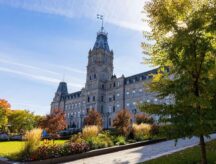
Quebec: International students may begin studies from abroad

Pour lire cet article en français, cliquez ici.
Quebec’s Ministry of Education and Higher Education (MEES) said international students who are forced to stay in their country of origin because of coronavirus-related travel restrictions will be allowed to begin their studies online in the province this fall, Radio-Canada reports.
This announcement is excellent news for the 60,000 or so international students that come to Quebec every year and who, until now, did not know if they could meet the required conditions to register for the fall 2020 or winter of 2021.
Under previous criteria, international students had to reside in Quebec to be allowed to study in the province. Colleges and universities in Quebec also receive funding from the provincial government only if that condition is met. However, because of the measures put in place to deal with the COVID-19 pandemic and the fact that the borders are still closed, the arrival of these students in the coming months is uncertain.
As a result, higher education institutions in Quebec were not sure whether they would receive government funding to cover their operating costs, continue to be able to offer all their programs or process foreign student registrations.
Quebec’s decision to relax the rules follows a broad public outcry from affected students who are determined to study in Canada as well as universities and colleges in the province. Many feared international students could choose other countries as their study destinations and that regulatory changes wouldn’t happen in time for September registration.
“Students make their decisions in May or early June. If they [can’t come] to Quebec, they will go elsewhere in the world,” Pierre Cossette, president of the Bureau de coopération interuniversitaire (BCI), told Radio-Canada a few weeks ago.
Both the Quebec and the Canadian governments have shown a willingness to temporarily lift some of the more restrictive policies that could have disqualified many previously eligible students who wish to study in Canada.
Two weeks ago, Immigration, Refugees and Citizenship Canada (IRCC) announced a major reform of the Post-Graduate Work Permit (PGWP). International students will now be able to complete 50 per cent of their programs while abroad and still be able to obtain the PGWP to work in Canada after they complete their studies. Normally, online courses do not count toward the study requirement for a PGWP application.
Around the same time, Quebec’s immigration ministry announced it would extend the validity of Certificates of Acceptance of Quebec (CAQs) that were about to expire. Quebec students are now able to apply to the federal government for an extension of their study permit without having to submit a new CAQ, which will allow them to maintain their temporary resident status and complete their programs of study.
The federal and provincial governments have a vested interest in supporting international students because they make a significant contribution to the Canadian economy.
According to Canadian government estimates, international students contribute some $22 billion to Canada’s GDP each year. In Quebec, where the population of international students is the third-largest in Canada, their contribution is estimated at $3 billion in addition to supporting 25,000 jobs on an annual basis.
© 2020 CIC News All Rights Reserved
- Do you need Canadian immigration assistance? Contact the Contact Cohen Immigration Law firm by completing our form
- Send us your feedback or your non-legal assistance questions by emailing us at media@canadavisa.com