Immigrant wages in Canada are on the rise: study


Immigrant wages have been trending up in recent years, according to a new Statistics Canada study.
Immigrants who became permanent residents in 2018 had a median wage of $31,900 reported in 2019, which is the highest among all groups of immigrants who came to Canada since 1981. It was also about 4% higher than what 2017 immigrants made in 2018. However, it was still nearly 18% lower than the median wage of Canadian-born workers at $38,800 in 2019.
These findings come from Statistics Canada's recent study on the wages of immigrants. The study extrapolated data from the Longitudinal Immigration Database, which provides information for researchers to study the characteristics of Canadian immigrants at time of admission, as well as their economic outcomes and regional mobility. It is the first in a two-part series about immigrant outcomes. The second part discusses immigrant mobility.
Discover if You’re Eligible for Canadian Immigration
When looking at just the principal applicants of economic-class immigration programs, the median wages were higher than the Canadian-born population in 2019. These immigrants who landed in 2018 had a median salary of $43,600 one year later, which is more than 12% higher than the Canadian median wage in the same year ($38,800).
The reason for this, may have to do with how economic-class immigrants are selected.
"Principal applicants in the economic categories are selected for their ability to integrate into the Canadian labour market and to contribute to the economy," the report says. "Most have post-secondary education and knowledge of at least one official language."
Canadian work experience boosts earnings
Having pre-immigration experience in Canada, seems to have an impact on immigrants' wages, as it provides the means for immigrants to improve language skills and knowledge of the Canadian labour market. Canadian experience was categorized into three groups: work and study experience, just work, and just study experience.
Immigrants who had both work and study experience before admission had the highest median wage one year later. For these immigrants who were admitted in 2018, their 2019 median wage was $44,600, which was even higher than the Canadian-born population who reported a median wage of $38,800 that year.
Work-related experience in particular supported immigrant wages in the first year after landing. Immigrants who only had work experience prior to landing in 2018 had a 2019 median wage of $39,300, also higher than the Canadian-born population.
Immigrants who had just study experience before landing had the lowest median wages one year after landing ($15,100 in 2019), likely because this group is on average younger than their counterparts.
In all three groups, 2018 immigrants had higher median wages one year after landing than immigrants who came in 2017.
Wage differences between men and women
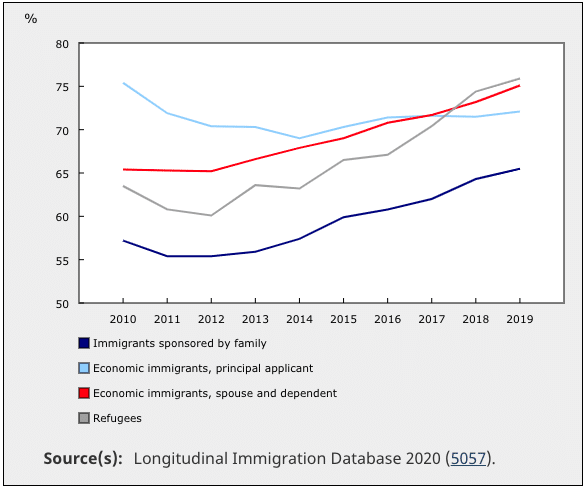
Between 2010 and 2019, median wages went up for both men and women across all immigration categories, but immigrant men and women benefitted differently from these increases.
Among economic-class principal applicants, women's median wage started lower than men's and men's median wage increased faster. As a result, the median wage gap widened between men and women over time in favour of men. The study says further analysis is needed to determine why this could be.
All other immigration categories saw the opposite effect. Women's median wages started even lower, but increased faster than men's in the following immigration categories: economic dependents (such as spouses of principal applicants), refugees, and family sponsored immigrants.
With women's median wages going up in these categories, the wage gap narrowed between men and women over the study period.
Median pay ratio of immigrant women versus men admitted in 2009 by immigration category, 2010 to 2019
Discover if You’re Eligible for Canadian Immigration
© CIC News All Rights Reserved. Visit CanadaVisa.com to discover your Canadian immigration options.

- Do you need Canadian immigration assistance? Contact the Contact Cohen Immigration Law firm by completing our form
- Send us your feedback or your non-legal assistance questions by emailing us at media@canadavisa.com