Understanding the IELTS Speaking test

In this post, we will look at the three parts of the IELTS Speaking test, the assessment criteria, and suggest how you can improve your performance in each part.
What is the format of the IELTS Speaking test?
The Speaking test lasts for 11-14 minutes and there are three parts. Each part is designed to reflect a skill you may need when you live, work or study in an English-speaking environment.
See more about how IELTS is scored
So how can you improve your vocabulary for IELTS? We’ll explore some simple ideas below.
What happens in Part 1?
The first part of the test is designed to put you at ease. The examiner will start by asking you questions about your work, study, your hometown, or home country. For example:
Let’s talk about your hometown or village.
- What kind of place is it?
- What’s the most interesting part of your town/village?
- What kind of jobs do the people in your town/village do?
- Would you say it’s a good place to live? (Why?)
This will then be followed up with questions on general, everyday topics such as hobbies, pets, the weather, holidays, sport, music, etc.
In this part, try to extend and expand your answers by giving reasons and examples.
Examiner: What kind of music do you like?
Candidate: I like pop music as it’s generally upbeat and helps to lift my mood if I’m feeling tired.
Examiner: Do you prefer to play or watch sports?
Candidate: I’d like to play sport, especially football, but I don’t really have the time so whenever I can I watch my favourite football team on TV.
What happens in Part 2?
This part focuses on your ability to speak at length on a given topic, simulating giving a presentation at work or university. You will be given a topic card and you will be asked to describe something or talk about an experience - however, many of the topics are a combination of the two. You are also given one minute to prepare what you are going to say. Use this time to make notes on the points on the card. Organise your answer in the same order as the points on the card as it will make what you say more coherent.
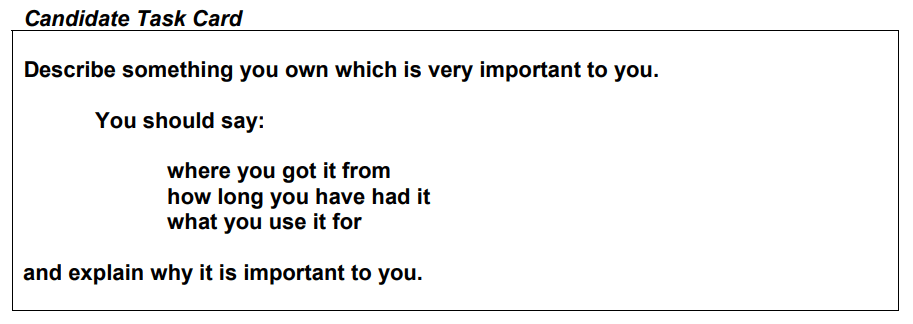
You might get a topic that you don’t have many ideas on. Don’t panic – get creative! The examiner isn’t going to fact-check what you say, and they are only interested in how you answer the task.
Remember you can look at your notes when you speak. Part 2 lasts for 3-4 minutes, including the preparation time, and the examiner will tell you when your time is up.
What happens in Part 3?
In this part, you will be tested on your ability to express and justify your opinions and to analyse, discuss and speculate on a variety of issues broadly linked to the topic in Part 2. The questions will be more general and abstract, similar to the types of discussion you may encounter at university or work.
Example:
Let’s consider first of all how people’s values have changed.
- What kind of things give status to people in your country?
- Have things changed since your parents’ time?
Finally, let’s talk about the role of advertising.
- Do you think advertising influences what people buy?
Listen carefully to the examiner’s questions and try to use the same tenses when you speak. You can also buy yourself some time to think by using some of these phrases:
Let me think, . . .
I’m not sure how to answer that, but . . .
I’ve never really thought about this before, perhaps . . .
That’s quite difficult to answer . . .
That’s quite a complex issue . . .
That’s an interesting question . . .
Assessment criteria – what are the examiners looking for?
The Speaking section is used to assess your use of spoken English. A wide range of speaking skills are assessed, such as:
- your ability to communicate opinions and information on everyday topics and common experiences and situations by answering a range of questions (Part 1)
- your ability to speak at length on a given topic using appropriate language and organising ideas coherently (Part 2)
- your ability to express and justify opinions and to analyse, discuss and speculate about issues (Part 3).
The test is recorded, and examiners will give you a score from 0-9 on the following criteria.
Fluency and Coherence
This looks at how easily and fluently you speak, how well you are able to link your ideas, and how well you form coherent and connected speech.
Lexical Resource
This looks at the range and precision of vocabulary you use, and how well you are able to express what you mean, think and feel on the given topic.
Grammatical Range and Accuracy
This looks at the range of structures you use and how well you are able to use them accurately and appropriately.
Pronunciation
This looks at your ability to speak comprehensibly and how well you are able to use a range of pronunciation features to communicate meaning. It is important to note that accent is not assessed.
Take a look at the Speaking Band Descriptors
How you can prepare for the IELTS Speaking section:
Listen to yourself speaking
One of the ways you can practice is by recording yourself responding to sample questions. Listen back and pay attention to the following:
Vocabulary
Did you use a variety of topic-specific vocabulary? Think of words and phrases that you could use to improve the answer.
Grammar
Did you use a variety of tenses? Did you make a lot of mistakes? Think of how you can improve the grammatical range and accuracy of what you said.
Make a note of the ideas you come up with and keep a vocabulary record in lexical sets (words and phrases connected to a particular topic).
Finally, speak, speak, speak!
Take every opportunity to practice speaking English! Spend as much time as you can talking to a teacher, classmate or a friend who also speaks English. If you have friend who is also taking the test, you can practice together by taking the role of the examiner and test taker. In the test itself, imagine you are talking to a friend and try to relax. Good luck!
Get more IELTS preparation material
© Want to advertise on CIC News? Click here to contact us.
- Do you need Canadian immigration assistance? Contact the Contact Cohen Immigration Law firm by completing our form
- Send us your feedback or your non-legal assistance questions by emailing us at media@canadavisa.com