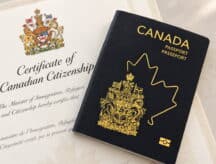
Why you may be ineligible to become a Canadian citizen

Obtaining Canadian citizenship offers numerous advantages, such as the opportunity to establish permanent residence in one of the world’s most prosperous nations, participate in the democratic processes of the country, and hold a passport widely recognized as one of the strongest in the world.
Schedule a Free Canadian Citizenship Consultation with the Cohen Immigration Law Firm
Canada is now looking to welcome 500,000 new permanent residents annually in 2025 and 2026, which is the highest level in its history. Over 85% of permanent residents become Canadians as Canada offers one of the most open citizenship policies in the world.
According to data from Immigration, Refugees and Citizenship Canada (IRCC), in 2023, more than 354,000 people became Canadian citizens in more than 3,000 citizenship ceremonies.
Who is eligible for Canadian citizenship?
You need to meet several criteria to be eligible to apply for Canadian citizenship:
- Be a permanent resident
- Meet Canada's physical presence requirements
- File your taxes (if necessary)
- Pass a Canadian citizenship test (if you are between the ages of 18-54)
- Prove your language skills (if you are between the ages of 18-54)
First and foremost, you must be a permanent resident to apply for Canadian citizenship. IRCC allows a permanent resident to apply for Canadian citizenship after he or she has been a physical resident of Canada for three years (1,095 days) out of the five years immediately preceding the application for citizenship.
If applicable to you, you may need to file taxes in Canada for at least three years within the five years before you submit your Canadian citizenship application.
If you are between of ages of 18 and 54 on the day you signed your Canadian citizenship application, you will need to take a Canadian citizenship test. The test is 30 minutes long and contains multiple-choice and true or false questions. You can complete the test in English or French.
Those between the ages of 18 and 54 also need to show they can speak English or French at a Canadian Language Benchmarks (CLB) level of 4 or higher.
What makes you ineligible for Canadian citizenship?
There are situations that may prevent you from becoming a Canadian citizen. According to IRCC, you may be ineligible for Canadian citizenship if:
- you’re in Canada serving a term of imprisonment, on parole or on probation
- you’re serving a sentence outside Canada
- you’re charged with, on trial for, or involved in an appeal for an offence under the Citizenship Act, or an indictable offence in Canada committed outside Canada that’s equivalent to an indictable offence in Canada
- you’re under a removal order (Canadian officials asked you to leave Canada)
- you’re being investigated for, are charged with, on trial for, involved in an appeal for or have been convicted of a war crime, or a crime against humanity
- you had a citizenship application refused for misrepresentation in the past 5 years
- you had your Canadian citizenship revoked (taken away) because of fraud in the past 10 years
- you’ve been convicted of an indictable offence in Canada or an offence under the Citizenship Act, and if IRCC received your application after June 11, 2015, and this conviction took place in the 4 years before you apply
- in the 4 years before you apply, you were convicted of an offence outside Canada that’s equivalent to an indictable offence in Canada. This applies even if you were pardoned or granted amnesty regardless of when we receive your application
- while a permanent resident, you were convicted of terrorism, high treason, treason or spying offences served as a member of an armed force of a country or territory, or an organized armed group, that’s engaged in armed conflict with Canada
Schedule a Free Canadian Citizenship Consultation with the Cohen Immigration Law Firm

- Do you need Canadian immigration assistance? Contact the Contact Cohen Immigration Law firm by completing our form
- Send us your feedback or your non-legal assistance questions by emailing us at media@canadavisa.com