
If you’re seeking Canadian permanent residence (PR) through Express Entry, planning ahead can have a big impact on your chances of success.
The Express Entry pool is competitive: the government sends invitations to apply (ITAs) for PR only to the candidates with the highest Comprehensive Ranking System (CRS) scores who qualify for each draw.
See how competitive your Express Entry profile is
Express Entry is complex, and both your eligibility and your competitiveness as a candidate will change over time.
Here are the most important factors to take into account:
- Your eligibility for the Canadian Experience Class (CEC).
- CRS points for Canadian work experience.
- CRS points for foreign work experience.
- Your age.
- Your eligibility for category-based selection.
- Your language test validity.
- Your educational credential assessment (ECA) validity.
If you keep these factors in mind, you can plan effectively to position yourself for the highest chances a year or two down the line.
You can create a profile on CanadaVisa+ (CV+) to explore different scenarios, and the app will tell you how your eligibility is expected to change over time.
Trisha’s changing eligibility likelihood over time
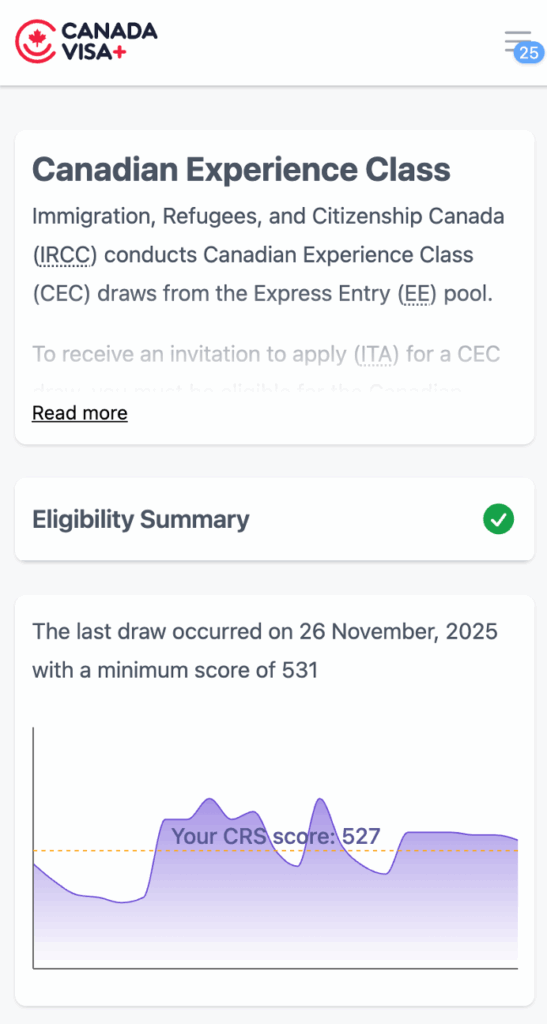
Trisha is a 37-year old materials scientist in the Express Entry pool. She has a PhD in Canada, ten years of Canadian work experience, and exceptional English skills (CLB 12). She also has a brother who lives in Canada as a PR. She speaks no French. Her CRS score is 527.
CV+ currently rates Trisha’s likelihood of getting PR through Express Entry as low, because her CRS score is not high enough relative to the cut-off scores of recent CEC draws, as we can see in the screenshot below:

See how competitive your Express Entry profile is
Let’s imagine Trisha gets a job offer from a US employer.
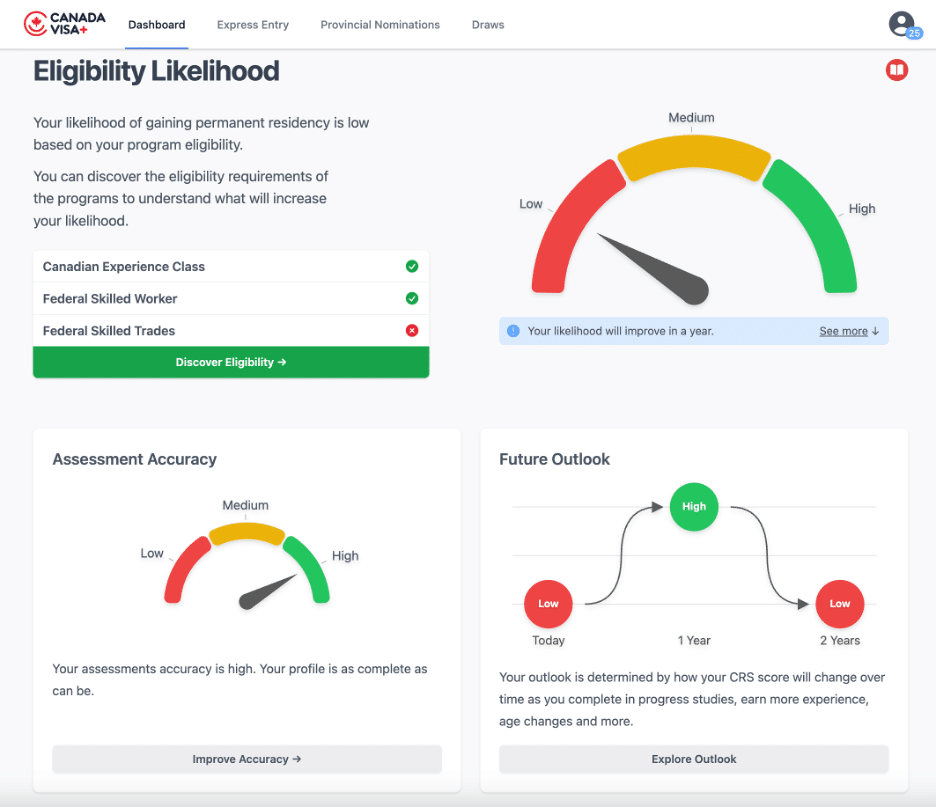
If Trisha were to move to the US and work in a skilled job for a year, her likelihood would increase to high, with a CRS score of 572 due to the skill transferability points gained from the foreign work experience (minus a loss of five points for being a year older).
If she were to continue to work in the US for a second full year, however, Trisha would no longer be eligible for the CEC (as she’d no longer have one year of Canadian work experience in the past three years), so her likelihood would drop to low, even though her CRS score would be 566.
We can see this in her CV+ profile – all she has to do is update her current job to a job in the US, and CV+ projects her eligibility and likelihood to gain Canadian PR in the future:

Here’s more detail on how each of the factors affects your chances of success with Express Entry over time.
Eligibility for CEC
Many candidates will likely need to be eligible for the Canadian Experience Class (CEC) to get PR through Express Entry, should the government continue its recent pattern of draws.
There has not been a general Express Entry draw since April 23, 2024, so for the past year and a half, non-CEC candidates have only been getting invited through category-based selection (select occupations or French language proficiency) or through draws inviting provincial nominees.
To qualify for the CEC, you need one year of skilled Canadian work experience as an employee, and cannot count work experience gained while you were enrolled as a full-time student.
If you’re currently working in a skilled job in Canada but have less than a year of skilled Canadian work experience, CV+ will factor your upcoming CEC eligibility into your future outlook.
See how competitive your Express Entry profile is
Canadian work experience
You can score CRS points for Canadian work experience under two portions of the CRS: core human capital factors and skill transferability factors.
CV+ will project your current Canadian employment into the future when calculating your CRS score in one year and two years.
Foreign work experience
For some candidates, gaining a year of foreign work experience may increase their score more than an additional year of Canadian work experience.
You can score up to 50 CRS points for foreign work experience as part of skill transferability factors.
Most candidates will require foreign work experience in order to score the maximum of 100 CRS points under skill transferability factors.
If your current job is outside Canada, CV+ projects your foreign employment into the future, which may score you additional CRS points.
With the projection of your foreign employment into the future, you may lose eligibility for CEC, as CEC requires you to have a year of Canadian work experience within the past three years.
Age
You score the maximum CRS points for age between the ages of 20 and 29: 110 for a sole applicant, and 100 for an applicant immigrating with a spouse.
You begin to score fewer points at age 30, and once aged 45 or higher, score zero CRS points for age.
If immigrating as a couple, listing the younger spouse as the primary applicant may result in a higher CRS score.
CV+ takes into account aging when determining your future eligibility likelihood.
Eligibility for Category-based draws
To be eligible for an occupation-specific category-based draw, you must have at least six months full-time (or equivalent part-time) continuous work experience in a single qualifying occupation within the past three years.
If your current job is eligible for a category-based draw but you do not yet have the requisite amount of work experience, CV+ will project your eligibility into the future.
If your CBS-eligible work experience is in the past, CV+ will project into the future your loss of eligibility for CBS upon the aging out of your qualifying work experience.
Language test validity
Immigration language tests are valid for up to two years, after which they expire.
While CV+ takes your language tests into account for evaluating your “assessment accuracy” (over a self-assessment), it does not age you out of eligibility on the basis of your language test results.
Currently, you need to keep track of when you took your language tests and when they are set to expire.
If your language tests expire before you apply for PR, you will need to re-take them.
To count, your language tests must be from a provider approved by the federal government.
Educational credential assessments
You need an educational credential assessment (ECA) for each foreign educational credential you wish to count in your Express Entry profile.
CV+ factors ECAs into the “assessment accuracy” rating, but does project ECA expiry into your future eligibility outlook.
ECAs expire in five years.
See how competitive your Express Entry profile is