As the U.S. stares down nationwide ban on abortion pill telemedicine, can Americans get access through Canada’s new citizenship law?


As a legal battle threatens telemedicine access to abortion medication across the United States, millions of those at risk of losing access are U.S.-Canadian dual citizens under Canada’s new citizenship law.
Americans across the United States may soon find themselves in the situation where they can be issued and filled prescriptions under Canadian law, only to be denied access to their medication under U.S. regulations.
Get a Free Consultation on Applying for Proof of Canadian Citizenship
On May 4, 2026, the U.S. Supreme Court temporarily restored telemedicine access to mifepristone, following a nationwide ban imposed by a lower court last week in the course of the legal battle between the State of Louisiana and the U.S. Food and Drug Administration (FDA).
Temporary access to telemedicine prescriptions of mifepristone, which in 2023 was used for 63% of abortions in the U.S., is set to remain in place until May 11, as of the time of writing.
If the state of Louisiana succeeds in obtaining its nationwide ban, will affected U.S. residents be able to obtain mifepristone through telemedicine from Canada-based healthcare providers?
The answer, unfortunately, is far from simple.
If any U.S. resident were to obtain a telemedicine appointment with a Canada-based healthcare provider, the healthcare provider would have the ethical and legal obligation to provide the appropriate standard of care to that patient.
So if an American gets treated by a Canadian medical practitioner, that practitioner would generally recommend and not hesitate to prescribe mifepristone, provided that the practitioner believed that the indication for mifepristone was consistent with the highest standard of care they could provide to the patient.
But in many cases, it's not clear whether even a U.S-Canadian dual citizen residing in the U.S. would be likely to obtain a telemedicine appointment with a Canadian-based physician.
Many states, Louisiana included, restrict the practice of telemedicine to physicians who are licensed within that state’s jurisdiction, and, in general, Canadian regulatory bodies for medical practitioners require their physicians to comply with the laws of the jurisdiction in which the patient is located at the time of the appointment, and practitioners' liability insurance won't cover them for treating patients outside their jurisdiction.
A Canadian-based physician faced with a telemedicine request from a U.S.-based patient seeking mifepristone could very likely find themself in a position in which the best interests of the patient and the appropriate standard of care are pulling them one way, while legal and regulatory requirements are pulling them the other way. The only thing certain is that the medical practitioner will apply to the situation what they consider to be their best possible professional judgement.
Let’s say a Canadian doctor takes the telemedicine appointment, sees the patient, indicates a medical abortion, and prescribes mifepristone.
Can the patient then take a prescription from that Canadian medical provider, and get it filled at a U.S.-based pharmacy?
Generally, no.
Under the mifepristone REMS program, U.S.-based pharmacies must complete a Pharmacy Agreement Form to be authorized to dispense mifepristone, and can only fill mifepristone prescriptions from providers who are certified under the mifepristone REMS program.
A prescription from a Canadian-based telemedicine provider would prove of no use for a patient seeking dispensation of mifepristone from a U.S. pharmacy.
But could a patient in the U.S. with a prescription from a Canadian physician obtain mifepristone from a Canadian pharmacy, without needing to travel to Canada?
Under Canadian law, it’s perfectly legal for a Canadian pharmacy to dispense medication to a U.S.-based resident who has a prescription from a Canadian doctor, and many Canadian pharmacies will dispense and fulfill prescriptions by mail to U.S. addresses.
But under U.S. law, it’s generally illegal for U.S. residents to import prescription medications for personal use. And under the mifepristone REMS program, the distribution of mifepristone outside approved U.S. pharmacy channels is expressly prohibited, so Canadian pharmacies might refuse to dispense and mail mifepristone to U.S. addresses.
If the telemedicine abortion pill ban succeeds, millions of Americans, many of them U.S.-Canadian dual citizens, will find themselves in the situation where they could conceivably be prescribed medication by Canadian doctors, have that medication dispensed by Canadian pharmacies, only to be banned from importing that medication by the U.S. government.
How many of these Americans will assert that they live in the land of the free?
Americans getting Canadian passports just in case
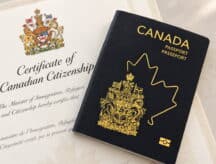
Since Canada changed its citizenship law, thousands of Americans across the United States have been applying for proof of Canadian citizenship, to get Canadian passports as a backup plan.
With the removal of the generational limit to inheriting Canadian citizenship for Americans born prior to December 15, 2025, millions of Americans have become eligible, including U.S. citizens whose families have been living in the U.S. for four or more generations.
Today, any American who can trace their descent from a Canadian ancestor can apply for proof of Canadian citizenship and then obtain a Canadian passport, provided they have the necessary documents to prove their Canadian ancestry.
Applying for proof of Canadian citizenship as an American generally requires submitting a paper application to Canada’s citizenship department, Immigration, Refugees and Citizenship Canada.
Eligible Americans can handle their applications themselves, or can hire representatives legally authorized by the Canadian government, such as Canadian immigration lawyers and licensed immigration consultants.
The processing time for proof of citizenship applications is 10 months, as of the time of writing.
Americans who obtain proof of Canadian citizenship do not incur any additional tax obligations, as unlike the U.S., Canada does not apply a worldwide tax on its citizens.
Get a Free Consultation on Applying for Proof of Canadian Citizenship

- Do you need Canadian immigration assistance? Contact the Contact Cohen Immigration Law firm by completing our form
- Send us your feedback or your non-legal assistance questions by emailing us at media@canadavisa.com