Roy, King, Mitchell, Desjardins, and more: Why your surname may be the key to Canadian citizenship

For much of the last 300 years, a French-Canadian family could answer to two surnames at once. A man baptized Roy might be buried as a Desjardins. Their grandchildren might use both, or pick one, or quietly drop the other.
If your family came from Quebec, you may have inherited the half that hides where you really come from. And the surname you carry today may be the key bridge between you and a second citizenship you didn’t know you had.
For French-Canadian families, the name can be a riddle — and the answer may be a second surname most people have never heard of—Mitchell was once Michaud. The Kings were once the Rois.
Get a Free Consultation on Applying for Proof of Canadian Citizenship
Since Canada’s new citizenship law removed the generational limit to Canadian citizenship by descent, many Americans are learning that a Canadian-born ancestor can make them Canadian too.
One family, two names
The custom is called the “dit name.”
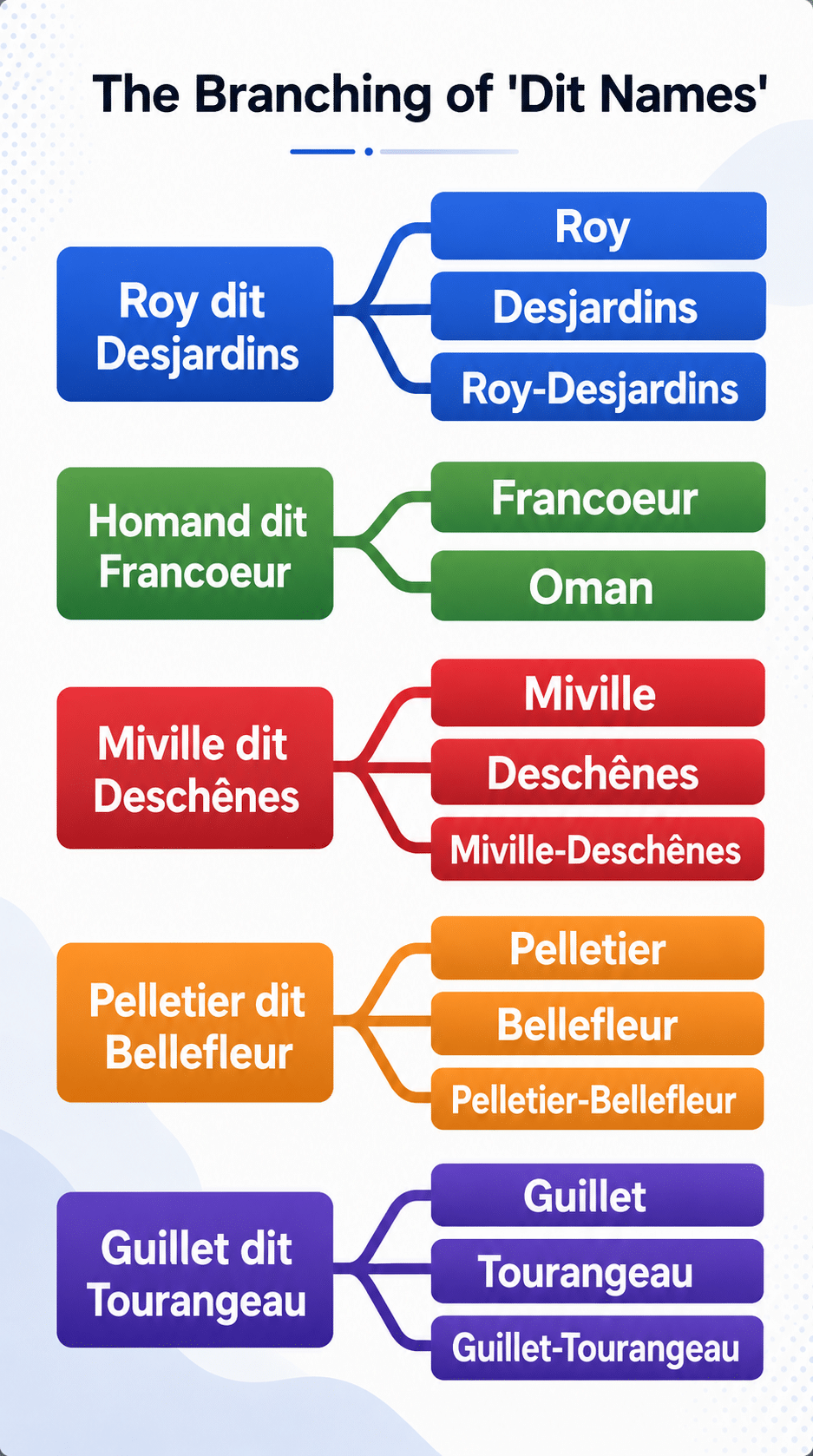
The word dit is French for “called,” and it linked a family’s original surname to a second one: “Miville dit Deschenes”, “Pelletier dit Bellefleur”, “Roy dit Desjardins”.
The following diagram illustrates some of the common name changes that result in a single French-Canadian family name being scattered across very different-looking American surnames:
Library and Archives Canada traces the practice to France, where families with the same surname in the same village needed a way to tell each other apart.
And when a family carried a dit name, a clerk might record just one side of the pair. Homand dit Francoeur could walk into one town as Francoeur and into another as just Homand, or even Oman.
A dit name could come from almost anything: a trade, a hometown, a physical trait, or an ancestor’s first name. It was a working surname and often appeared in the records that families left behind.
Can't find your surname here? We compiled a list of the 42 most common names for Americans who are "secret Canadians"—and their likelihood of having Canadian citizenship.
Library and Archives Canada notes that both surnames tended to appear in records until around the 1850s—after that, families usually kept just one. Which one they kept was almost a coin toss, which determined what the rest of the family trees are called today.
Other French surnames were translated outright, and many English-speaking clerks and priests wrote last names the way they sounded. Roi became King, Lenoir became Black, as shown in the table below:
| What you might be called today | The French-Canadian name it can hide | How the name changed |
|---|---|---|
| King | Roi | Translated — roi means king |
| Black | Lenoir | Translated — noir means black |
| Shackett | Chouquette | Written the way it sounded |
| Bostwick | Bousquet | Written the way it sounded |
| Mitchell | Michaud | Written the way it sounded |
Between 1840 and 1930, hundreds of thousands of French Canadians left Quebec for the United States, many moving down the Richelieu Valley into Vermont and northern New York. Their names did not always survive the crossing intact.
Get a Free Consultation on Applying for Proof of Canadian Citizenship
You're more likely to be eligible than you might think
This is also why surname counts can undersell the number of Americans who have French-Canadian ancestry.
A recent CIC News analysis found names like Tremblay and Ouellet are dozens of times more common in Canada than in the United States — a strong signal of Canadian roots. But the dit name breaks the signal entirely.
A family that left as Roy dit Desjardins and settled as Roy shows up in no French-surname count at all. The Canadian thread is still there in the records. It is just wearing a different name.
So the true number of Americans with a Quebec-born ancestor is almost certainly larger than any list of French surnames suggests.
How to use a name as a starting point
A dit name doesn’t make anyone a citizen. What it can do is point you toward an ancestor worth investigating.
If any of this sounds like your family, a few simple steps can help:
- Ask your oldest living relatives where the family came from, and listen for French first names (Jean, Pierre, Marie, Joseph) even behind an English surname.
- Search for both possible surnames, separately and together, plus phonetic and translated spellings.
- Look in Quebec parish, census, and notarial records, where both halves of a dit name often appear.
If you are from New England, upstate New York, or Upper Midwest roots, you may want to watch for a name that looks English but includes hyphens or is among those commonly translated.
And remember the multiplier. If you qualify, your siblings almost certainly do too — along with cousins, their children, and anyone else who descends from the same ancestor.
You can check where your family line stands using CanadaVisa’s citizenship by descent eligibility checker.
The other half of your name
Since Bill C-3 took effect, Quebec’s archives have reported a 3,000% rise in requests for vital records, most of them from Americans. As a result, citizenship by descent applications now carry a 15-month processing period.
Roy, Desjardins, Oman, King, Shackett. To an American eye, these names have nothing in common. In a Quebec parish register, some of them are the same family. For one of the few times in history, the half of the name your family let go of may be worth more than the half it kept.
Your last name isn’t proof of anything. But for many Americans, it’s the first clue — and sometimes the real clue is the name nobody remembers.
Get a Free Consultation on Applying for Proof of Canadian Citizenship
- Do you need Canadian immigration assistance? Contact the Contact Cohen Immigration Law firm by completing our form
- Send us your feedback or your non-legal assistance questions by emailing us at media@canadavisa.com