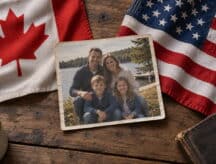
Your ancestor’s Canadian birth could make you a citizen, thanks to Bill C-3

Birthright citizenship has been in the spotlight this past week after the U.S. Supreme Court struck down Donald Trump's order seeking to end it in the United States.
While the president and the court may not agree on the issue, birthright citizenship isn't a concept unique to the U.S. Dozens of countries recognize some form of it, including Canada.
Get a Free Consultation on Applying for Proof of Canadian Citizenship
That means anyone ever born on Canadian soil is automatically a Canadian citizen in most cases. And because of a new bill which took effect on December 15, 2025, that citizenship can now pass down generations.
How Bill C-3 changed everything
On December 15, 2025, Canada's Citizenship Act was amended under Bill C-3. The change eliminated what had been known as the first-generation limit for those born before that date*.
Before that, citizenship by descent could only pass down one generation to someone born outside the country. Grandchildren and later descendants were typically excluded, even if their Canadian ancestor's citizenship was not in doubt.
Bill C-3 removes that limit for anyone born before December 15, 2025. As long as someone can trace an unbroken line of descent back to a Canadian citizen, they may be a Canadian citizen too, whether that ancestor is a parent, grandparent, great-grandparent, or further back. Neither the applicant nor their parents need to have been born in Canada themselves.
* For children born or adopted abroad on or after December 15, 2025, a substantial connection test applies: the Canadian parent, if also born abroad, must show 1,095 days of physical presence in Canada before the birth, unless an exception applies.
Why this makes Canada's birthright citizenship all the more relevant
Birthright citizenship, known legally as jus soli, grants citizenship automatically to those born within a country's territory, regardless of their parents' nationality.
Canada has followed this rule since the Citizenship Act took effect on January 1, 1947. With narrow exceptions, mainly children of foreign diplomats, anyone born on Canadian soil is a Canadian citizen at birth.
Combined with Bill C-3, this is turning millions of American families into Canadian ones. Birthright citizenship is what made the ancestor Canadian in the first place, often without any action on their part. It didn't matter if they left the country as an infant or never returned. Being born there was enough.
Bill C-3 lets that status pass forward, generation after generation, to descendants born before December 15, 2025, who have never set foot in Canada.
In other words, birthright citizenship made the ancestor Canadian; Bill C-3 is what passes this citizenship down to their descendants today.
An example
Take the case of fictional Sheila Morgan, born in a hospital in Halifax in 1948. Her family moved to Massachusetts before she turned one. She grew up in the U.S., married an American, and never applied for a Canadian passport. She never thought of herself as Canadian, even though she was one.
Her son, born in the U.S., is a first-generation descendant. He doesn't know it and never applied for a Canadian citizenship certificate or passport. He, too, married an American in the U.S.
Their daughter, Samantha, was born in Massachusetts in 2001, making her a second-generation descendant. Under the old rules, the first-generation limit would have excluded her from Canadian citizenship. Because of Bill C-3, Samantha is now a Canadian citizen.
Samantha can apply for proof of citizenship certificate through her grandmother. Once she has a Canadian citizenship certificate, she can use it to apply for a Canadian passport.
That said, qualifying and proving it are two different things. Samantha still has to assemble records for both her Canadian-born grandmother and the parent who connects her to that grandmother. If Sheila changed her surname after marriage, Samantha may also need her grandmother's marriage certificate to close that gap.
Get a Free Consultation on Applying for Proof of Canadian Citizenship
What if my ancestor was born in Canada before 1947?
Before January 1, 1947 (or April 1, 1949, for Newfoundland and Labrador, which joined Canada later), people born in Canada, or living there, held the status of British subject.
An ancestor born in Canada before that date generally became a Canadian citizen automatically when the Citizenship Act took effect, and may pass that citizenship down by descent. The same is often true for a Canadian-born woman who lost her British subject status by marrying a foreign national before 1947 — a pattern that shows up more often in family trees than people expect.
Even where an ancestor fits one of these categories, citizenship still has to be established at each generation in the chain, not just at the original ancestor. That means proving the family link, and the citizenship status, of every parent between that ancestor and the applicant.
What to do if you have an ancestor born in Canada
If you believe you're Canadian through your ancestry, the next step is research.
Start by talking to the oldest living relative in your family. Ask who left Canada, when, and why. Ask where they were born and whether they remember any details about the trip or the family they left behind. Write everything down as you go, including names, dates, and place names, even if they're only partial or uncertain.
Once you've gathered what your family remembers, you can start collecting the supporting documents: birth, marriage, and death certificates for each generation in the chain, along with identity documents for yourself. Provincial vital statistics offices and archives are the right place to request historical Canadian records if you don't already have them.
From there, you can complete and submit your application. Processing takes time, so it helps to start as early as possible.
If your case involves a pre-1947 ancestor, multiple generations, or a name that's changed over the years, it's worth speaking with a citizenship lawyer before you apply. You can also use CanadaVisa's citizenship by descent calculator to get a sense of whether your family history could qualify.
Get a Free Consultation on Applying for Proof of Canadian Citizenship
- Do you need Canadian immigration assistance? Contact the Contact Cohen Immigration Law firm by completing our form
- Send us your feedback or your non-legal assistance questions by emailing us at media@canadavisa.com