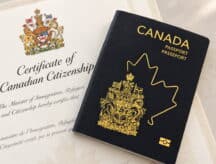
This Fourth of July, Americans are discovering that they are Canadian too

This Fourth of July, millions of Americans will light the grill, pour a drink, and watch the fireworks without knowing they've quietly gained far more options for themselves.
A door to Canadian citizenship, with all the travel, healthcare, retirement, and social benefits that status entails, opened for them in December 2025, with the passage of Bill C-3.
Under Canada’s new citizenship laws, these individuals are already citizens, only needing to apply for proof of citizenship by showing a direct line of descent to a Canadian ancestor. There is no generational limit.
Get a Free Consultation on Applying for Proof of Canadian Citizenship
With that in mind, far more Americans are eligible for a second passport than is commonly known or typically conveyed through surveys and self-reports.
Nearly 900,000 French Canadians left Quebec for New England textile mills between 1840 and 1930, and their descendants anglicized the surnames to blend in. Maine now has the highest share of French ancestry of any U.S. state, close to one in five residents, and in some counties, one in three.
Moreover, due to the rich history of immigration from Canada to the United States, the country is likely scattered with secret Canadians.
For the many Americans doing their own quiet stock-taking this Fourth, that reshapes what the years ahead can look like. And for those thinking about retirement, it changes the math.
Unlocked options with a second passport
A second life, an hour's flight away
For a lot of Americans nearing retirement, the appeal isn't a purchase. It's a second life running alongside the first. Summers in Montreal, winters back home, and no border official deciding how long you're allowed to stay in either place.
Canadian citizenship makes that ordinary. You can come and go on your own schedule, with no visitor clock counting down your weeks and no immigration process standing between you and a longer stay. A place in Montreal, if you want one, comes with none of the foreign-buyer restrictions that apply to Americans.
You can work there too. Citizenship carries the right to take a job, consult, sit on a board, or run something seasonal in Canada, with no work permit to apply for. For a semi-retirement that's more about staying busy than clocking out, that's the difference between visiting a country and living a life in it. And the door swings wider than Canada alone.
A Canadian passport opens easier long stays across Commonwealth countries like Australia and New Zealand, the kind of unhurried travel that suits the years after full-time work (more on this below).
Then there's the money. U.S. retirement savings stretch further across the border when the exchange rate runs in your favour, and everyday costs in much of Canada sit below what you'd pay in coastal U.S. cities.
Healthcare concerns are more manageable
American retirees have watched warnings pile up about Medicare's finances, and the coverage gaps in later life are real enough to plan around.
Canadian citizenship opens a door here, with an honest caveat: the passport alone doesn't hand you a provincial health card. Each province ties public coverage to residency (typically between 2 and 3 months; however, this varies by province).
What citizenship gives you is the standing to establish it, on your own timeline, without an immigration application deciding whether you're allowed to. For someone weighing where to grow old, that's a card worth holding.
Get a Free Consultation on Applying for Proof of Canadian Citizenship
Passing it down
Once you hold proof of your Canadian citizenship, under Canada’s amended Citizenship Act, you can pass it to your children.
The old first-generation limit cut the line off after one generation born abroad. Now the line keeps going. Your kids can claim it, and their kids after them, each generation carrying the status forward.
One rule applies to the youngest branch: for a child born outside Canada on or after December 15, 2025, to a parent who was also born abroad, the parent has to show a real link to the country: at least 1,095 days of physical presence in Canada, roughly three years, before the child is born. Time spent living, working, or studying in Canada counts, and it doesn't have to be continuous.
To learn more about this requirement and a simple method to get around the physical presence requirement, visit our dedicated article on the topic.
Wider than retirement
A Canadian passport outranks the U.S. passport on the Henley index and opens working-holiday access in more than 36 countries through International Experience Canada, including the U.K. for up to three years, France, Germany, Spain, Australia, and Japan. An American with only a U.S. passport gets that access in six. If you have kids or grandkids, you've handed them options that don't expire.
Canada and the U.S. both allow dual citizenship, so claiming the Canadian side costs you nothing on the American side. And because citizenship passes down the family line, one person's discovery tends to unlock a whole branch. If you qualify through a grandmother, your siblings almost certainly do too. So do your cousins, and their children after them.
What it means for your taxes
Does a second citizenship mean a second tax bill? For an American, the reassuring part is that claiming Canadian citizenship doesn't hand the IRS anything new. The U.S. already taxes its citizens on worldwide income no matter where they live, so you're filing a U.S. return either way. Becoming Canadian doesn't add to that. That’s because, unlike US personal income taxes, which apply to US citizens residing anywhere in the world, Canadian personal income taxes apply based on residency.
You also won't be taxed twice on the same money. The Canada-U.S. tax treaty and the foreign tax credit exist to stop that, and between them, they cover most situations a person is likely to run into.
What it takes to prove it
The claim rests on documents that can prove your direct lineage to a Canadian ancestor. To accomplish this, you must build an unbroken chain from yourself back to your Canadian-born ancestor through documents that include (but are not limited to): birth certificates, marriage records, the paperwork that connects each generation to the next.
IRCC has recently further clarified what documents are accepted in support of a proof of citizenship application.
A grandparent-level line is shorter. A great-grandparent line can run to roughly eight birth certificates across the generations, and the surname changes are exactly where these searches get interesting.
Clues are also abundant and often hiding in plain sight: anglicized or dit names, or a family lineage that runs through New England, just to name a few. The paradox of Canada’s new citizenship law is that far more people are eligible than those who actually choose to apply.
Many individuals choose to retain professional help to assist them in completing their paper trail to a Canadian ancestor and submitting the strongest application possible to avoid delays and even possible revocation of status after the fact.
This Fourth of July, the fireworks look different once you know the name on your family's mailbox may have been hiding a choice for the better part of a century.
Find out if your family line qualifies with CanadaVisa's free citizenship by descent calculator.
Get a Free Consultation on Applying for Proof of Canadian Citizenship

- Do you need Canadian immigration assistance? Contact the Contact Cohen Immigration Law firm by completing our form
- Send us your feedback or your non-legal assistance questions by emailing us at media@canadavisa.com