
In a 2025 Gallup poll, 40% of American women aged 15-44 stated that they would move to another country permanently if they had the opportunity.
Canada was their top destination of choice, at 11%, ahead of New Zealand, Italy, and Japan, which tied at 5%.
What most of these women don’t know: in the same year, Canada passed a bill that made some of them Canadian citizens automatically.
Get a Free Consultation on Applying for Proof of Canadian Citizenship
Why so many American women are thinking of leaving the US
Gallup’s numbers come from telephone interviews with 1,000 US people aged 15 and older, a modest sample. But they track a longer trend. Women’s desire to leave the US has climbed steadily since 2014, and politics looks like a driving force behind it.
In 2014, the percentage of American women who said they wanted to move abroad was 10%. This jumped to 21% in 2016, , the last year of Barack Obama’s second term. By 2025, the first year of Donald Trump’s second term, that number had nearly doubled to 40%.
In media interviews with women who’ve already left, some interviewees cited other reasons behind the move: active shooter drills at their kids’ schools, discrimination, feeling judged for who they are, and frustration regarding healthcare and their work-life balance.
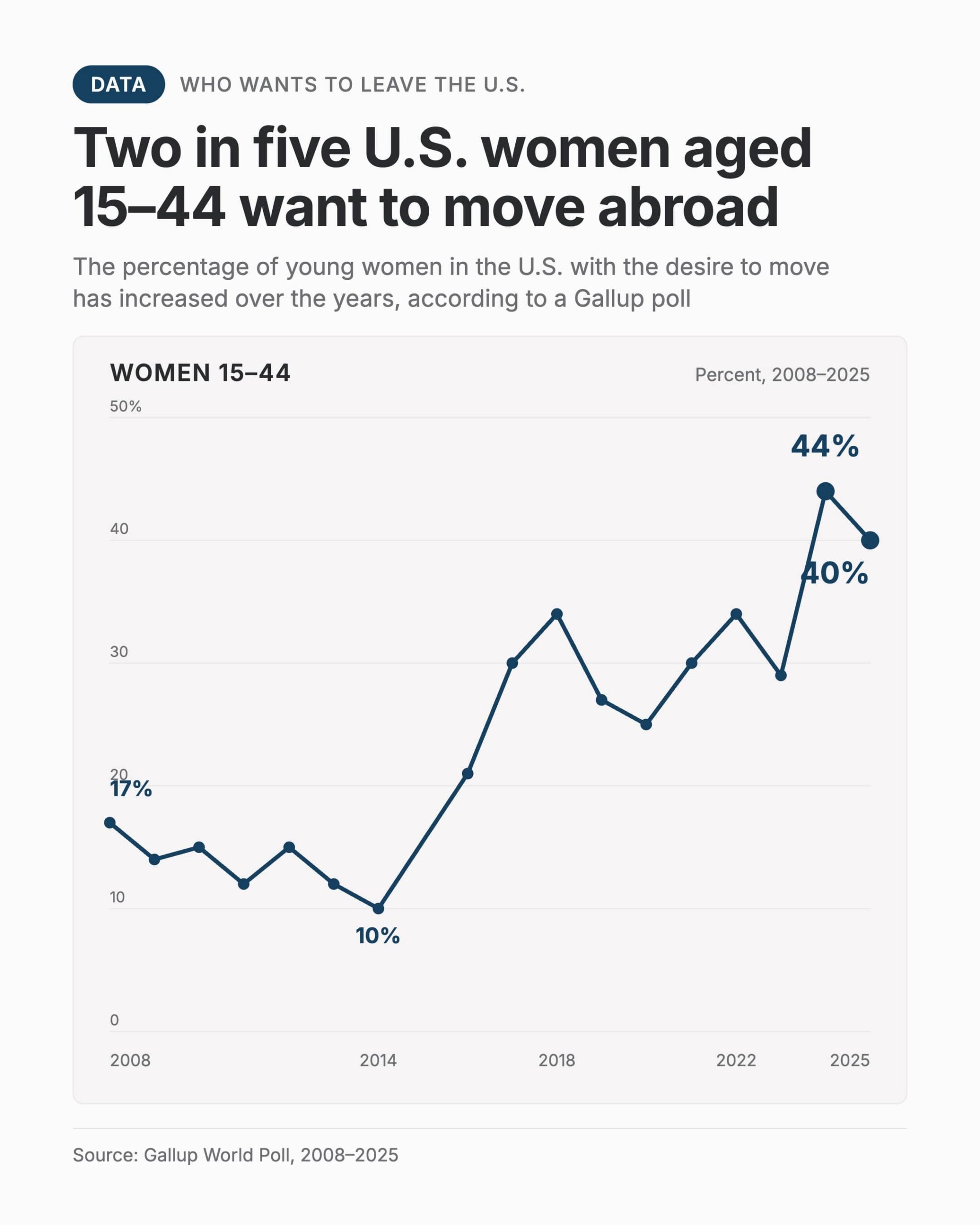
According to Gallup, a record number of younger women want to leave the U.S.
Why Canada is increasingly seen as the better choice for American women
On the flip side, Canada seemed to offer a lot of what these women say they’re looking for.
Safety
Canada is regularly considered one of the safest countries in the world for travellers.
It also ranks above the US on the Women, Peace and Security Index for women’s safety. The global index ranked Canada in the 16th position in 2026, while the US featured in the 31st place. The ranking is based on 13 indicators spanning women’s inclusion, justice, and security.
Parental leave benefits for a growing family
New parents in Canada (outside of Quebec) can take up to 84 weeks of combined paid leave through the federal Employment Insurance program (Employment and Social Development Canada) after the birth of their child.
In comparison, Federal FMLA rules provide eligible employees of covered employers with up to 12 weeks of job-protected leave and this is unpaid. State and employer benefits vary. This is a huge draw for many planning a bigger family.
Abortion rights
Abortion is legal across Canada with no federal restrictions. Canadian law treats abortion access as healthcare rather than a criminal matter.
This is in sharp contrast to the US, where access to abortion varies according to state, following the overturning of Roe v. Wade.
Work-life balance
Canada is also known for its work-life balance and has even implemented laws in some provinces to restrict after-work communications.
Canadians also get more paid time off. Federal law guarantees two weeks of vacation days annually for most employees after one year of continuous employment. In contrast, many US jurisdictions provide no vacation minimums whatsoever.
Stability for minorities:
Human rights protections for gender identity exist in every Canadian province, something LGBTQ Americans and parents of LGBTQ kids increasingly weigh when they think about moving.
Canada is also known for its diverse population. Canada reported over 450 ethnic and cultural origins, according to the 2021 census.
And now, many of these women may already be Canadian citizens
On December 15, 2025, Bill C-3 took effect in Canada, removing the first generation limit that previously cut citizenship by descent after one generation born outside Canada.
The change came two years after the Ontario Superior Court of Justice ruled that limit unconstitutional in December 2023, finding it unfairly cut off citizenship for children born abroad.
The bill expanded eligibility for citizenship by descent to anyone with an unbroken line back to a Canadian ancestor. If you were born before December 15, 2025, and have a Canadian-citizen grandparent, great-grandparent, or ancestor further back, you may already be a Canadian citizen
Since the change took effect, tens of thousands of Americans have applied for proof of Canadian citizenship, the certificate that confirms the status they already have.
Many do not have immediate plans of moving either. For them, it serves as a backup option and a second passport just in case things get harder or the political situation gets more volatile at home.
Am I a Canadian citizen?
If you are unsure whether you have Canadian ancestry, there are some clues that could help. A French-Canadian surname, an ancestor who spoke French, a grandparent who talked about living “up north” may all be indicators.
The odds are especially high in New England. Between 1840 and 1930, nearly 900,000 French-speaking Canadians left Quebec for the region to work in its textile mills, settling in tight-knit neighbourhoods known as “Little Canadas.”
If you believe that you have a Canadian ancestor, speak to your eldest relatives first. They can often point you to your anchor ancestor — the Canadian through whom any citizenship claim would run.
From there, it’s all about collecting the right documentation: birth certificates, marriage certificates, and records of any name changes for every generation between you and that ancestor. Once you’ve gathered the relevant documentation, the next step is completing the application and submitting it to Canada’s citizenship department.
Get a Free Consultation on Applying for Proof of Canadian Citizenship