
Many people researching their family history assume there’s only one way to have a Canadian ancestor: that at some point, someone in their lineage must have been born in Canada.
But that assumption would be incorrect.
Several other routes may provide the Canadian link in a citizenship-by-descent case, although whether citizenship reached a particular descendant depends on the law applicable to each generation.
Get a Free Consultation on Applying for Proof of Canadian Citizenship
Why “born in Canada” is only part of the picture
Citizenship by descent works by tracing an unbroken line back to a “Generation Zero” ancestor: the person whose Canadian status supplies the link for everyone who came after them. It could be a grandparent, great-grandparent or someone further along the chain.
Being born in Canada is one of the most straightforward paths due to Canada’s birthright citizenship rules.
However, a person didn’t have to be born in Canada to hold that status. As a general rule, they had to become Canadian at some point, in one of several recognized ways, before the next generation was born.
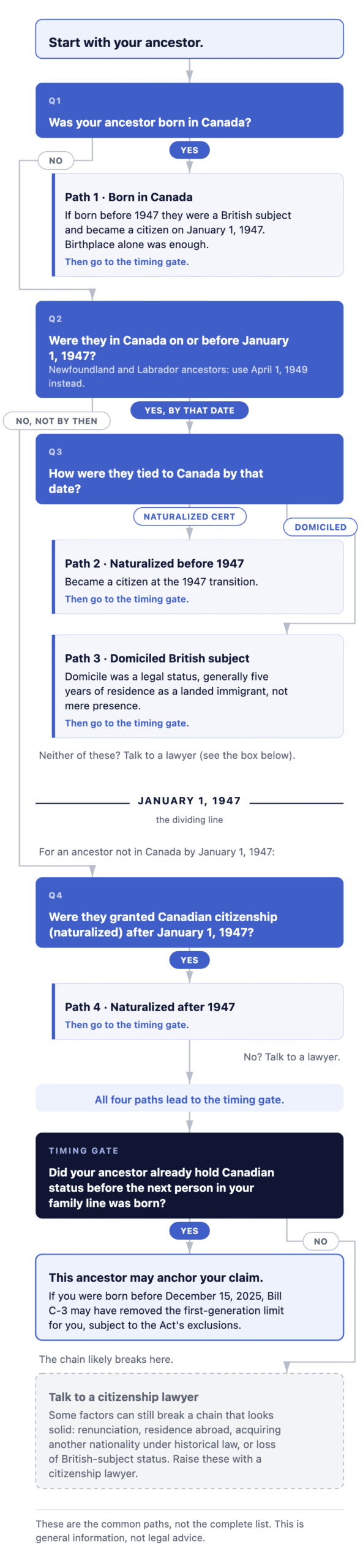
Here are the four main ways this could have happened.
1. Born in Canada before 1947
Canadian citizenship didn’t exist as a legal status until January 1, 1947. People born in Canada before that date were British subjects, not Canadian citizens.
Because of this, they never received a Canadian citizenship certificate. That’s often the source of confusion for their descendants today.
However, the current Citizenship Act includes provisions that recognize this pre-1947 British-subject status as a starting point for citizenship by descent claims today.
In other words, the law today treats their British-subject status as if it were Canadian citizenship, so their descendants can still use that connection to claim Canadian citizenship by descent.
2. Naturalized in Canada before January 1, 1947
Since Canadian citizenship didn’t exist until January 1, 1947, someone naturalized in Canada before that date became a British subject, not a “Canadian citizen” in the modern legal sense.
An immigrant ancestor who came to Canada and formally naturalized before 1947 may qualify their descendants, just like someone born there could.
This holds even if they left Canada before 1947, as long as one can prove they naturalized in Canada before leaving (although this can be tricky to prove in many cases).
Whether citizenship ultimately passed to a descendant still depends on exclusions and the timing of when the subsequent generation was born.
3. A British subject residing in Canada on January 1, 1947
A British subject who had Canadian domicile on January 1, 1947 is a qualifying ancestor for citizenship by descent.
Domicile was a legal status, not mere presence: it generally meant five years of residence in Canada as a landed immigrant.
This can apply even if they were born elsewhere, provided they had built the required years of residence, not just recently arrived.
4. Naturalized or granted citizenship in Canada after January 1, 1947
If an ancestor immigrated to Canada at any point after the Citizenship Act came into force and was formally granted citizenship, they may be just as valid a Generation Zero ancestor as someone born in the country.
The distinction matters for timing: the naturalization needs to have taken effect before the next generation in the family was born.
Consider a fictional case: Anna Kowalski.
Anna’s grandfather, Tomasz, immigrated to Canada from Poland in 1968 and became a naturalized Canadian citizen in 1974. He later moved to the US, where his daughter, Maria, was born in 1980, six years after his naturalization took effect.
Because Tomasz was already a citizen before Maria was born, Maria may be Canadian too. And because Anna was born in 1997, before December 15, 2025, Bill C-3 may have made her a citizen automatically, subject to the Act’s exclusions.
To prove the chain, Anna would need to gather:
- Tomasz’s naturalization certificate, showing the date his citizenship took effect
- Maria’s long-form birth certificate, naming Tomasz as her father
- Anna’s own long-form birth certificate, naming Maria as her mother
Tomasz’s citizenship or naturalization certificate would be the clearest evidence of the effective date. If it is unavailable, the family may need to request a search of IRCC’s citizenship records and follow IRCC’s instructions for missing official documents. A birth or immigration record alone would not ordinarily establish that he received citizenship.
Note: The 1947 date above don’t apply to Newfoundland and Labrador, which didn’t join Canada until March 31, 1949. Ancestors from there became Canadian citizens on that later date, not January 1, 1947, so anyone tracing a Newfoundland and Labrador line needs to check eligibility against 1949 cutoffs instead.
There are exceptions
Each of these paths may qualify an ancestor, but none of them guarantees that citizenship passed all the way down to a specific descendant today.
The ancestor generally needed to already hold their status by the time the next person in the family line was born. Other factors, including renunciation, residence abroad, acquisition of another nationality under historical law, or the loss of British-subject status, can affect whether a given family’s chain holds up.
Any of the above mentioned factors can break a chain that looks solid on paper, so raise them with a citizenship lawyer.
Was your ancestor a Canadian?
A “generation zero” ancestor who wasn’t born in Canada isn’t automatically out of the picture.
Immigrants who naturalized, whether in 1935 or 1985, and British subjects who called Canada home in 1947, can all potentially anchor a family’s claim to Canadian citizenship by descent.
If your family’s story doesn’t fit the “born in Canada” mould, it may still be worth mapping out the details: who came to Canada, when, and whether they were naturalized or otherwise recognized as Canadian before the next generation arrived.
Unsure whether you qualify as a Canadian citizen by descent? CanadaVisa has a free eligibility checker you can use to find out.
Get a Free Consultation on Applying for Proof of Canadian Citizenship