A Canadian grandparent isn’t enough for a successful citizenship by descent application. You need the chain linking you both

Since the passing of Bill C-3 on December 15, 2025, the first-generation limit on Canadian citizenship by descent has been removed for those born before that date. This means that any individual with a Canadian ancestor may already be Canadian.
But before you celebrate, or start mailing off your paperwork, there's a catch worth understanding.
Get a Free Consultation on Applying for Proof of Canadian Citizenship
Having a Canadian grandparent, or any ancestor further back, may make you Canadian, but you still need to prove your status to the Canadian government to avail all the rights of a citizen.
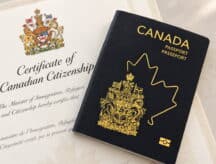
The harder part is applying for a Canadian citizenship certificate, the document that proves your status as a Canadian citizen and can be used to apply for a passport and access other benefits.
To get one, you can't just submit your grandparent's birth certificate and call it done. You have to show the paper trail linking them to you, generation by generation.
How the chain works
Take the case of a fictional applicant, Stacy McAdams, born in the US.
Stacy's grandmother, Simone, was born in Quebec, making her a Canadian citizen, but left Canada as a child. Simone married and had a son, Cameron, Stacy’s father, in the US.
Because of Bill C-3, Stacy is now a Canadian citizen herself. However, she still needs to submit a proof of citizenship application to prove it.
To submit a successful application, Stacy would need to gather:
- Simone's birth certificate, showing she was born in Canada.
- Simone's marriage certificate, closing the gap if she changed her name.
- Cameron's long-form birth certificate, the version that names Simone as his mother.
- Stacy's own long-form birth certificate, naming Cameron as her father to complete the loop.
One certificate proving your ancestor was Canadian isn't enough. Canada’s citizenship department, Immigration, Refugees and Citizenship Canada, (IRCC) wants an unbroken chain of documents connecting every generation in between.
Canada just emphasized that requirement
Showing this chain linking you to your Canadian ancestor is integral to proving your status. In June, IRCC updated its supporting documentation requirement for proof of citizenship applications, emphasizing this.
Amongst other things, it specified that, in cases where a person was born abroad to a Canadian parent, they had to submit “proof of parentage and Canadian citizenship for your Canadian parent, grandparent and parental ancestor as applicable.”
It went on to add, “for each person, you must provide one or more of the following documents...”
In other words, emphasis was placed on showing the links between the generations, not just a single document of your Canadian ancestor.
Have a Canadian grandparent? Get a Free Consultation on Applying for Proof of Canadian Citizenship
Why the chain matters so much
IRCC needs to verify that each generation between you and your Canadian ancestor retained citizenship, to deem you a Canadian citizen, with all the rights and benefits that this entails.
Proving the chain does two things: it shows you're connected to your ancestor across generations that may include name changes, multiple countries, and gaps in records. And it shows that citizenship itself was passed down, unbroken.
If a person in the chain was not, and is now not deemed to have been, a Canadian citizen at the relevant time, eligibility may be broken.
What can break the chain?
There are some scenarios where you may not be Canadian, even if your grandparent was Canadian.
Two scenarios listed below illustrate how this can happen. However, these are not exhaustive. There are a variety of other possible scenarios in which an IRCC officer may deem Canadian citizenship broken along a line of descent.
Scenario 1: In case of renunciations
If a Canadian parent renounced their citizenship before their child was born, that child is not eligible for Canadian citizenship, even if their grandparent was Canadian.
Keep in mind that renunciation scenarios are complex. In such situations, it may be best to speak to a licensed immigration lawyer.
Scenario 2: If one wasn’t Canadian when their child was born
Consider a fictional family: Bruno, who lives in France with a wife and child named Claude. Bruno moves to Canada for six years in search of work, and becomes a naturalized Canadian citizen in the process. However, he does not apply for Claude to become a citizen, and he moves back to France later to be with his family.
In this scenario, Claude is not eligible for Canadian citizenship by descent through Bruno, because Bruno was not a Canadian citizen when Claude was born. It does not matter that Bruno is Canadian now.
Because Claude is not a Canadian citizen, if he were to have children, they would not be able to claim Canadian citizenship either, despite having a Canadian grandparent.
Have a Canadian grandparent?
A Canadian grandparent, or even great-grandparent, is a real reason to check if you may also be a Canadian citizen.
But it isn't a guarantee. Before assuming anything, it's worth mapping out your own family's timeline: who was born where, who naturalized when, and if anyone in the chain ever gave up their citizenship.
You can start by checking your situation against CanadaVisa's citizenship by descent calculator, and for cases involving multiple generations, name changes, or renunciation, it's worth speaking with a citizenship lawyer before applying for proof of Canadian citizenship.
Have a Canadian grandparent? Get a Free Consultation on Applying for Proof of Canadian Citizenship

- Do you need Canadian immigration assistance? Contact the Contact Cohen Immigration Law firm by completing our form
- Send us your feedback or your non-legal assistance questions by emailing us at media@canadavisa.com