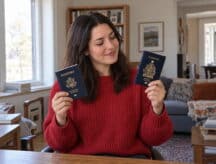
What you need to know about IRCC-accepted identity documents for Canadian citizenship by descent applications

Every proof of citizenship application needs two valid pieces of identification to be submitted along with the rest of the package.
Immigration, Refugees and Citizenship Canada (IRCC) uses these documents to confirm that you are the person named on the application.
This article covers which documents IRCC accepts, which ones it rejects, what to do if you live outside Canada or are applying for a child.
Get a Free Consultation on Applying for Proof of Canadian Citizenship
What IRCC requires
IRCC asks every proof of Canadian citizenship applicant to establish their identity with two valid pieces of ID. Each document has to meet a few conditions:
- Both must display your full name and your date of birth.
- At least one must carry your photograph.
- Both must be valid on the date you submit your application.
Missing any one of these details can lead to a returned application.
Which documents IRCC accepts
IRCC lists several Canadian federal, provincial and territorial government-issued documents that applicants can use to prove their identity:
- Passport
- Driver's licence
- Travel document
- Health insurance identification card
- Age of majority card
- Senior citizen's card
- Certificate of Indian Status card
IRCC notes that its list gives examples only. It is not complete, and the documents appear in no order of priority.
Applying from outside Canada
Americans file more proof of citizenship applications than the next nine countries combined, and many have never held Canadian ID.
Since they may have never held a Canadian ID, IRCC lets these applicants submit identity documents issued by a foreign government instead, as long as they serve the equivalent function of the Canadian documents on the list above.
For example, a US passport or a state-issued driver's licence would serve the same purpose as its Canadian counterpart.
Applicants whose foreign IDs are in a language other than English or French must also send a translation and an affidavit from the translator.
| IRCC-listed document | Closest US equivalent | Shows name, date of birth and photo? |
| Passport | US passport | Yes |
| Driver's licence | State-issued driver's licence | Yes |
| Travel document | US passport card | Yes |
| Age of majority card | State-issued ID card (non-driver) | Yes |
| Health insurance identification card | Medicare card or private health insurance card | Medicare card: name only. Private cards: varies |
| Senior citizen's card | No common US equivalent | Varies |
| Certificate of Indian Status card | No direct US equivalent |
Which documents a lawyer recommends
While IRCC accepts a range of IDs (listed above), CIC News asked a lawyer at Cohen Immigration if there are any specified identity documents they recommend to clients, and they listed the following:
- A passport
- A government-issued travel card
- A driver's licence
These documents show your name, date of birth and photo, so any two of them could satisfy every part of IRCC's requirement.
Some clients already hold citizenship in two countries, such as the UK and the US. In such a case, these applicants can submit both of their valid passports as their two pieces of identification.
Trace your family lineage with the Family Line Explorer
The common mistake
According to the same lawyer at Cohen Immigration, one common identity document error in Proof of Canadian citizenship files is submitting a document that is expired or soon to expire.
Applicants tend to grab whatever ID they have on hand. Some assume an old passport still proves who they are because the name, photo and date of birth haven't changed. However, since IRCC asks for valid identification, an expired document does not meet that standard.
Applicants are advised to check the expiry date on both documents before they mail their application. If either one has lapsed, renew it first or choose a different document from the accepted list.
Applying for a minor
Young children often have no driver's licence and may not yet have a passport. If you are applying on behalf of a minor who lacks two pieces of identification, or who has no ID with a photo, IRCC guidance is to include an explanation letter with the application.
Use the letter to explain which identity documents the child does not have. IRCC's operational guidance notes that officers may use discretion when the applicant is a preschool-aged child.
Documents IRCC will not accept
IRCC rejects several common documents as personal identification for a Proof of Canadian citizenship application. This includes:
- Birth certificates
- Social Insurance Number (SIN) cards
- Bank cards
- Credit cards
- Previous Canadian citizenship certificates
The birth certificate rule can confuse citizenship by descent applicants, who need birth certificates elsewhere in the application.
IRCC uses birth certificates to establish date and place of birth and to link a child to their parent. Those records still belong in your package, just not as one of your two IDs.
Quick checklist before you submit
Run through these points before your application goes to IRCC:
☐ You have two identity documents.
☐ Both show your name and date of birth.
☐ At least one has your photo.
☐ Neither document has expired.
☐ Foreign IDs not in English or French come with a translation and affidavit.
☐ For a minor without two IDs or photo ID, you have included an explanation letter.
☐ You have not counted a birth certificate, SIN card, bank card, credit card or old citizenship certificate as one of your identity documents.
A few minutes spent checking expiry dates can save you from having IRCC return or delay your application.
Have doubts about submitting an application for Canadian citizenship by descent? A licensed immigration lawyer can provide personalized guidance.
Get a Free Consultation on Applying for Proof of Canadian Citizenship

- Do you need Canadian immigration assistance? Contact the Contact Cohen Immigration Law firm by completing our form
- Send us your feedback or your non-legal assistance questions by emailing us at media@canadavisa.com