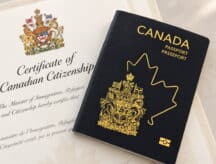
Canada is updating its immigration system. But for Americans with Canadian ancestry, citizenship has never been more direct

On October 16, Canada announced major upcoming changes to Express Entry, the online system it uses to select skilled workers for permanent residence.
For Americans who have ever weighed a second passport, the news raises a new question: does this make Canadian citizenship more unattainable?
The answer depends on several factors. From November 3 onwards, the path leans more heavily on a job offer or Canadian work experience in a well-paid field.
Get a Free Consultation on Applying for Proof of Canadian Citizenship
Interestingly though, for Americans with a Canadian ancestor, this means little. Many of them are already Canadian citizens, thanks to a change to the Citizenship Act that took effect in December 2025.
What does this mean for Americans who want Canadian citizenship?
For an American thinking about a second passport, there are two ways to become a dual US-Canadian citizen. They can immigrate and naturalize, or they can inherit citizenship through a Canadian ancestor.
Naturalization begins with permanent residence, and for most skilled foreign nationals, this process begins with Express Entry. From November 3, the strongest profiles will be those holding a high-wage Canadian job offer or Canadian work experience.
It’s also worth noting that getting permanent residence is only the first stage of the process towards becoming a dual US-Canadian citizen. A permanent resident then needs 1,095 days of physical presence in Canada within five years before they can apply. After that come language and knowledge requirements, a citizenship test and an oath ceremony.
Put together, the naturalization route asks an American to relocate, build a Canadian work history and spend years in the country before a citizenship application is even possible.
And the new changes to Express Entry only make the first step more competitive for anyone without a well-paid job or Canadian work experience lined up.
Americans with Canadian ancestry bypass the entire Express Entry process
On December 15, 2025, Bill C-3 amended Canada's Citizenship Act. It removed the first-generation limit, a 2009 rule that ended citizenship by descent after one generation born outside Canada.
The effect was immediate. Anyone born before December 15, 2025 with an unbroken line to a Canadian ancestor is likely a Canadian citizen today. It does not matter how many generations separate them from that ancestor.
These Americans do not apply to become Canadian citizens. They are already Canadian citizens.
Instead, they apply for proof of Canadian citizenship, which, if successful, grants them a Canadian citizenship certificate that confirms a status they already have.
They can do this process without ever having to move or live in Canada. Both Canada and the US allow dual citizenship, so applicants keep their American passport too.
Americans are applying in record numbers
Since Bill C-3 took effect on December 15, 2025, Americans have led the rush since Bill C-3 took effect. In January 2026 alone, applications from US citizens exceeded those from the next nine countries combined.
The queue has grown fast. IRCC counted 70,400 people waiting for a decision in May 2026. By October, that number stood at 130,700.
Wait times have climbed with it. A new application now takes an estimated 34 months to process. In May 2025, before the law changed, the estimate was five months.
The pressure reaches beyond Canada’s citizenship department. Canadian archives holding the records applicants use to prove their ancestry have reported years' worth of requests arriving within a few months.
Check Your Eligibility for Canadian Citizenship
Why are so many Americans applying?
The benefits are practical. As a dual US-Canadian citizen, one can live, work and study anywhere in Canada without a permit. That might mean a job in Toronto, an apartment in Montreal or retirement on the Nova Scotia coast.
The benefits extend to one's children. Those who hold citizenship pay Canadian rather than international tuition at Canadian universities. Those under the age of 30 (or 35 in some cases) can apply through International Experience Canada (IEC) for working holiday permits in more than 30 countries, including the United Kingdom, France, Germany, Australia and Japan. A US passport opens far fewer of these arrangements.
Then there is the passport itself. The Canadian passport now ranks above the American one for visa-free travel. Both countries allow dual citizenship, so holding it costs you nothing on the US side.
Getting a Canadian citizenship certificate, on its own, doesn’t add a tax bill either. Canada taxes people based on where they live, not on citizenship. That means Americans who stay in the US and have no Canadian income won’t owe Canadian income tax.
Many Americans applying for proof of citizenship also have no immediate plans to move. They see it as a back-up plan at a time of deep political division at home.
For an American with a Canadian grandparent or great-grandparent, the November 3 changes have no bearing on their claim. Canada may be narrowing its main immigration route toward workers it sees as the best economic fit, but its citizenship law has opened a wide door for millions. And for those eligible, applying is less a question of whether it’s worth doing than of why they wouldn’t.
What is changing with Express Entry?
From November 3 onwards, an American financial manager with a CAD$200,000 Canadian job offer may get up to 100 extra points in Express Entry.
On October 16, Immigration Minister Lena Metlege Diab unveiled changes to Express Entry at a press conference to "better align with Canada's economic and labour market needs."
Express Entry is the flagship online system Canada uses to manage applications from skilled workers who want to settle in the country for good. Each candidate builds a profile and receives a score under the Comprehensive Ranking System (CRS). Canada then invites the top scorers to apply for permanent residence (PR).
Starting November 3, 2026, a new CRS scoring criteria called the Labour Market Integration Factor will reward candidates tied to high-wage occupations. IRCC defines these as jobs whose median wage is at least 1.3 times the national median.
Candidates can earn up to 100 points for a high-wage job offer, or up to 70 for at least a year of high-wage Canadian work experience, whichever is higher.
Get a Free Consultation on Applying for Proof of Canadian Citizenship

- Do you need Canadian immigration assistance? Contact the Contact Cohen Immigration Law firm by completing our form
- Send us your feedback or your non-legal assistance questions by emailing us at media@canadavisa.com