The security screening process for Canadian immigration

The government of Canada requires all immigration applicants to undergo a security screening, which is a thorough background check to ensure that you do not pose a threat to Canadian society. Before you arrive, Canadian immigration officials will conduct a background check in order to make a final decision on your application for admission to Canada.
Discover if You Are Eligible for Canadian Immigration
Three federal bodies work together to do immigration and citizenship security screenings:
- Canadian Security Intelligence Service (CSIS)
- Canada Border Services Agency (CBSA)
- Immigration Refugees and Citizenship Canada (IRCC)
Canadian Security Intelligence Service (CSIS)
The Canadian Security Intelligence Service’s(CSIS) role is to check your background for any activities that could constitute a threat Canada’s security and to report it to the Government of Canada.
Section 14 of the CSIS Act authorizes CSIS to gather information relating to security or criminal activity that is relevant to any duty or function under the Immigration and Refugee Protection Act (IRPA). Section 15 of the CSIS Act authorizes CSIS to conduct such investigations for the purpose of providing security assessments. Together, these sections allow CSIS to conduct security screenings of all applicants seeking admission to Canada through Immigration, Refugee and Citizenship Canada (IRCC).
Section 34 of the CSIS Act deals with inadmissibility based on security. The section states that a permanent resident or a foreign national is inadmissible to Canada on security grounds for:
- engaging in an act of espionage that is against Canada or that is contrary to Canada’s interests;
- engaging in or instigating the subversion by force of any government;
- engaging in an act of subversion against a democratic government, institution or process as they are understood in Canada;
- engaging in terrorism;
- being a danger to the security of Canada;
- engaging in acts of violence that would or might endanger the lives or safety of persons in Canada; or
- being a member of an organization that there are reasonable grounds to believe engages, has engaged, or will engage in acts referred to above.
Essentially, security screenings are conducted to discover applicants who are or have been involved in espionage, subversion, terrorism or who would pose serious danger to Canadian society.
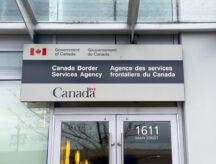
Canada Border Services Agency (CBSA)
The CBSA is responsible for providing integrated border services that support national security and public safety priorities. Their responsibilities include detaining those people who may pose a threat to Canada, removing people who are inadmissible to Canada and investigating people who violate IRPA or who are suspected criminals.
The CBSA also screens visitors, immigrants and refugees seeking admission to Canada. CBSA performs background checks on anyone 18 and over who applies for immigration or claims refugee status.
Immigration, Refugees and Citizenship Canada (IRCC)
IRCC works closely with these other federal bodies to carry out their screening process. IRCC works with CSIS and CBSA, who can access international databases, to enforce provisions of the IRPA and determine immigration admissibility.
CSIS and CBSA do not decide on an immigration application. Instead, their security assessment is provided to IRCC, who independently reviews CSIS’s findings and will make the final decision on an application.
What do you need to provide for the screening process?
The security and background clearance checks will require information and documents from the applicant, including:
- biometrics, i.e. your fingerprints and a recent photo;
- results of a medical exam and health history;
- a valid passport; and
- a police clearance certificate.
As an applicant, you will most likely to be required to submit a Police Clearance certificate. The certificate must be obtained from the country of your current residence and from each country in which you have resided for more than six months since your 18th birthday.
It is important to note that there is a clear distinction between the Police Certificate, which you are required to obtain, and the security clearance, in which for the most part you are not actively involved.
- Do you need Canadian immigration assistance? Contact the Contact Cohen Immigration Law firm by completing our form
- Send us your feedback or your non-legal assistance questions by emailing us at media@canadavisa.com