New report breaks down who’s been succeeding pursuing PR through Express Entry

When it comes to getting permanent residence (PR) through Express Entry, foreign work experience may be even more important than Canadian work experience, according to the latest Express Entry report.
The report, published on November 3, 2025, provides in-depth analysis on the Express Entry system throughout 2024, and shows that while Canadian Experience Class (CEC) candidates received the most invitations to apply (ITAs) last year, over one-third of all invited candidates had no Canadian work experience whatsoever.
In fact, only one percent of invited candidates had no foreign work experience, and more than half (56%) of all invited candidates had two years of Canadian work experience or less.
Get a Free Express Entry Assessment
The majority of the 98,903 ITAs issued in 2024 went to candidates already in Canada, with India being the top country of citizenship among those invited. Indians were issued more than four times the number of ITAs of the second most common source country (Federal Republic of Cameroon).
The article will review who received those ITAs, including breakdowns by
- Program / Category;
- Work Experience;
- Profession; and
- Country of citizenship and residence.
CEC tops ITA issuances, French category comes in second, and features the lowest average CRS cut-off
ITA issuances by program in 2024 mark the start of trends that continue to impact the Express Entry system today.
Consistent with the 2024 federal government’s commitment to prioritize in-Canada candidates for ITAs, CEC draws issued the most ITAs of any single draw type last year, at 26,500, or 27% of all ITAs issued. CEC draws also featured the third-highest average CRS cut-off score at 524 points.
In a similar vein, Provincial Nominee Program (PNP) draws through the Express Entry system issued the third-most ITAs of any Express Entry program or category draw type, at 15,483 invitations (15% of ITAs). These draws featured the highest average CRS cut-off score of any draw type at 725 points*.
French-language proficiency category draws issued the second-greatest number of ITAs at 23,000 (23% of ITAs) in 2024 and featured the lowest average cut-off score among any program or category type at just 409 points.
Last year also saw IRCC conduct several other kinds of draws that the department has not yet employed through Express Entry in 2025, including General (all-program), STEM occupation, and Agriculture and Agri-food occupation draws.
The table below presents summary data on the draws that took place throughout 2024:
| Draw type | Average CRS Cut-off | Total ITAs issued |
|---|---|---|
| Canadian Experience Class | 524 | 26,500 |
| French language proficiency | 409 | 23,000 |
| Provincial Nominee Program | 725 | 15,483 |
| General | 536 | 14,445 |
| Healthcare Occupations | 443 | 10,250 |
| STEM Occupations | 491 | 4,500 |
| Trade Occupations | 435 | 3,600 |
| Transport Occupations | 430 | 975 |
| Agriculture and agri-food Occupations | 437 | 150 |
| Total ITA | 98,903 | |
In 2025, these trends have altered slightly, with French category-based draws now leading the pack in terms of ITA issuances at 36,000 invitations, as of November 4—and some of the lowest CRS cut-off scores seen this year. CEC trails in second at 22,850 ITAs, while Healthcare and social services draws have seen a greatly increased prominence, issuing 9,792 ITAs as of November 4.
Most candidates received ITAs within two years of working in Canada, AND foreign work experience
56% of all invited candidates in 2024 received an ITA with two years of Canadian work experience or less; however, only one percent of candidates who had no foreign work experience, or less than a year of foreign work experience, were invited.
This indicates that while Canadian work experience was a significant contributor to the scores of candidates who received an ITA, increased competitiveness in the Express Entry pool required that candidates have a mixture of both foreign and Canadian work experience to achieve a score high enough for an invitation.
On the other end of the spectrum, more than one third (34%) of all candidates who received ITAs through the Express Entry system in 2024 had no Canadian work experience whatsoever—a dynamic which was facilitated by category-based selections which require candidates only to have NCLC 7 French proficiency, or six months of relevant foreign or Canadian work experience in an eligible National Occupation Classification (NOC) code, to be eligible. This work experience must be included within, or in addition to, the one year of minimum foreign work experience required for a candidate to be eligible under the Federal Skilled Worker Program (FSWP), or the two years of work experience required to qualify under the Federal Skilled Trades Program (FSTP).
In the past, ITAs issued to candidates without any Canadian work experience would be facilitated through program-specific draws for Express Entry’s other programs—the FSWP and the FSTP—or through “general” or “no program specified” draws.
In 2024, however, candidates in these two programs were only selected for general draws (outside of category-based draws), which saw far fewer ITAs issued, and wherein they would have to compete with CEC candidates as well.
IRCC has not held a general draw through the Express Entry system in 2025.
IT and healthcare jobs make up most of the top ten professions issued ITAs; however, general work experience mattered more
The most common named roles among 2024 invitees were Software engineers and designers (21231), Food service supervisors (62020), Software developers and programmers (21232), and Administrative assistants (13110).
When comparing these roles with the 2024 Express Entry occupation-based lists, a clear concentration in STEM and a moderate inclusion of Healthcare professions (e.g., Registered nurses (31301), General practitioners (31102)) can be observed.
By contrast, large-volume roles like Food service supervisors (62020), Administrative assistants (13110), Administrative officers (13100), and Retail sales supervisors (62010) are not on the 2024 occupation-targeted lists—indicating those ITAs flowed through general or CEC draws rather than occupation-based rounds.
“Other professions” accounted for ~66% of all ITAs (65,279 of 98,903). This strongly suggests that, in 2024, most invitations were issued for overall human-capital strength and skills-transferability (e.g., age, education, language, Canadian work/study) rather than for specific work experience in a targeted NOC:
| Primary Occupation | TEER | 2024 ITAs issued |
|---|---|---|
| Software engineers and designers (21231) | 1 | 3,715 |
| Food service supervisors (62020) | 2 | 3,608 |
| Software developers and programmers (21232) | 1 | 3,142 |
| Administrative assistants (13110) | 3 | 2,669 |
| Secondary school teachers (41220) | 1 | 2,136 |
| Information systems specialists (21222) | 1 | 2,091 |
| Financial auditors and accountants (11100) | 1 | 2,079 |
| Nurse aides, orderlies and patient service associates (33102) | 3 | 1,946 |
| Professional occupations in advertising, marketing and public relations (11202) | 1 | 1,945 |
| General practitioners and family physicians (31102) | 1 | 1,841 |
| Registered nurses and registered psychiatric nurses (31301) | 1 | 1,776 |
| User support technicians (22221) | 2 | 1,733 |
| Retail sales supervisors (62010) | 2 | 1,718 |
| Administrative officers (13100) | 3 | 1,708 |
| Business systems specialists (21221) | 1 | 1,517 |
| Other occupations | — | 65,279 |
| Total ITAs | — | 98,903 |
Indians in Canada do increasingly well in the Express Entry system, with African Francophone nations on the rise
In 2024, Canada remained by far the most common country of residence among Express Entry candidates who received Invitations to Apply (ITAs), accounting for nearly 69% (67,817 of 98,903) of all invitations.
This dynamic reflects the federal government’s ongoing effort to transition temporary residents already living and working in Canada—such as international graduates and temporary foreign workers—into permanent residents. By prioritizing in-country candidates, IRCC aimed to stabilize immigration outcomes and ease labour shortages without significantly increasing short-term population pressures.
Beyond Canada, the data show an increasingly diverse global footprint of invitees by country of residence, with an emphasis on Francophone nations.
The Federal Republic of Cameroon, Morocco, Algeria, and Côte d’Ivoire ranked prominently among the top countries of residence, with several of these also appearing among the leading countries of citizenship. This shift highlights the growing influence of French-speaking countries, largely driven by the French-language proficiency category-based draws introduced in 2023 and expanded in 2024.
| Country of Residence | Number of ITAs (2024) |
|---|---|
| Canada | 67,817 |
| Federal Republic of Cameroon | 8,999 |
| India | 3,104 |
| Nigeria | 3,088 |
| Morocco | 1,770 |
| Algeria | 1,621 |
| United Kingdom and Overseas Territories | 1,139 |
| United States of America | 991 |
| Republic of Ivory Coast | 982 |
| France | 819 |
| Other countries combined | 8,573 |
| Total | 98,903 |
When looking at country of citizenship, India continues to dominate—with 43,004 Indian citizens receiving ITAs in 2024, far ahead of any other nationality.
This underscores the historical success of Indian nationals within the Express Entry system, with 2024 marking the third year in a row that Indian citizens have led ITA issuances.
Following India, the Federal Republic of Cameroon, Nigeria, the People’s Republic of China, and the Philippines rounded out the top five citizenship groups:
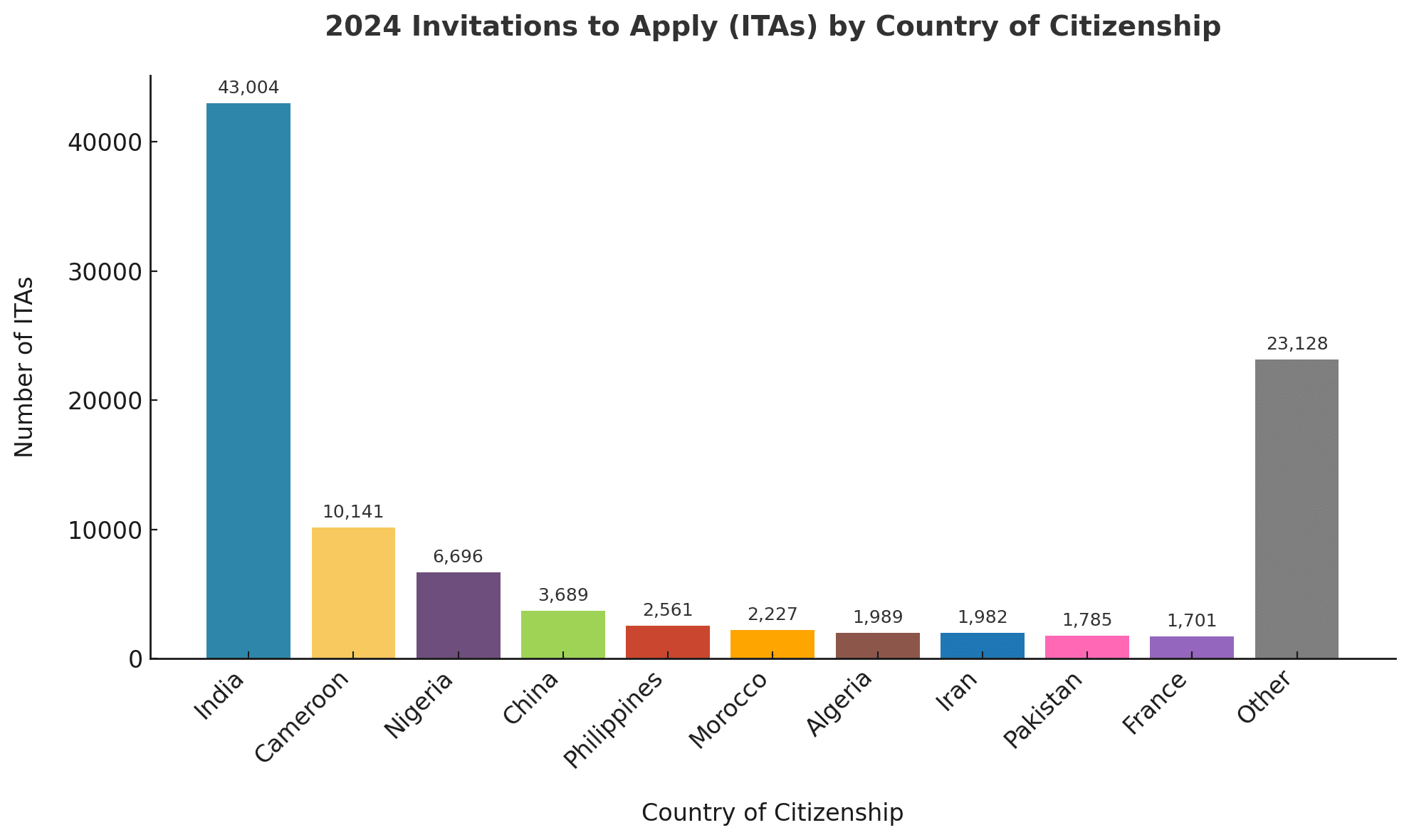
| Country of Citizenship | Number of ITAs (2024) |
|---|---|
| India | 43,004 |
| Federal Republic of Cameroon | 10,141 |
| Nigeria | 6,696 |
| People’s Republic of China | 3,689 |
| Philippines | 2,561 |
| Morocco | 2,227 |
| Algeria | 1,989 |
| Iran | 1,982 |
| Pakistan | 1,785 |
| France | 1,701 |
| Other countries combined | 23,128 |
| Total | 98,903 |

- Do you need Canadian immigration assistance? Contact the Contact Cohen Immigration Law firm by completing our form
- Send us your feedback or your non-legal assistance questions by emailing us at media@canadavisa.com