IELTS Writing Task 2: Preparing to write, how to generate ideas

Many students start writing before planning what they are going to say.
This could lead to a writing response which is disorganized and could negatively affect their score. In this blog, we’ll look at how you can improve your writing skills and suggest some ideas for effective planning so that you are ready for test day.
Read the following Writing Task 2 question and an example introduction. Do you think the writer has fully understood the question?
Rushing into writing
It looks like the writer has not spent the necessary time to read and understand the question before beginning to write, and has started to write the wrong type of essay as a response. This type of mistake happens in the IELTS Writing test when test takers are understandably nervous about writing 250 words in only 40 minutes so are in a rush to get started. However, by taking the time to fully analyse the question, test takers can ensure they write about the right topic, with the right focus, and the right type of essay.
See more sample IELTS test questions
Here are a few steps to follow to make sure that you are fully prepared before you start writing and to avoid making this type of mistake.
Step 1: Analyse the question
Before you start writing, you need to spend some time with the question. Read the question and instructions carefully and ask yourself these questions:
- Do I have to give my opinion?
- Do I have to discuss both sides of an argument?
- Do I have to answer any questions?
This will help you to identify the type of essay. Ask these questions about the previous example Writing Task 2 question and identify the key words that helped you.
Once you’ve identified the type of essay, be sure to identify the focus of the essay. What problem is it that you’re being asked to discuss in this question? What key words would you underline or highlight?
If you are doing IELTS on paper, you are free to write on the question paper. If you are doing IELTS on computer, you can also take notes and highlight text in the online platform, or use the piece of scrap paper that you are provided with. Any notes that you take aren’t assessed, and the Examiner will not see your rough notes.
Why do I need to take rough notes?
Remember that you only have 40 minutes to write your essay so this means that you do not have time to write a first draft. Instead, you can plan your ideas and prepare an outline of your essay in rough notes. The more ideas you can put down, no matter how roughly, the more you’ll have to write about. Also, if you prepare what you’re going to write about in advance, you can focus on how you’re writing once you’re ready to start.
Step 2: Brainstorm your ideas
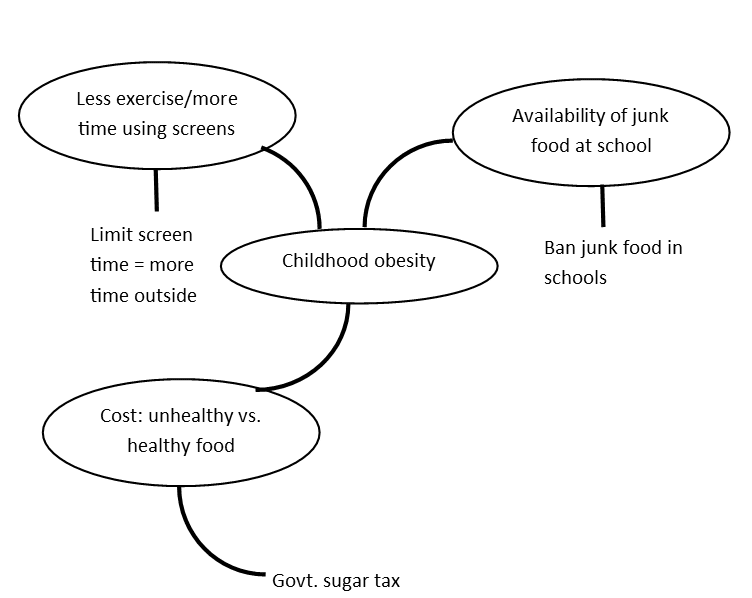
How you write your rough notes is entirely up to you. You might want to write your notes in a mind map or in bullet points or as a table. Whatever method you choose, take a few moments to jot down as many ideas or arguments as you can.
| Causes | Solutions |
|---|---|
| 1. Availability of junk food at school | 1. Schools ban junk food |
| 2. Low cost of unhealthy food vs. expensive healthy food | 2. Government introduce sugar tax |
| 3. Less exercise, more time in front of screens | 3. Parents limit screen time, increase time outside |
Consider alternative perspectives
If you are struggling to come up with ideas, for any question type, consider alternative perspectives to your own. Think of the categories of people who would be interested in or affected by the topic of the question. For the example question above, you could ask yourself about the individual roles and responsibilities of those involved in a child’s life. Think of the following questions as a guide for a variety of topics and question types that may come up on test day:
- What could the individual do?
e.g. children could save pocket money for occasional treats
- What could parents do at home?
e.g. limit screen time, increase time outside
- What could schools do?
e.g. ban junk food on school premises
- What could companies and businesses do?
e.g. sponsor healthy food initiatives
- What could the local or national government do?
e.g. sugar tax
Step 3: Choose your best arguments
Once you have a list of all the arguments, all the ideas you can think of, you can then choose two to three to write about in your essay. Make sure that you choose the points that you know you can write about. Consider these questions when making your choices:
- Which of the ideas could you write most about?
Remember the instructions in Task 2 state that you have to write from your own knowledge and experience. You are not expected to have any specialist knowledge or expertise, but it is important that you choose arguments that you know you could expand on.
- Can you think of reasons, examples, and results of each idea?
Take a note under each idea in your mind map/table of the key words that you will use in your supporting arguments. Consider providing reasons and examples for your argument as well as outlining any possible impact or effects.
- Which ideas are different from each other?
Avoid writing about very similar ideas or arguments. This will help your paragraphs to have clearer central topics and avoid too much repetition of language.
- Have you chosen ideas to support your position?
In opinion or discussion essays you are explicitly instructed to provide your position, make sure that you choose ideas that clarify your position for the Examiner. In problem and solution essays, your position is implicit in your choice and description of effective solutions.
- Have you chosen an idea to balance the essay?
This is optional in opinion essays but is essential in 2-sided discussion essays where you must discuss both sides of the argument. In problem and solution essays, you do not need to debate whether or not the problem exists when it is presented as fact.
Take an IELTS practice test and get feedback so that you are ready for test day
Doesn’t all of this planning waste too much writing time?
These steps can be completed in just two to three minutes and this time is very well spent. Conversely, it would be a waste of time to rush into writing and realise halfway through that you have not fully understood the question, and don’t have enough time to make the corrections.
As you prepare for your IELTS test, make planning a part of your test practice. The more often you do this, the quicker your idea-generation will be, and the more prepared you’ll be to write the best essay you’ve ever written on your actual test day.
Good luck!
Ready to take your IELTS test? Book now!
© Want to advertise on CIC News? Click here to contact us.
- Do you need Canadian immigration assistance? Contact the Contact Cohen Immigration Law firm by completing our form
- Send us your feedback or your non-legal assistance questions by emailing us at media@canadavisa.com