How Canada will handle groups of immigration applications with new C-12 powers

Canada's new immigration law gives the government broad authority to cancel, suspend, or change immigration documents and applications in bulk.
Now that Bill C-12 has received royal assent, Immigration, Refugees and Citizenship Canada (IRCC) has laid out how these powers will work in practice — and what safeguards are in place.
Here's what you need to know about the new tools, how the government will use them, and how you'll find out if they affect you.
Consult with a lawyer at Cohen Immigration Law
What the government can now do
Under C-12, the Governor in Council can issue orders that apply to large groups of immigration documents and applications at once. These include the power to:
- Cancel, suspend, or change immigration documents such as work permits, study permits, temporary resident visas, and permanent resident visas;
- Cancel or suspend the processing of immigration applications; and
- Pause the intake of new applications entirely.
These tools are not limited to individual cases. They can target entire categories of documents or applications at once, but only to address matters of public interest — specifically fraud, public health or safety risks, administrative errors, or national security.
For more information on what powers are given to the government under C-12, visit our dedicated article.
What these powers can't do
The new authorities have limits. They can't be used to grant, change, or revoke a person's immigration status, such as permanent or temporary resident status.
In other words, the government can cancel a document like a work permit, but these specific tools can't be used to strip someone of their status as a permanent or temporary resident.
The powers covered here don't apply to asylum claims—Bill C-12 does however, contain separate reforms to Canada's asylum system.
How decisions are made
Each time the government wants to use these powers, it must follow a multi-step approval process. No single person can make the decision alone.
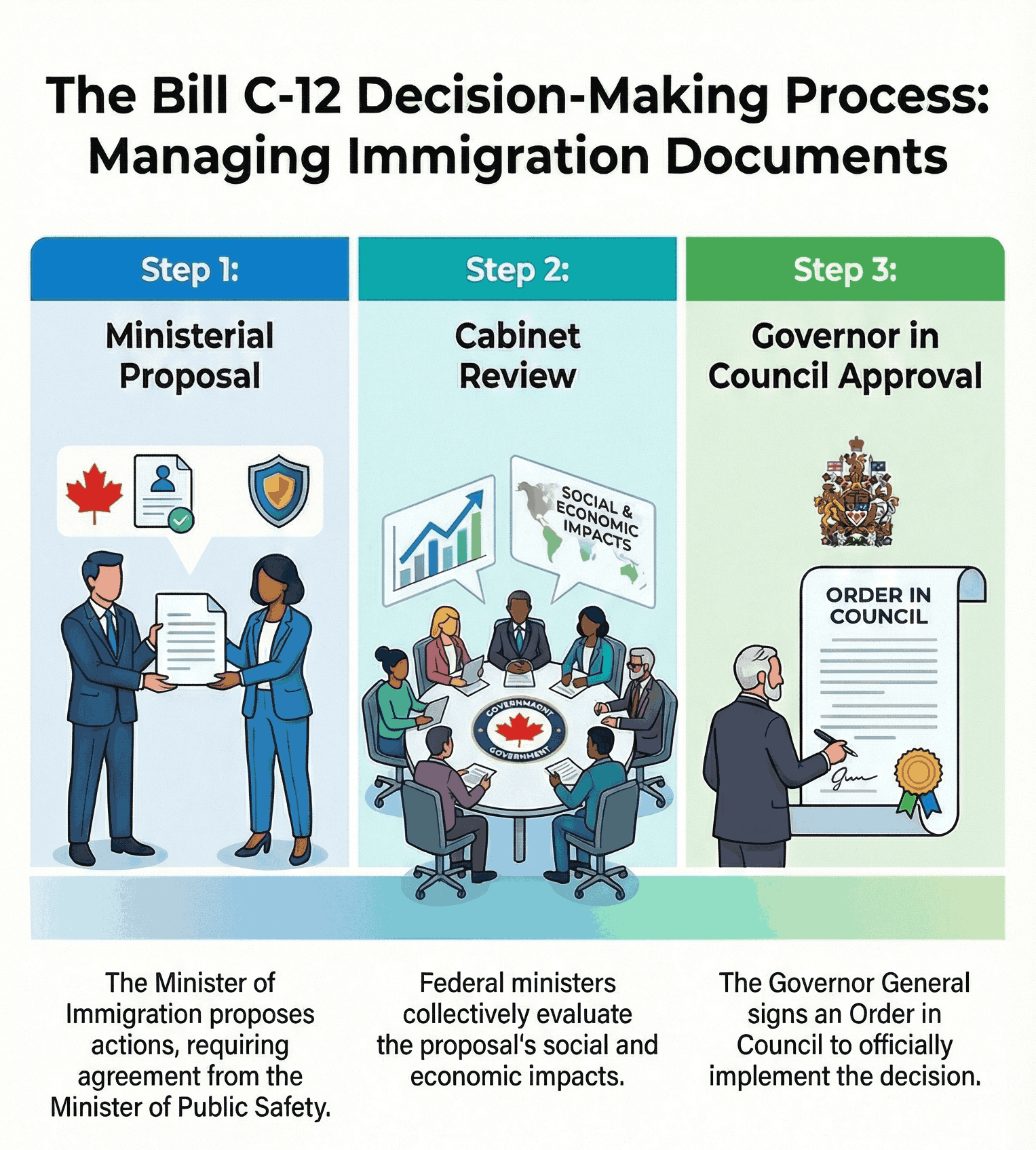
Step 1: The minister proposes an action. The minister of immigration puts forward a proposed order based on information they have received. If the order affects people who are already in Canada, the minister of public safety must also agree to it.
Step 2: Cabinet reviews the proposal. The full Cabinet — the group of federal ministers chosen by the prime minister — reviews the proposed order. The cabinet considers broader impacts, including social and economic effects, and provides advice. This is a collective decision, not an individual one.
Step 3: The Governor in Council approves the order. The governor general, acting on the advice of cabinet, formally approves the decision through an order in council — a legal document that allows the government to carry out the order.
How the public is informed
The government has committed to transparency measures for these new powers.
Every order in council issued under these authorities will be published in the Canada Gazette, the official public record of federal government decisions and regulations. This means each use of these powers will be part of the public record.
Beyond publication, the immigration minister must table a report in Parliament on the impact of any orders issued. The minister must also appear before a parliamentary committee to answer questions, if requested.
Under an amendment introduced by the Senate, a Parliamentary committee will also review the overall impact of these provisions and present recommendations for changes five years after the bill's passage.
We regularly cover immigration changes published by the government in the Canada Gazette. You can stay up to date with the latest news by subscribing to our weekly newsletter.
What this means for your immigration application
These new powers don't change how you apply for immigration documents or how IRCC processes routine applications. Your current application, work permit, or study permit isn't affected unless the government issues a specific order under the circumstances described above.
However, C-12 does mean the government can now act quickly to cancel or suspend documents and applications in bulk if it identifies fraud, a public safety risk, or a national security concern. If an order is issued that affects your documents, it will be published in the Canada Gazette.

- Do you need Canadian immigration assistance? Contact the Contact Cohen Immigration Law firm by completing our form
- Send us your feedback or your non-legal assistance questions by emailing us at media@canadavisa.com